Mary had a royal title and an English gaoler. More than eighteen years in custody had not settled what to do with her. Now the House of Commons was being urged to settle it by ending her life.
On 3 November 1586, Sir Christopher Hatton addressed the House of Commons about Mary, Queen of Scots. As Elizabeth I's vice-chamberlain, he spoke by the English queen's command. His subject was the danger Mary posed to Elizabeth and her kingdom; his proposed remedy was death by judicial process. Mary was not in the chamber to answer him. She was a prisoner at Fotheringhay Castle, where she had faced her trial the previous month.
She was forty-three. She had become Queen of Scotland at six days old, when her father died, and had once been Queen of France as well. By the time she crossed into England in May 1568, she had lost her Scottish throne and was seeking Elizabeth's protection. What followed was custody, lasting through the rest of her life. Her descent from Henry VII gave her a claim to the English succession. Her Catholic faith made that claim especially attractive to people who wanted a different queen and a different religion on the English throne. Keeping her under guard had contained the woman. It had not disposed of her name.
The distinction mattered to Mary. At Fotheringhay in October, she had challenged the right of Elizabeth's commissioners to try her at all.
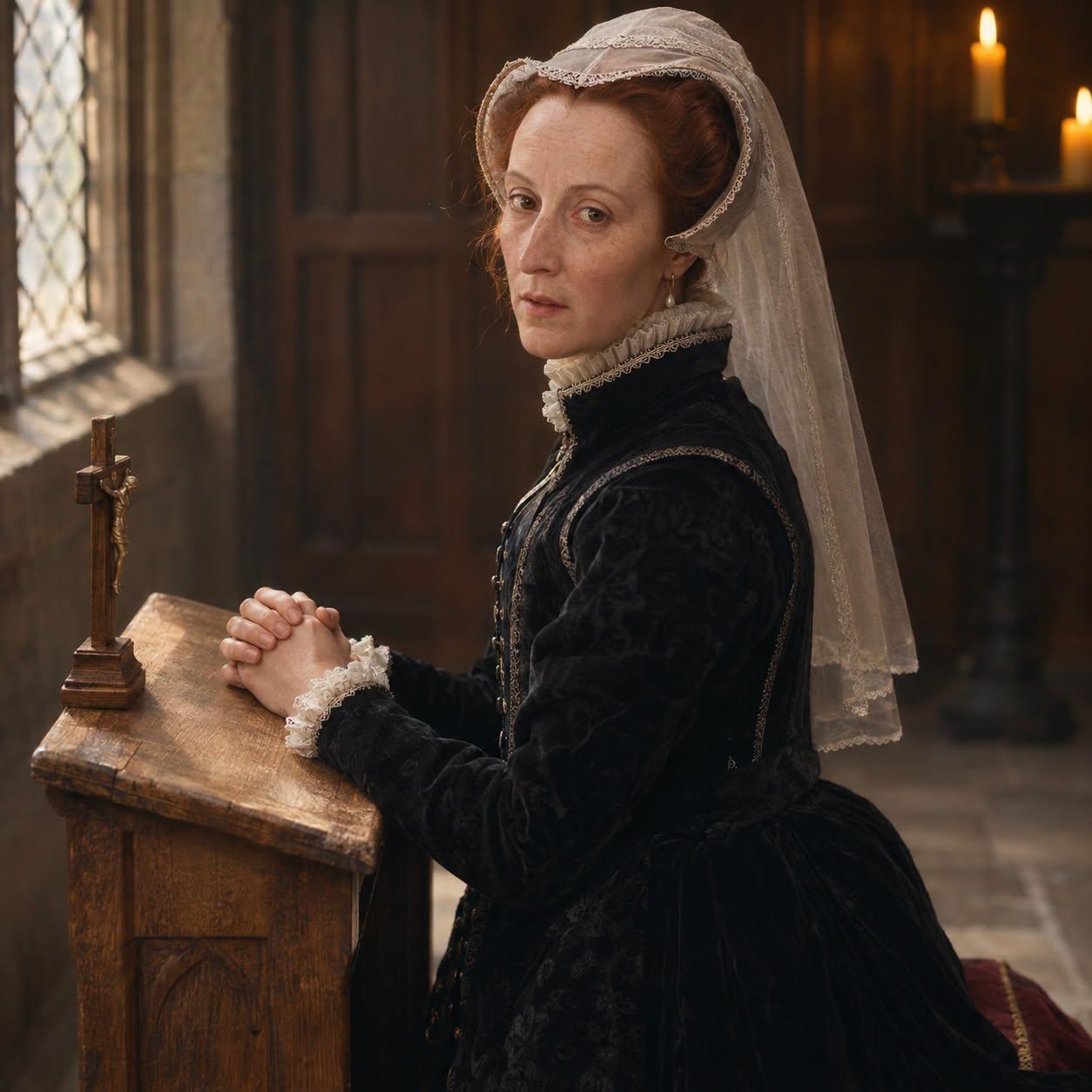
For the proceedings on 14 October, Mary wore a black gown and a white veil of fine linen. Her chair, furnished with crimson velvet, was placed below the cloth of state, a little apart from the lords' benches. There was room for royal furnishings in an English treason trial. The question was how much royal authority their occupant could claim.
Mary insisted that she was a sovereign, born a queen and answerable to God. Her appearance must not prejudice the rights of other rulers, her allies or her son. She asked for her protest to be formally recorded and called on her servants to witness it. The lord chancellor insisted that England's crown must suffer no prejudice either, and the commissioners had his answer recorded too. Before the accusations could be examined, both sides were putting their claims of authority into the record. Mary could insist on hers. She could not make the commissioners withdraw.
Nor was the danger to Elizabeth imaginary. That summer, Anthony Babington and his fellow conspirators had planned Elizabeth's assassination and Mary's release and elevation to the throne. Secret correspondence had passed through an intelligence operation controlled by Sir Francis Walsingham. Letters were intercepted and deciphered, and one of her letters even left the intelligence office with a postscript she had not written, asking for the conspirators' names. Statements from Mary's secretaries helped build the prosecution's case. The prosecution read the correspondence as Mary's approval of the plan to murder Elizabeth. Mary denied authorising the assassination. She contested the act for which England intended to condemn her, as firmly as she contested England's right to judge her.
By 3 November, the proceedings had moved beyond that room at Fotheringhay. The commissioners had pronounced sentence in October. Hatton's task in the Commons was to press the consequences of leaving Mary alive.
His case reached backwards through earlier conspiracies as well as the latest one. Allegations associated with Norfolk, Throckmorton and Parry helped construct a history of recurring danger. Each episode could be made to reinforce the next: imprisonment had continued, yet schemes involving Mary's name had continued too. It was an argument against giving confinement another chance. For the woman who had spent more than eighteen years in it, the very length of her custody could now be turned against her.
Hatton described threats to Elizabeth, Protestant religion and the kingdom itself, including foreign invasion and civil conflict. In the account of his speech, Mary was Queen of Scots "so called". The qualification did its work in two words. In October she had insisted that her sovereignty placed her beyond an English court's authority. In November, an officer of the English queen was urging Parliament towards "the cutting of her off by course of justice". Her title remained in the discussion. It offered very little protection.
Yet the speech was not a death warrant. Parliament could urge; Elizabeth still had to authorise the killing. On 12 November, a deputation from both Houses came to her at Richmond, asking for the sentence to be published and carried out. She asked for time before giving her answer. The decision would be hers, and so would the scrutiny.
Mary remained at Fotheringhay while the pressure continued. Elizabeth's warrant was dated 1 February 1587. On 8 February, Mary was executed in the castle, aged forty-four. The argument she had made in October had not stopped the English court, the parliamentary campaign or the order sent to her keepers. In the warrant authorising her death, she was still "commonly called the Queen of Scots".