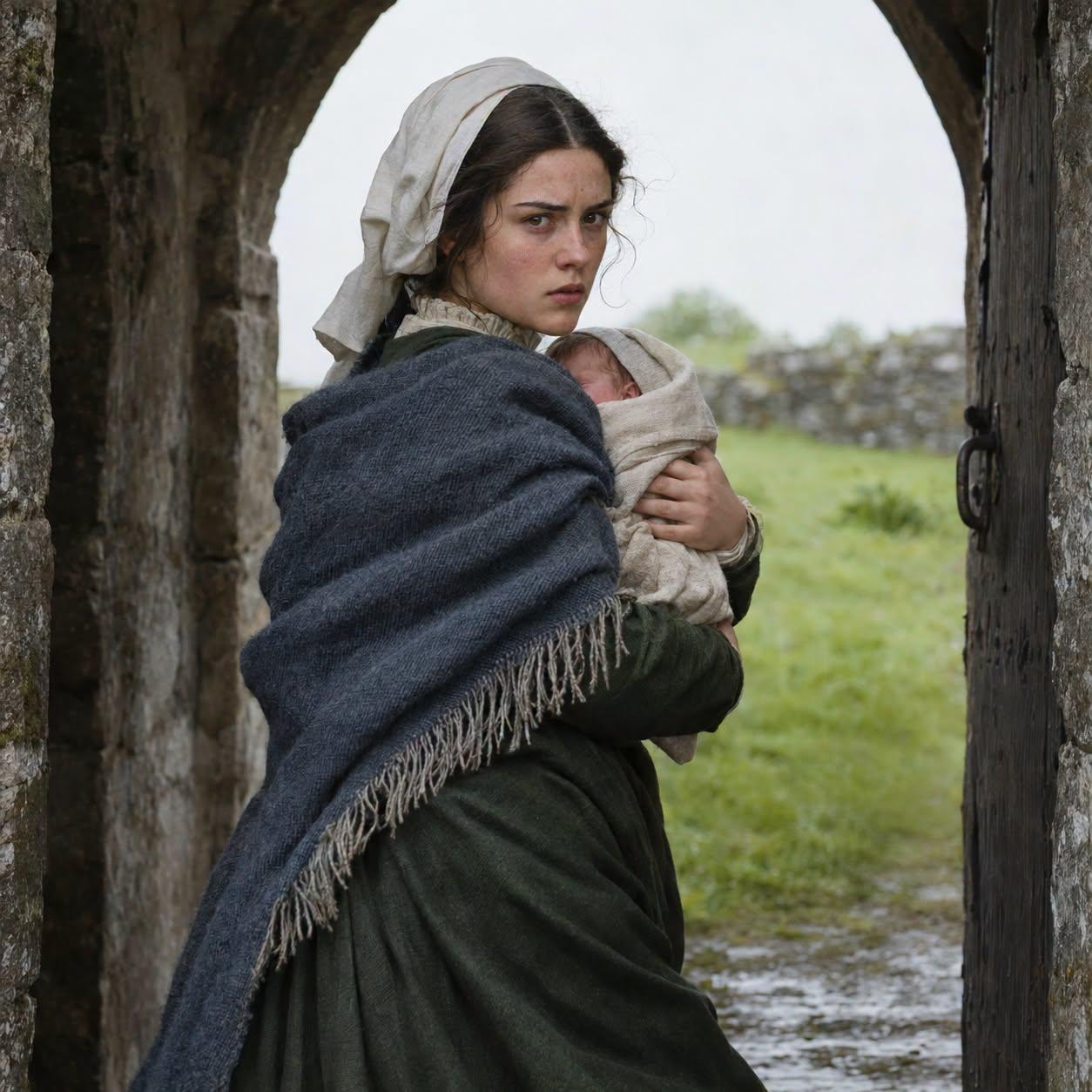
Mary left her husband and took their little son with her. Years later, the queen would eventually have the boy's father executed.
On 3 November 1591, Brian O'Rourke, lord of West Breifne, was executed at Tyburn for treason. He had been arrested in Scotland and handed over to Elizabeth I's government. Mary Burke had married him some fifteen years earlier and had long since separated from him. Their son, Tadhg, was being raised on the other side of the quarrel.
Mary belonged to a powerful family in the west of Ireland. Her father was Richard Burke, second Earl of Clanricard; her mother was Margaret O'Brien. Her marriage, around 1575 or 1576, joined her to a lord whose territory lay around Dromahair, in what is now County Leitrim. This was a marriage between great families, with land and authority passing through the generations. A son could inherit both the estate and the quarrels attached to it.
In June 1577, Mary's father reported that she had been so gravely ill she had come close to death. She recovered. Tadhg was born around this time.
Soon after the boy's birth, Mary left Brian because of his rebellion, taking Tadhg with her. He would be brought up among her own Burke kin. She supported Elizabeth's government. That allegiance ran through the marriage itself: the authority Brian resisted was the authority Mary accepted.
For Brian, the struggle concerned the survival of his lordship under an English government pressing ever more closely upon it. Sir Richard Bingham, the English governor of Connacht, was a determined opponent. Agreements made with the Crown did not bring lasting peace. Brian challenged the terms imposed upon him; Bingham sought to bring him under control. Between them lay the territory Brian regarded as his inheritance.
Then, in 1588, the Spanish Armada brought another danger to the Irish coast. Brian sheltered survivors of the wrecked Spanish ships and helped men whom Elizabeth's government regarded as enemies. Among those who found protection with him was Francisco de Cuéllar, a Spanish captain who survived the disaster. Hospitality to shipwrecked strangers was also assistance to men from the fleet sent against England. The same act could look very different from London.
Driven from his territory, Brian found refuge in the north of Ireland before going to Scotland early in 1591. There he sought help from James VI. Elizabeth wanted him handed over, and her representatives pressed the Scottish king to surrender him. In April, Brian was arrested in Glasgow and sent south into English custody.
Scotland had offered no escape.
He was held in the Tower of London and tried in Westminster Hall. The charges included helping the Spaniards and defying Elizabeth's authority in Ireland. Brian refused to be tried by a jury of twelve men, or by anyone except the queen in person. He understood no English, and the indictment had to be put into Irish for him. The man whose standing at home rested on his lordship and ancestry now had to answer an English prosecution in a language he could not follow.
He was convicted and put to death at Tyburn. In Ireland, the memory of him included his hospitality and his defence of his family's lands. The English government had condemned a traitor. Tadhg, fourteen or fifteen, no longer had a father.
The execution did not settle the inheritance. Brian had another son, Brian Óg, by a different mother, who sought terms with the government in April 1592. He was refused possession of his father's lands. English officials favoured Tadhg's claim as the lawful heir under English law, turning the distinction between the brothers into an instrument of government. The father was dead; the family name and its territory remained worth fighting over.
Mary had taken Tadhg away from Brian years before any of this. Her loyalty to the Crown had placed her on the opposite side of the conflict that ended at Tyburn. Her son was still an O'Rourke, with a rival half-brother and a claim to the land his father had defended.
In 1592, Tadhg was being educated in Limerick. His father's imprisonment, trial and execution were over; the inheritance remained unsettled. Mary's part in his upbringing survives in a small, specific instruction: the education was proceeding "by his mother's order". The child she had carried away from Brian was still being brought up at her direction.