He was the most powerful king in Europe. He wept at the carriage door while she climbed in. You are the king, she said, and you weep. He dried his eyes and married someone else. She spent the next fifty years making sure the record was accurate.
Marie Mancini was born in Rome in 1639, the fourth daughter of Michele Mancini and Geronima Mazzarini, whose brother Jules would become Cardinal Mazarin, the most powerful man in France after the queen regent Anne of Austria. That uncle is the reason Marie ended up at the French court, and the reason she was removed from it.
She arrived in France as a girl and was not, initially, remarkable. Her sister Olympia had already made a conquest of the young king. Marie was considered the plain one, the difficult one, the one who read too much and talked too freely and did not perform the courtly graces with the fluency the occasion required. Louis noticed her anyway. She was seventeen and he was nineteen and what began between them was, by every account including his own, the closest thing to a genuine love affair that Louis XIV would permit himself before the requirements of his position closed around him entirely.
They read together. They talked. She introduced him to Italian poetry and he gave her access to a court whose pleasures she consumed with the appetite of a woman who had spent her childhood on the edge of everything and was finally at the centre of it. He told people he intended to marry her. He may have believed it. Mazarin did not believe it, and Mazarin was the man who ran France.
Cardinal Mazarin was not opposed to his niece's happiness in principle. He was opposed to it in practice, because the practice required Louis to marry a Spanish infanta and conclude a peace between France and Spain that would define the next generation of European politics, and Marie Mancini, whatever she was to the king, was not a Spanish infanta. Mazarin and Anne of Austria moved against the relationship with the combined authority of the two people whose approval Louis needed most, and Louis, who was nineteen years old and not yet the absolute monarch he would become, did not have the will or the architecture to resist them. He agreed. The marriage to Maria Teresa of Spain was arranged. Marie was to be sent away.
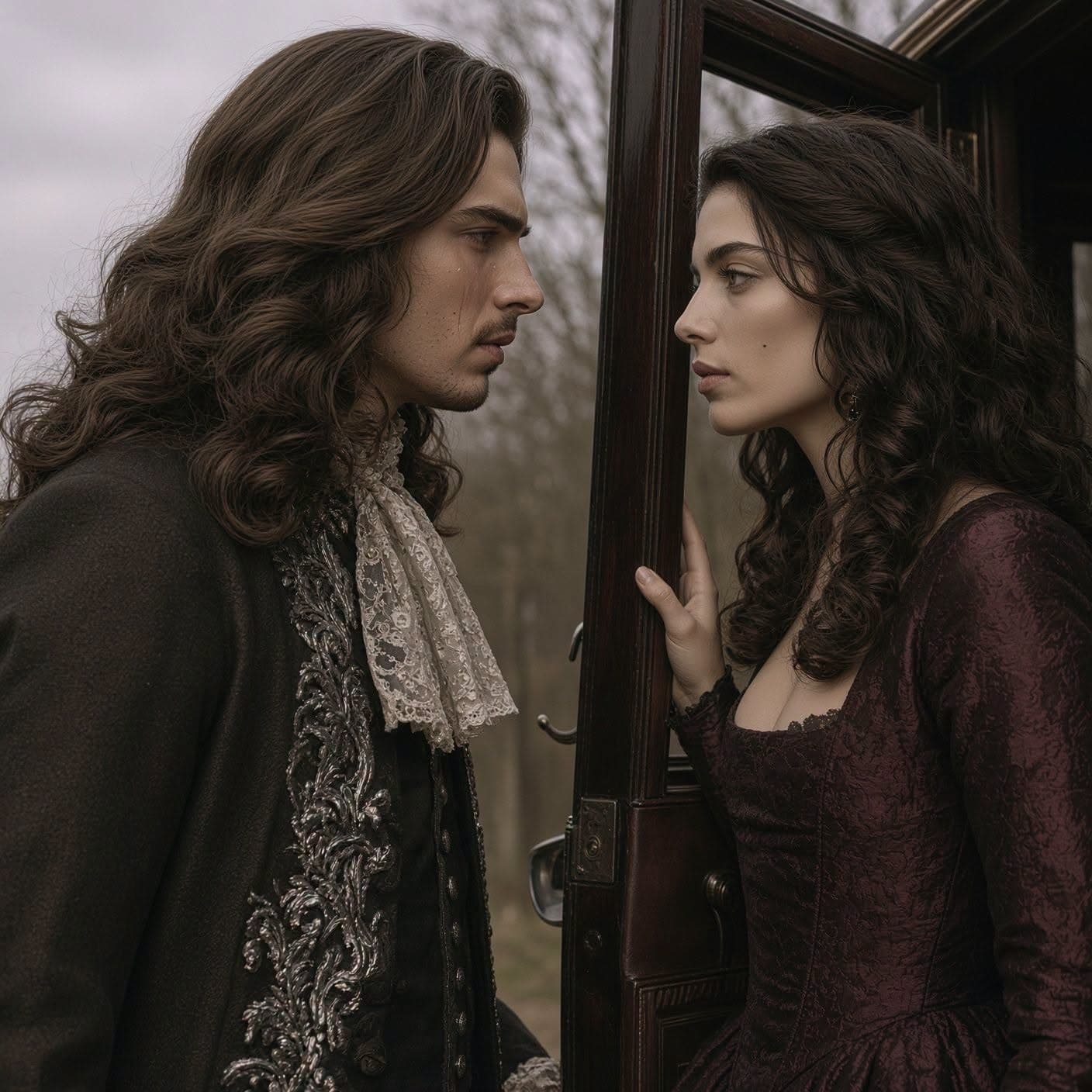
The parting was on the road from Paris in the summer of 1659. Exactly what was said belongs to Marie's own account, written in her memoirs nearly twenty years later, and she wrote it with the precision of a woman who had been carrying the scene in her memory for two decades and had not misplaced a word of it.
The king wept. She looked at him, this most powerful king in Europe, weeping at the carriage door, and she said what she saw: "You are the king and you weep". In French the line feels harder: "Vous êtes le roi et vous pleurez". It is the line of a woman who understood the mechanism completely, who knew that his tears were real and that they changed nothing, and who said so to his face before the door closed.
He dried his eyes. He married Maria Teresa of Spain. He became the Sun King, built Versailles, made the French court the model for every court in Europe, and accumulated mistresses with the systematic efficiency of a man who had decided early that love was a thing he had already used up on a girl in a carriage in 1659.
Marie married Lorenzo Onofrio Colonna, the Constable of Naples, in 1661. She was twenty-two years old and the marriage had been arranged by Mazarin with the specific intention of placing her far enough from Paris that the problem she represented could be considered resolved. It was not a good marriage. She was intelligent and independent and had been loved by a king and was now the property of a Neapolitan nobleman who understood her value as a diplomatic prize and very little else about her. She endured it for eleven years and then she stopped enduring it.
In 1672 she left her husband and fled with her sister Hortense across the Alps into France, two women travelling without their husbands' permission through a Europe that had no legal framework for women who decided their marriages were finished. They were pursued. Colonna sent agents. Louis, whose interest in Marie had not entirely extinguished itself, sent his own. The sisters separated eventually. Hortense went to England and became a celebrated figure at the court of Charles II. Marie went to Spain, to Aix, to various Italian cities, to the margins of courts that were not hers, carrying her freedom and its costs with her across the decades.
She published her memoirs in 1677 because an unauthorised version had appeared under her name and she would not permit someone else's version of her life to stand as the true one. She wrote her own account with the same directness she had brought to the road from Paris, and in it she said that nothing had hurt her so deeply in her life as the loss of Louis. She wrote it plainly, without apology, twenty years after it happened, because it was true.
She died in Pisa in May 1715, seventy-five years old. Louis XIV died in September of the same year, four months after her. He had outlived her, the man who had wept at the carriage door, and spent his last months on earth as the person left behind by the only woman who had ever told him the truth to his face and watched him do nothing about it.
Vous êtes le roi et vous pleurez.
She had said it fifty-six years before she died, on a road from Paris with the door still open, and she had written it down so the record would not be wrong, and then she had died in a city that was not hers. Four months later the Sun King followed her, and the grandest court in Europe buried him with all the ceremony he had built for exactly that purpose.
Somewhere in the archives in her own handwriting was the sentence that said what he actually was.