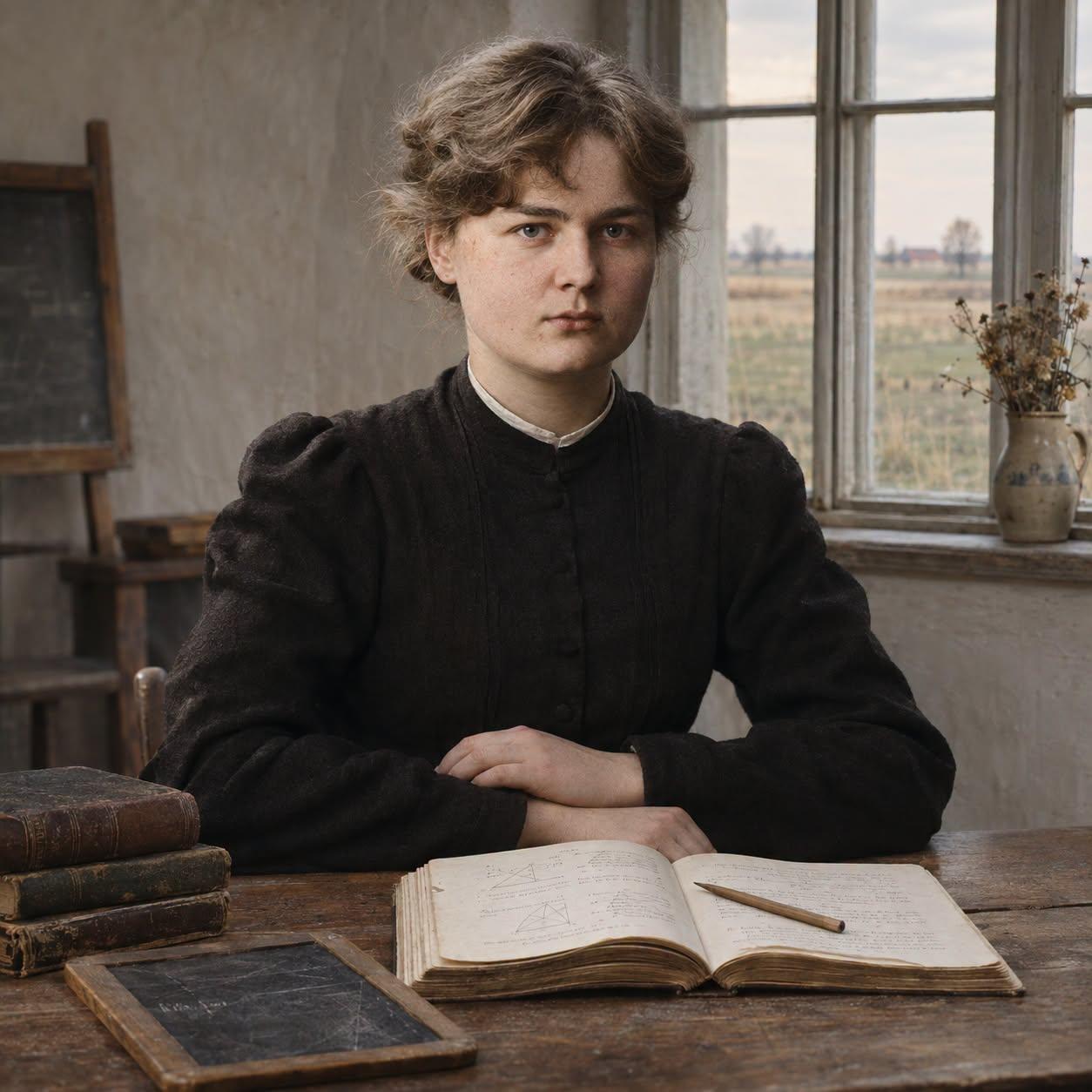
Marie taught other people's children to help send her sister to university. Her own studies would have to wait. There was not enough money for both of them to go.
Born Maria Skłodowska on 7 November 1867 at 16 Freta Street in Warsaw, the woman who would win two Nobel Prizes as Marie Curie was the youngest of five children in a household where teaching was the family profession. Her mother, Bronisława, ran the girls' boarding school at that address. Her father, Władysław, taught mathematics and physics. Their daughters grew up among people who took a girl's intelligence seriously.
Outside the home, education was a more complicated business. Warsaw was under Russian rule, and Polish schools operated under close supervision. Teaching children their own country's language and history could bring trouble upon the adults responsible. Within the family, their father read classics of literature to his children on Saturday evenings. Laboratory teaching had been removed from the curriculum, so the scientific apparatus he had once used in his classes now stayed at home.
The household had its losses. Her father was moved into lower posts, money became scarcer, and the family took in boarders. Marie's eldest sister, Zofia, caught typhus from one of them and died when Marie was eight. Their mother, ill with tuberculosis, died in 1878, when Marie was ten. Her father was left with four children and his teaching work. The woman who had run a girls' school would not live to see where her own daughters' education led them.
Marie finished secondary school in 1883, aged fifteen, with a gold medal. After a year spent recovering from the strain of study, she returned to Warsaw. Her brother could attend the university there. She could not. The admission rules had survived her excellent examination results quite undisturbed.
She and her elder sister Bronisława, known as Bronya, pursued their studies elsewhere. They attended the clandestine courses of the Flying University, whose lectures moved between locations to evade the authorities. Bronya wanted to become a doctor. Marie's interests still ranged across literature, sociology and science. Both wanted the education that a foreign university could give them, and their father's resources would not stretch to two daughters studying abroad.
So they agreed to take turns.
Marie would work and help support Bronya's medical studies in Paris. Once Bronya was able, she would help Marie in return. The arrangement turned a distant ambition into a succession of wages earned, money saved and lessons given. For one sister to sit in a lecture room, the other had to remain at work.
From 1886 to 1889, Marie was a governess at Szczuki, teaching the Żorawski family's children. After their lessons, she had her own preparation to do. She worked through books in the subjects she hoped eventually to study properly. Her father helped her with mathematics by correspondence. She also taught local rural children, with the assistance of her employer's daughter, passing on an education while still trying to obtain her own. "Even this innocent work presented danger," she later recalled.
Life in the household then became difficult. Marie and the family's son, Kazimierz, fell in love and wanted to marry. His parents opposed the match. The governess they employed to educate their children was not the daughter-in-law they wanted. The marriage did not happen, and Marie continued working there. Bronya's studies, and the agreement between the sisters, still required money.
Back in Warsaw in 1889, Marie continued teaching. While she was away, her father had become director of a reform school, and the better pay let him send Bronya money every month. He began setting part of it aside to repay the sums Marie had been sending. Through a cousin, she gained access to a laboratory at the Museum of Industry and Agriculture, where she could work in the evenings and on Sundays. Experiments that looked straightforward in a book could go wrong in practice. She persisted through the failures. Mathematics and physics had become the subjects she wanted to pursue.
In November 1891, around her twenty-fourth birthday, she finally reached Paris. Bronya and her husband, a doctor, welcomed her into their home. The elder sister whose studies Marie had helped to support could now offer her a place to begin. Maria from Warsaw enrolled at the Sorbonne as Marie. Within months she had moved nearer to her classes, because the journey from her sister's home took an hour by horse-drawn bus.
Her independence came with a room under the roof and very little money. In winter, the small stove was often short of coal. Water froze overnight in the washbasin, and she piled her clothes on the bedcovers for warmth. When there was coal, she carried it up six flights herself. She cooked on an alcohol lamp, and her meals often came down to bread, chocolate, eggs or fruit. Her days were divided between lectures, laboratory work and the library.
She had been studying for years before she arrived, but still found gaps in her preparation, especially in mathematics. The private lessons and solitary reading had brought her this far. Now she had to catch up with students whose schooling had prepared them more fully for the courses they shared.
At last, the work was her own.
Bronya had completed her medical studies; Marie was working towards her first university degree. The sisters had managed the waiting, the employment and the separation without either abandoning the other's education. In 1893, the former governess who had helped pay for a place in someone else's lecture room passed her physics degree at the Sorbonne. She came first.