Maria’s face had travelled through Europe before she left Spain to become a queen. Her portraits could be copied and sent abroad. Her inheritance was harder to dispose of.
On 7 November 1659, the Treaty of the Pyrenees ended the long war between France and Spain. On an island in the river marking their frontier, Cardinal Mazarin and the Spanish minister Luis de Haro agreed a marriage between Louis XIV and Maria Theresa, the twenty-one-year-old daughter of Philip IV of Spain. The marriage contract was signed that same day and made part of the peace. Her father was giving France a bride. He intended to keep the Spanish succession out of the arrangement.
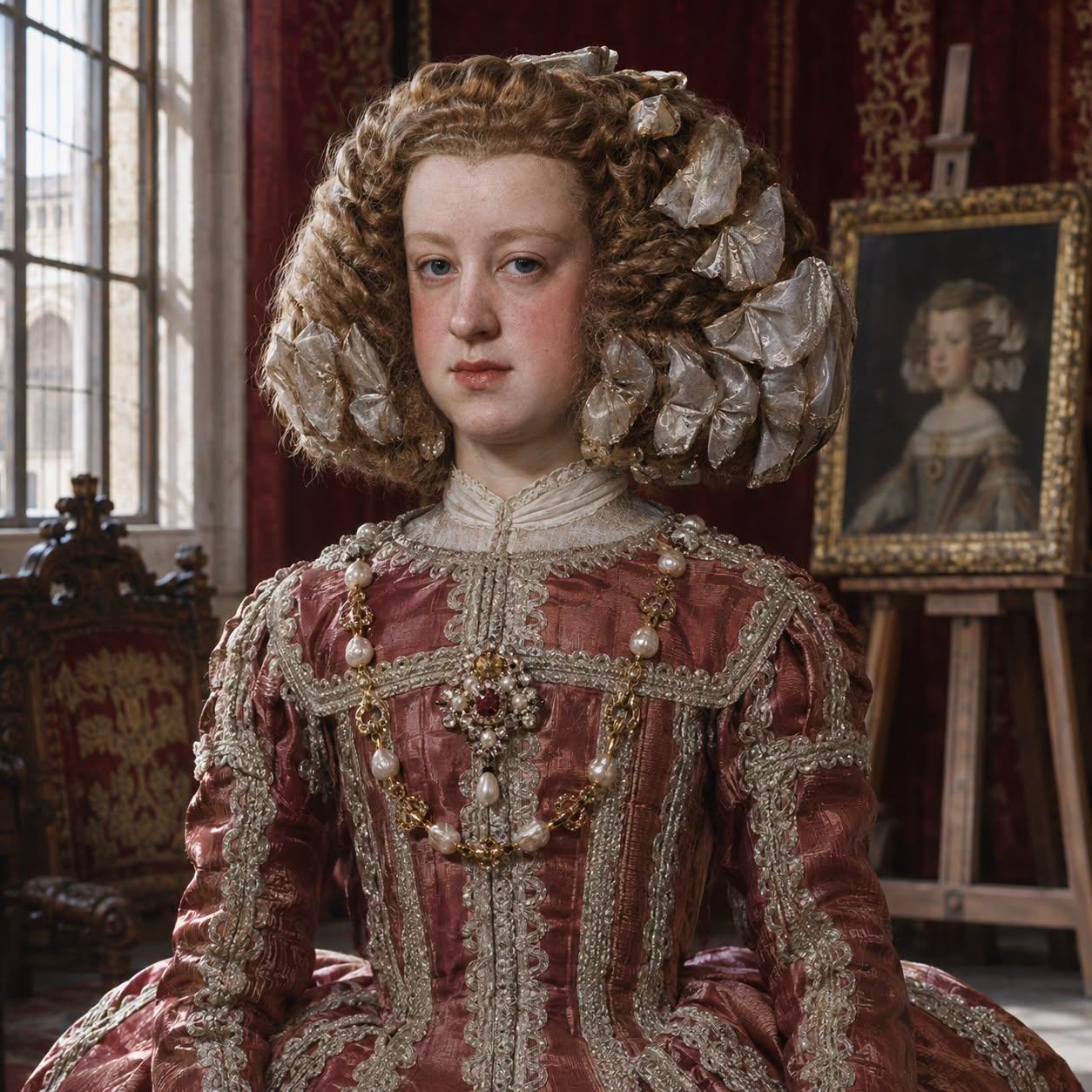
Years earlier, Velázquez had painted Maria with a wig dressed in butterfly ribbons, her young face framed by the elaborate ornaments of the Spanish court. His assistants copied the likeness to meet the demand for portraits. Men considering a marriage could examine her appearance without ever meeting her. The ribbons, the jewellery and the face could all be reproduced. The difficult part was what came with her.
Maria belonged to both the families that had been fighting. Her father’s sister, Anne of Austria, was Louis’s mother. Her own mother, Elisabeth of France, had been the sister of Louis XIII, his father. Maria and Louis were first cousins twice over. In 1615 their parents’ generation had already tried to secure peace by exchanging brides on the same river, Elisabeth going south and Anne north. Close kinship had proved perfectly compatible with a long war.
For years Maria’s position in Spain had made another French marriage dangerous. Her mother had died in 1644, and her elder brother Balthasar Charles died two years later. Maria remained a possible successor to her father’s vast monarchy. A husband in France might one day claim more than a wife. Philip’s second marriage eventually produced two little sons, Philip Prospero and Ferdinand. With boys ahead of her in the succession, sending Maria abroad became easier to contemplate.
Then, on 22 October 1659, Ferdinand died. He was not yet ten months old. The treaty was sixteen days away. Philip Prospero remained, but the margin between a French bride and a Spanish inheritance had narrowed again before anything was signed.
The marriage settlement excluded Maria from the Spanish succession, along with every child she had not yet borne. It also provided for a dowry of 500,000 gold écus, payable in three instalments.
The bride could cross the border. Her claim to Spain was supposed to stop there.
There was still a winter and a spring between the agreement and the wedding. In June 1660, Maria reached Fuenterrabía, on the Spanish side of the frontier. On 2 June she ratified the renunciations stipulated in her marriage settlement. The following day she married by proxy, with Luis de Haro standing in for Louis. The minister who had helped negotiate her marriage now represented her husband at the ceremony.
Pheasant Island, where the peace had been signed, became the setting for the royal meetings that accompanied her passage into France. Her father was there, and so was his sister, Anne of Austria, who had crossed that river as a bride forty-five years earlier. On 9 June Maria married Louis in person in the church at Saint-Jean-de-Luz. She was still twenty-one, and was now queen of France.
Even her clothes belonged to the transition. The enormously wide Spanish skirt, held out by its guardainfante, gave way to French court dress. The woman whose likeness had travelled in Spanish dress now appeared beside her husband in the fashions of his court.
French came with more difficulty than the royal title. Maria surrounded herself with Spanish ladies-in-waiting, and Anne, her aunt as well as her mother-in-law, was a valuable ally until her death in 1666. By then Louise de La Vallière, the king’s first official mistress, was living at court. Madame de Montespan, who succeeded her, had an apartment connected directly to his. The settlement of 1659 had been exact about what Maria must give up. It had nothing to say about this.
Her marriage produced six children. Five died in childhood, three of them in 1671 and 1672. Only her eldest, Louis, the Grand Dauphin, reached adulthood, and Maria involved herself closely in his education. “Do not accept anything, Dear Sir, in the behaviour of my son, which might offend the sanctity of the religion,” she wrote to his tutor, Bossuet.
The gold écus were never paid in full.
Louis’s lawyers later used the unpaid dowry to challenge the renunciations and advance claims to Spanish possessions in her name. In 1667 his armies marched into the Spanish Netherlands. The settlement that had helped make her a queen became an instrument in another quarrel with her father’s monarchy.
Maria died in July 1683, aged forty-four. That December her son’s wife gave birth to a boy, Philip, Duke of Anjou, a grandson she never saw. In Spain, Philip Prospero had died in 1661, the year a last half-brother, Charles II, was born. Charles would reign for decades and leave no child.
The young face beneath the butterfly ribbons survives in the portrait Velázquez painted before the peace and the wedding. The agreement of November 1659 had provided for her marriage and for the exclusion of her descendants from Spain. In 1700, her grandson Philip became its king.