She was eighteen. Her elder sister had just spent the evening answering thirty guests from every nation in Europe in Latin. Teresa Agnesi answered them in music she had written herself.
Maria Teresa Agnesi was born in Milan on 17 October 1720, into a family whose money had come from the textile trade. Her father, Pietro, gave his daughters an unusually broad education, and two of them gave his visitors considerable reason to come back. Maria Gaetana, the elder, became a mathematician. Teresa became a harpsichordist, singer and composer. The same household had made room for both.
Their accomplishments were part of the life of the house. Learned visitors came to hear the sisters, and the gatherings brought their work before people who could carry news of it elsewhere. Gaetana had been taught languages from childhood; Teresa studied singing and the harpsichord. There was money for education, company in which to exercise it, and a father willing to provide both. Talent had been given something to work with.
On 16 July 1739 the guests sat in a circle in a large room, with the two sisters together on a sofa. Gaetana debated in Latin on the origin of springs and the causes of the ebb and flow of some springs, then on the soul and how it perceives the physical world. One French guest, called upon to join in, found himself speaking for an hour in a language he had rather less occasion to use.
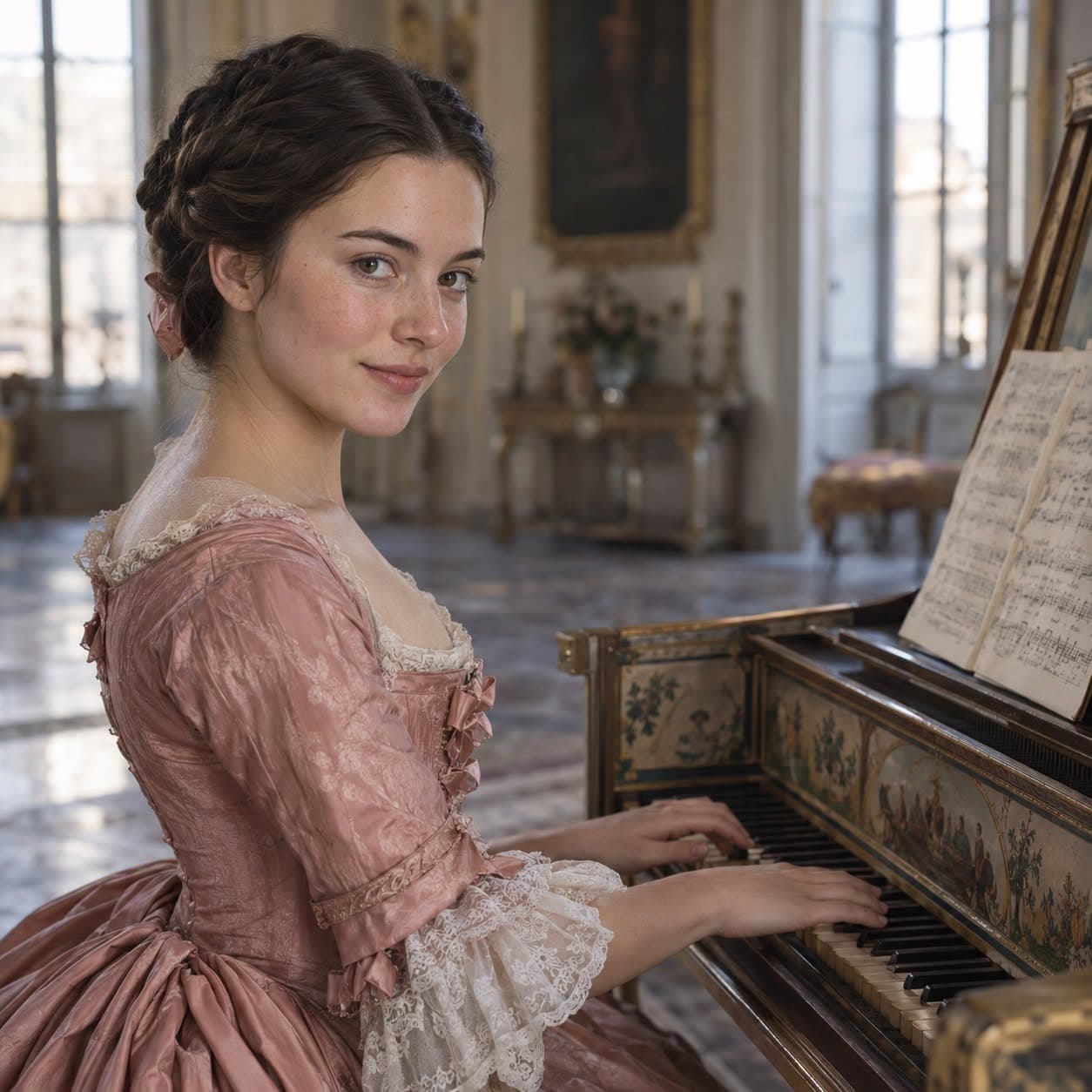
Then Teresa went to the harpsichord. She played pieces by the French composer Rameau, and played them, the same guest wrote, like Rameau himself. She played pieces of her own. Then she sang, providing her own accompaniment. He had come to a house celebrated for one remarkable daughter and heard another.
In September 1750, Count Giordano Riccati wrote from Treviso to Gaetana, asking for her sister's compositions. He wanted examples for a treatise on counterpoint, the art of weaving independent musical lines together. Teresa sent arias and cantatas. Later that month he wrote directly to her, thanking her and giving his considered opinion of the music. The request had gone through her sister; the musical conversation belonged to Teresa.
The visitors in the drawing room had applauded. Riccati wanted music he could take apart to show how composition worked. Teresa's pieces could stand that kind of attention. The notes could travel without her.
One of her largest works was Sofonisba, an opera in three acts offered to the Emperor Francis I for the name day of his wife, the Empress Maria Theresa. Its manuscript survives in Vienna, with the Habsburg arms on the binding. The music called for strings joined by oboes, piccolos, horns and trumpets. Some arias had the force of a battle cry and others were more intimate. Teresa had sung to her own accompaniment as a girl. In Sofonisba she was writing for other people's voices and for whole sections of instruments to answer them.
Sofonisba was not alone. Other music went to the Saxon court at Dresden, and she wrote for the theatre across two decades, including Il Re Pastore and Ulisse in Campania.
Her father died suddenly in 1752. That June, aged thirty-one, she married Pietro Antonio Pinottini. Marriage did not end the work. Her married name appears on musical manuscripts, and the operas kept coming after it. There was no single bright youth after which the achievement stopped.
What did not last was the security. The woman who had begun with wealth and an admiring audience spent her later years, from around 1770, in financial hardship and legal difficulties. The few relatives left to her helped. Her late letters to her younger sister Paola were full of gratitude. The correspondence had once brought requests for music. Now it carried thanks for support.
She was widowed in 1792. When she died in Milan on 19 January 1795, she was seventy-four and poor. Her brother Giuseppe paid for her funeral, held in the parish of San Babila. The family that had once filled a room with guests to hear her was now paying to bury her.
The score of Sofonisba is still in Vienna, under its imperial arms. Inside are the parts she wrote for singers, oboes, horns and trumpets, across three acts. In her father's house she had once played her own pieces for thirty strangers. In Vienna there is still enough of her music to fill an opera.