She was fourteen when they bought it for her. The bed waiting for Portugal's new queen stood on a raised platform, beneath a canopy bearing the royal arms.
Maria Pia of Savoy was born in Turin on 16 October 1847, the daughter of the future Victor Emmanuel II of Italy and Adelaide of Austria. Her father belonged to the House of Savoy, her mother to the Habsburgs. She grew up among brothers and a sister, with governesses and the arrangements of a royal childhood. One brother would become King of Italy, another King of Spain. When Maria Pia was seven, her mother died. The women responsible for her upbringing could teach her what a princess needed to know. None of them was her mother.
In January 1859 her elder sister Clotilde, aged fifteen, was married to a cousin of Napoleon III. Maria Pia was eleven. Three years later it was her turn. Her father was now King of Italy, and a marriage had been arranged with Luís I of Portugal. On 27 September 1862 she married him by proxy in Turin. On 6 October, in the church of São Domingos in Lisbon, the couple ratified their marriage in person. Her fifteenth birthday was still ten days away.
Portugal had acquired a queen. Maria Pia had acquired a husband, a household and a country.
The ceremony was recorded in a painting completed two years later. Luís wears his gala uniform, Maria Pia a white wedding dress. Red velvet hangs throughout the church, and above the couple the arms of Portugal and Savoy share a royal crown. In the galleries the women sit in front, the men behind. The Cardinal Patriarch leads the clergy down the nave. Everything has its place, including the young bride through whom two royal houses have been joined.
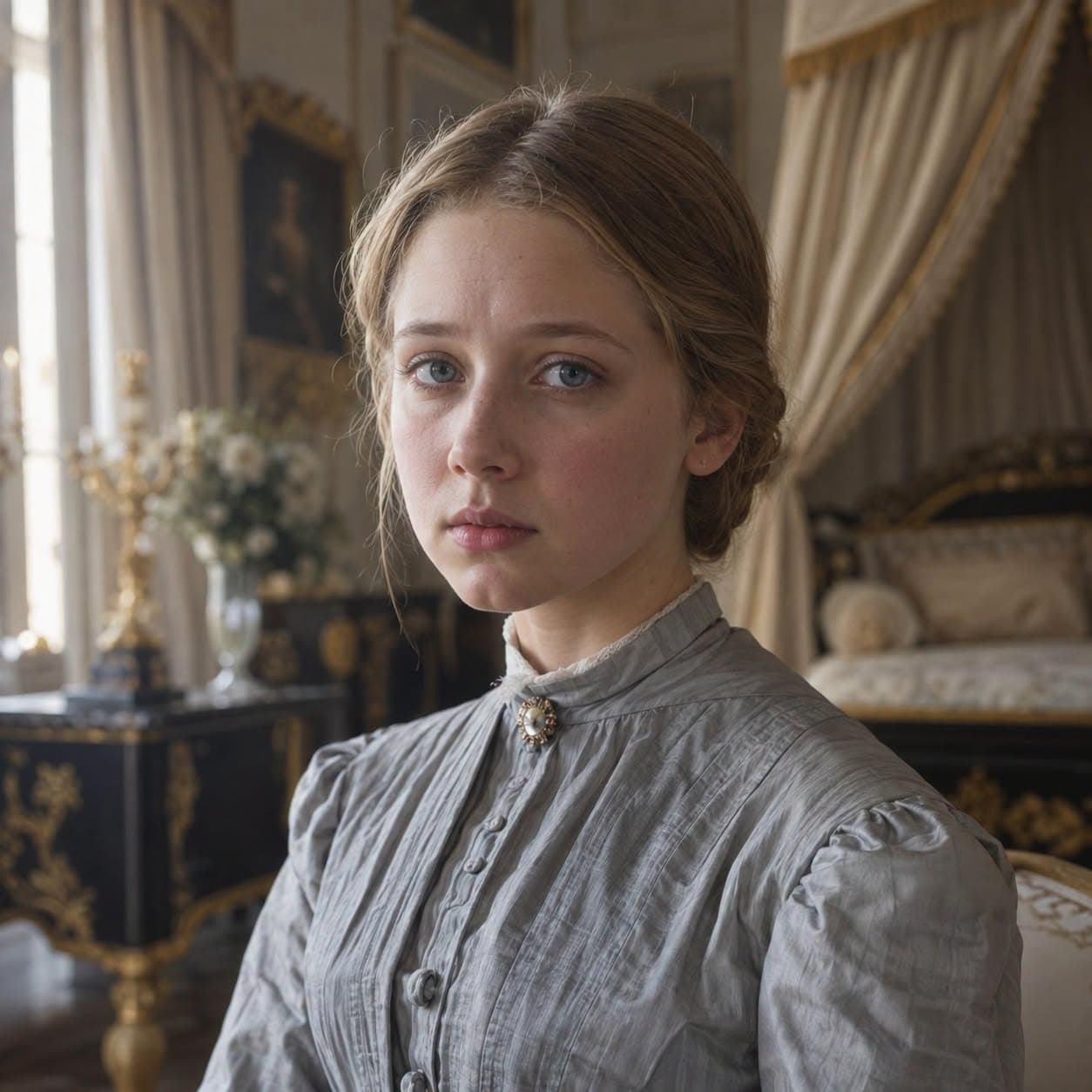
At the Ajuda Palace, her bedroom had been furnished from Paris. Luís had bought the furniture and silks there, in the style of Napoleon III's court, the wood lacquered to resemble ebony. There was an Italian prie-dieu inlaid with mother-of-pearl, and a painted ceiling overhead. Even the place where she would sleep announced her rank. A royal household could prepare a queen's rooms in advance. It could not prepare the queen.
She missed her family and wanted her brothers to visit. But in March 1863, writing to her father, she described her happiness with Luís and his kindness to her. She was expecting a baby, and wanted her father to share their pleasure. Homesickness and happiness travelled to Turin by the same post.
On 28 September 1863 she gave birth to Carlos at Ajuda. She was fifteen, eighteen days short of sixteen. The child was heir to the Portuguese throne, and parliament formally recognised his birth. For the dynasty, the succession had been secured. For Maria Pia, who had lost her own mother at seven, motherhood had begun while she was still a girl herself.
A second son, Afonso, followed in July 1865, when she was seventeen. She began acquiring works of art and taking charge of the palace's decoration, choosing how the rooms would look where the family lived and the court received its guests. The girl for whom a bedroom had been ordered was now ordering things herself.
Beyond the palace, she supported institutions for vulnerable children. Queens could lend their names to charitable causes, and a royal name was useful. It brought attention, introductions and access to people with money. When the Tagus rose in the great flood of the winter of 1876, Maria Pia used hers to bring a relief effort together. She was twenty-nine.
On 13 December she took the initiative to establish an assistance commission. In Lisbon's parish of São Nicolau, a local committee followed. Its members met, raised donations and corresponded with the central commission the queen had set in motion. The work ran on into the following year, long after the floodwater had gone.
Donations were sought throughout Portugal and among Portuguese people abroad. There were collections, raffles and benefit performances, and money came from several countries, with Brazil giving particularly generously. Maria Pia took an active part in the commission's work. The appeal raised more than was needed, and the surplus was invested as a reserve against future calamities. The next disaster would not have to wait for the next appeal to begin.
Portugal called her the Angel of Charity and the Mother of the Poor. They were grand names, as royal names tended to be. The work behind them was meetings in a Lisbon parish, raffle tickets, benefit nights and accounts that had to balance.
At Ajuda, her taste spread through the palace. Rooms were redecorated, paintings and furnishings accumulated, and the household came to bear the mark of the woman who had arrived there at fourteen. The bedroom Luís had prepared for her was the exception. Maria Pia never remodelled it. Among all the interiors she changed, she kept the room bought for the girl, down to the painting on its ceiling.