She left her servant the bed he slept in. Her daughter had been Queen of England. Her grandson was king. When she died, even mourning her became a matter for his council.
Margery Wentworth, Lady Seymour, died on 18 October 1550. Jane Seymour had been dead for nearly thirteen years, and Thomas, Margery's son, had gone to the scaffold in 1549. Her son Edward, Duke of Somerset, was still alive. He had already discovered how little protection there was in being the king's uncle.
She was born around 1478, a daughter of Sir Henry Wentworth of Nettlestead in Suffolk, and in 1494 she married John Seymour, a Wiltshire knight. The family lived at Wolf Hall, near Savernake Forest. She had borne ten children. Their sons and daughters carried the Seymour name into the royal household, and Jane's marriage to Henry VIII in May 1536 carried it further than service alone could have done. Margery became the mother of the king's wife. The family's advancement now rested on a daughter whose own position rested on giving Henry the son he wanted.
Jane gave birth to that son at Hampton Court on 12 October 1537, after a labour of two days and three nights. Three days later he was carried into the Chapel Royal for his christening, with his half-sister Mary as godmother, and afterwards brought back to his mother. There was a living prince, a christening, and a queen well enough to receive him.
On 24 October Jane died.
Twelve days had made Margery a prince's grandmother and taken her daughter away. Jane's son was heir to the throne. Jane's own place in the family stood empty through the years in which his grew more important. When Henry died in January 1547, the boy became Edward VI. He was nine years old. Margery had lived to see her grandson inherit a kingdom his mother never saw him rule.
Her sons moved into the space around him. Edward Seymour became Lord Protector, governing on behalf of his nephew. Thomas married Henry's widow, Katherine Parr. One brother stood at the head of the government; the other had married a queen. Jane's death had ended her own part in the family's rise, but it had not ended the rise.
Nor had it made the brothers content with one another. Thomas wanted greater access to the young king and resented Edward's authority. In January 1549 he tried to break into the king's private apartments. Arrest followed, then the Tower. On 20 March he was executed on Tower Hill. Margery's grandson remained king, her elder son remained Protector, and another of her children was dead.
Within months, Somerset himself fell. In October 1549 his fellow councillors moved against him, and the man who had governed England went into the Tower. He was released in February 1550 and returned to the council that spring. By the autumn he was again serving his nephew, but without the protectorship. Margery died during that partial recovery, with Thomas beyond recall and Somerset back at court.
Four of her children were living when she died.
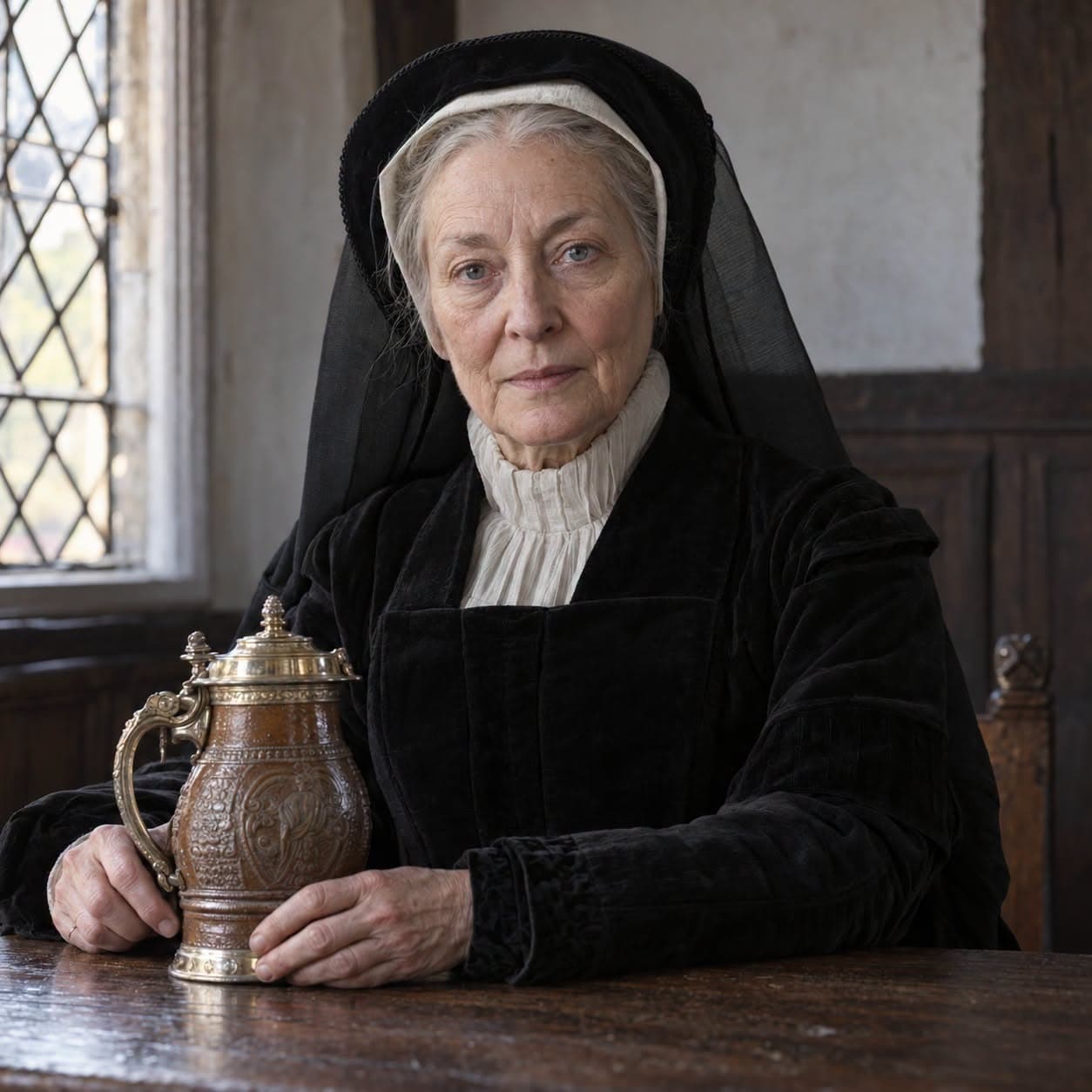
Her own arrangements were on a different scale. Her will provided for her surviving daughters, Elizabeth Cromwell and Dorothy Smith, for her son Henry, for grandchildren and for servants. In the last days of her life she made changes to it. Her granddaughter Anne Smith was now to have a stone jug covered with silver, and three pounds. Dorothy was to have her basin and ewer. Her gentlewoman Anne Gressye was to receive a tawny damask gown trimmed with tawny velvet, and her French hood.
These were individual possessions going to named people. The woman known through a queen, a duke and a king had a household of her own to provide for, and she was still rearranging it two days before she died.
When her death came before the council on 18 October, Somerset asked how he should observe his mother's mourning. Her relationship to Queen Jane and to the king was expressly recognised. So was his duty as her son. That duty had to be fitted to his duty at court.
The councillors reasoned that outward mourning did nothing for the dead and might suggest too little faith in the life to come. There was the expense of black cloth, too. Private sorrow, they held, belonged at home rather than in the royal presence. The king released Somerset and his household from wearing mourning and from keeping certain customary observances. The decision was entered in the council's book as a precedent.
Her son was excused from wearing black for her.
Margery's own provisions had reached people whose names would never come before a royal council. James Leke, her servant, was to have four pounds as well as the bed. She had said which bed: the one he already slept on, with everything belonging to it.