Margaret Tudor was born on 28 November 1489 at Westminster Palace, the second child of Henry VII of England and Elizabeth of York, the first daughter of the new Tudor dynasty that her father had won at the point of a sword at Bosworth Field four years earlier.
She was given the name of her grandmother Margaret Beaufort, the most formidable woman in the family, the one who had kept the Tudor claim alive through thirty years of danger and had lived to see her son take the throne. It was a name that carried weight. Margaret was four years old when her elder brother Arthur was formally betrothed to Catherine of Aragon.
She was watching, from the edges of rooms she was not yet old enough to fully understand, the machinery of dynasty at work. She would be inside that machinery herself before she was old enough to have been asked.
In January 1502 Henry VII signed the Treaty of Perpetual Peace with Scotland. The mechanism of the peace was Margaret. She was twelve years old. The treaty stipulated that she would marry James IV of Scotland, a man of twenty-nine, a king she had never met, whose country she had never visited, whose language and court and landscape were entirely foreign to everything she had grown up knowing.
The negotiations were conducted entirely between men in rooms Margaret was not present in, about a future that was entirely hers to live. Her father Henry VII considered the match diplomatically advantageous. Her brother Henry, twelve years old and already large and loud and full of the certainty that would define him, had no objection. Margaret was not asked to have one either.
Her mother Elizabeth of York died in February 1503, ten days after giving birth to a daughter who lived only nine days. Margaret was thirteen. She had watched her mother go through pregnancy after pregnancy, had watched children arrive and disappear, and now watched her mother disappear too, in the same month as the last baby, and was left in a court that was already preparing to send her away.
There was no period of particular mourning extended to the children. The court had business to conduct and Margaret had a departure to prepare for.
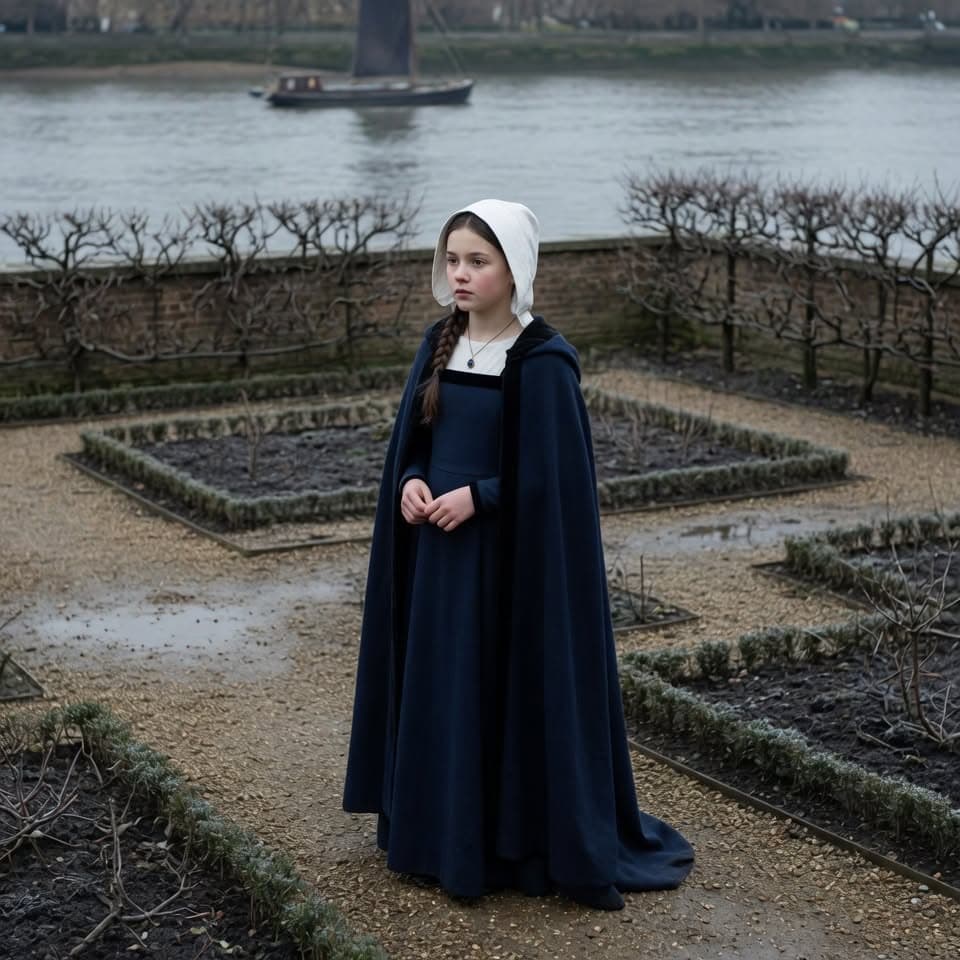
She left London in July 1503 at the age of thirteen, travelling north through England in a formal procession that was simultaneously a farewell and a display of Tudor wealth, Henry VII spending lavishly on the spectacle of giving his daughter away. She crossed the border into Scotland on 1 August 1503. Everything she had ever known was behind her.
She was a queen now, which meant she belonged to Scotland and to James, and the life she had lived in Westminster and Greenwich and Richmond was finished in the specific way that the lives of royal daughters finished when their diplomatic usefulness was finally collected. She married James IV at Holyrood Palace on 8 August 1503.
She was thirteen years old. He was thirty years old. The marriage was consummated. The court recorded this because the court recorded everything that bore on the succession.
James IV was by the standards of the period a reasonable husband. He was educated, cultured, genuinely interested in the new learning, and appears to have treated Margaret with a degree of consideration that was not guaranteed and should not be mistaken for equality. He also had a longstanding mistress, Janet Kennedy, by whom he had children, and he did not end that relationship upon marriage.
Margaret knew. She was not expected to object. She was expected to produce children, and she tried, and the children died, one after another, until in April 1512 a son survived and was named James. She was twenty-two years old and had been trying for nine years.
In September 1513 James IV invaded England in support of France while Henry VIII was away fighting on the continent. He was killed at the Battle of Flodden on 9 September 1513, along with ten thousand Scottish men. Margaret was twenty-three years old, pregnant with her fifth child, and suddenly regent of Scotland for her seventeen-month-old son James V. She had been sent to Scotland to serve the interests of the Tudor dynasty. The Tudor dynasty was now at war with the country she governed. Henry VIII sent her a letter of condolence. He did not come.
She governed Scotland for two years, was stripped of the regency when she remarried without the Scottish council's permission, fought to recover her son from the men who used him as a political instrument, married twice more, divorced once in circumstances the church found scandalous, and died on 18 October 1541 at the age of fifty-one at Methven Castle in Perthshire.
Henry VIII, who had seen his father use her as a diplomatic instrument at twelve, done so again himself later and ignored her for most of the following thirty years, wept when he heard she was dead. He had not visited her once.
Every British monarch from James I onwards descends from Margaret Tudor. Every one. The Tudor dynasty died with Elizabeth I in 1603 because Elizabeth had no children. The crown that Henry VII fought for at Bosworth passed to the Stuarts because Margaret had been sent to Scotland at thirteen and had done what she was sent there to do.
The girl in the procession heading north in the summer of 1503 is the reason the British monarchy exists in the form it exists today. Nobody asked her if she wanted to go.