Diego Velázquez painted her at three years old. Then at five. Then at eight. Then at nine. Her father sent every portrait north to Vienna so that the man she was going to marry could watch her grow up. That man was her uncle.
Her name was Margaret Theresa. She was born in 1651 in Madrid, the daughter of Philip IV of Spain and his wife Mariana of Austria. She was not the first Habsburg child produced by a consanguineous marriage. She was not even the first in her immediate family. Philip IV was Mariana of Austria's uncle. He had married his niece because the Habsburgs had spent two centuries ensuring their inheritance passed between Habsburg hands, which meant the family tree had stopped branching outward and had begun folding back on itself, the same bloodlines appearing in the same places, generation after generation, in arrangements the dynasty regarded as prudent and history has since regarded as catastrophic. Margaret Theresa arrived in the world already carrying that compression. The marriage that would define her life had not yet been arranged. The damage that would kill her was already done.
The portraits began almost immediately. Velázquez was the court painter and Margaret Theresa was the Infanta, and so he painted her as a matter of professional duty, but the portraits served a purpose that went beyond documentation. Philip IV was conducting a negotiation with Leopold I, Holy Roman Emperor, about his daughter's future, and the currency of that negotiation was the girl herself, and the portraits were proof of the transaction. Leopold received them in Vienna at intervals across her childhood. He was Mariana of Austria's brother, which made him Margaret Theresa's maternal uncle. He was also her father's nephew through the Spanish line. He was her uncle through one line and her cousin through another, and he studied the paintings of his niece arriving from Madrid every few years and satisfied himself that she was developing as required.
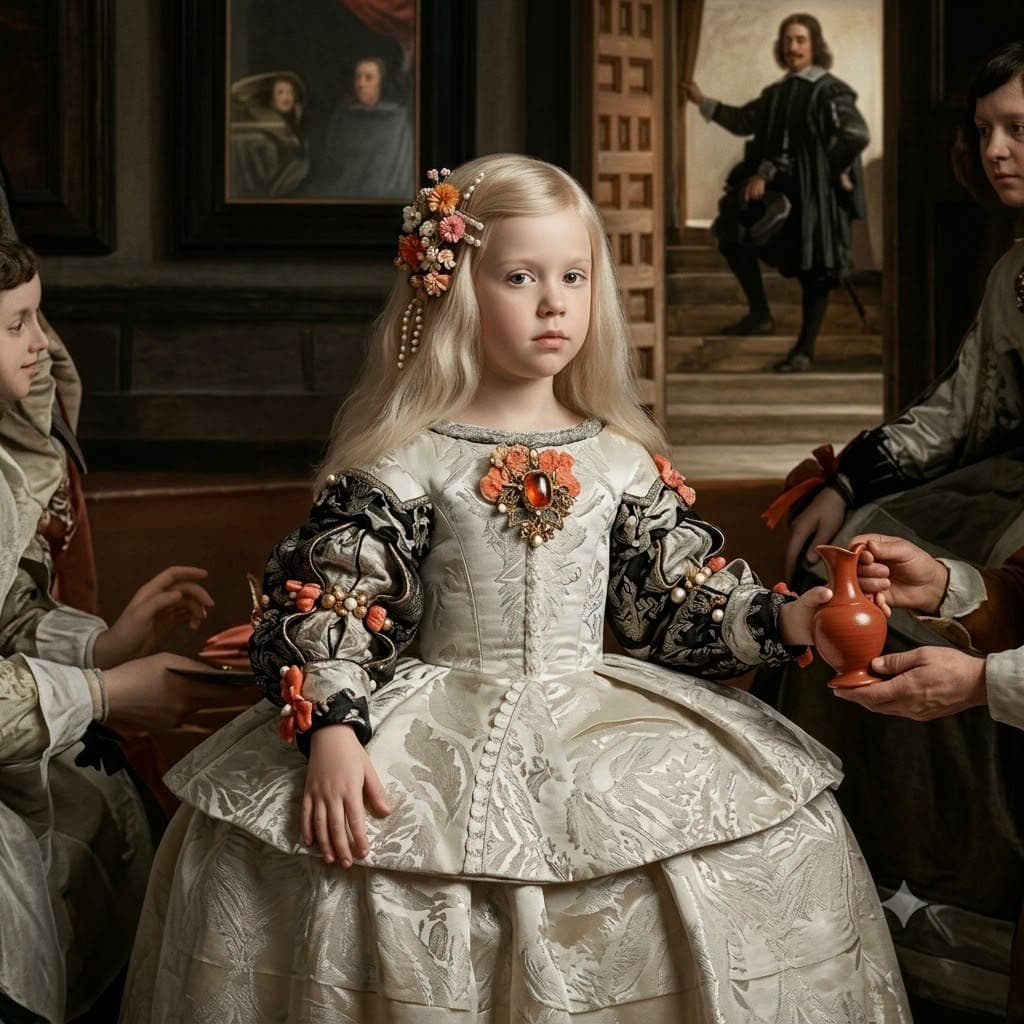
The most famous of those portraits is Las Meninas, painted in 1656. She is five years old in it, standing in a shaft of light in the Madrid palace, her ladies arranged around her, a small and self-possessed figure in a wide dress. It hangs in the Prado now and people travel from across the world to stand in front of it. Almost none of them know they are looking at a child whose development was being monitored from a distance by the man her father had chosen to give her to.
She had no voice in that arrangement and no mechanism through which to acquire one. She grew up in Madrid knowing that Vienna was her destination, that Leopold was her future, that the portraits being made of her were being sent north for a purpose she could not have named at five but which shaped the terms of her existence from the moment she was born. At nine Velázquez painted her again, the last portrait before his death the following year, and by then the negotiation had been concluded. She was going to Vienna. The only question was when.
She arrived in December 1666 at fifteen years old, a Spanish infanta deposited into the Habsburg court in Austria, required to become someone else's version of a queen. The displacement was total. The language was different, the customs different, the specific rhythms of a court she had spent her childhood preparing for and had never once visited. She carried Spain with her in her bearing and her training and she spent the following years translating herself into something Vienna could accommodate, learning what was required and performing it correctly, because performance was what courts demanded and correctness was the only form of agency available to her.
Leopold was twenty-six. She was fifteen. He had watched her grow up in paint and now she was in front of him in person, and the marriage proceeded with the smooth efficiency of an arrangement that had been decades in the making.
The first child came in 1667. The second in 1668. The third in 1669. The fourth in 1670. Then two pregnancies that did not produce living children. Six pregnancies in six years, each one a negotiation between a body that had been genetically compromised before it drew its first breath and the dynastic necessity that required it to keep producing. Of the four children born alive, three died in infancy. The court registered each death as a disappointment and adjusted its calculations and waited for the next pregnancy. Margaret Theresa was not asked whether she was ready. She was not asked anything. She was fifteen when she arrived in Vienna and twenty-one when she died there, and in the six years between those two facts she had been pregnant for the majority of them.
The one child who survived to adulthood was a daughter. They named her Maria Antonia.
Margaret Theresa died on the twelfth of March 1673, four months into a seventh pregnancy. The cause was almost certainly the accumulated physical toll of six pregnancies on a body that had never been given time to recover between them. She was twenty-one years old. Leopold remarried within the year, because emperors required heirs and the machinery of dynasty did not pause for grief, and the court that had received her at fifteen absorbed her death at twenty-one with the same efficiency it brought to every logistical problem and moved on.
The portraits that Velázquez made of her are still in the Prado and in the Kunsthistorisches Museum in Vienna. They show a child growing up in careful stages, three years old, five, eight, nine, each one sent north on schedule to reassure the man waiting in Vienna that the investment was developing correctly. She was twenty-one when she died. She had spent fifteen of those years being painted for someone else's inspection and six of them producing children for someone else's dynasty.
Her daughter Maria Antonia lived to twenty-three. She bore three sons, two of whom died in infancy. She died on Christmas Eve, 1692, in the same Hofburg Palace where her mother had spent her married life, almost certainly of the same cause. The dynasty had built the same life twice, in the same place, from the same materials, and both times it had produced the same ending.
Nobody sent portraits of Maria Antonia to Vienna. By then she was already there.