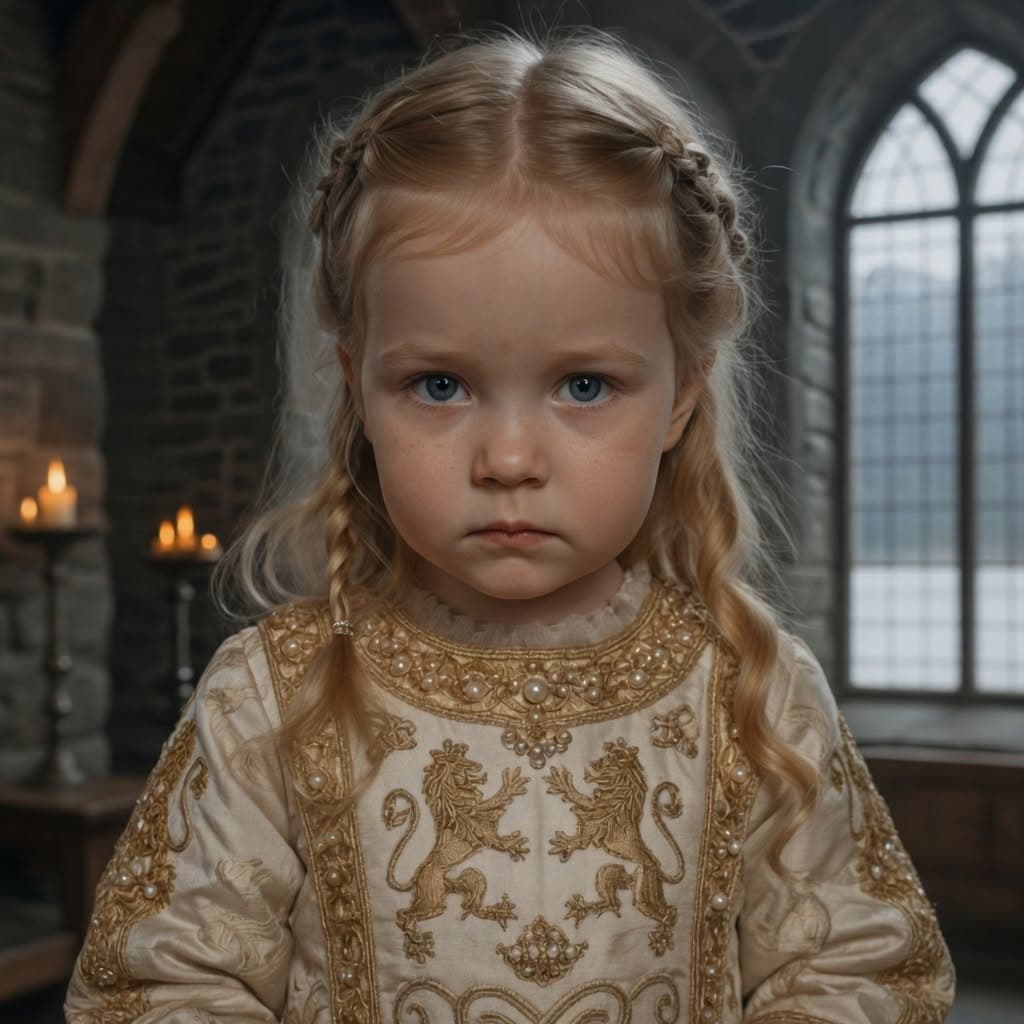
She was seven years old when she died. She had been Queen of Scotland for four of those years. She never saw it once.
Her name was Margaret. She was born in Norway in 1283 to a mother who did not survive the birth. That mother was Margaret of Scotland, daughter of Alexander III, and she died on the same day she gave her daughter life, leaving behind an infant who carried a Scottish crown in her blood without yet having a name for what that meant. Her father was Eric II of Norway. She was raised in Bergen. She grew up Norwegian in every way that mattered, in language and custom and the ordinary textures of a childhood, while across the North Sea a kingdom she had never visited began slowly to understand that she was all it had left.
Alexander III of Scotland had watched his children die before him. His sons first. Then his daughter, Margaret's mother, in that Norwegian childbed. He had remarried, hoping for another heir, and ridden out one night in March 1286 into a storm off the Fife coast, and his horse had gone over the cliff, and in the morning they found his body on the beach below Kinghorn. He left behind no legitimate children. He left behind one grandchild, three years old, in Bergen. The Scottish nobility looked at what remained and appointed six Guardians to govern in her name, and Margaret of Norway became Queen of Scotland without being told, without being asked, without being old enough to understand what either of those things meant.
In Scotland the machinery of governance turned in her name. The Guardians corresponded. The nobles negotiated. Edward I of England, who understood an opportunity when grief created one, inserted himself into the arrangements with the careful patience of a man who intended to be indispensable. By 1290 the Treaty of Birgham had been concluded, betrothing Margaret to Edward's son, the future Edward II. The two crowns of Scotland and England were to be united in the next generation. The borders and laws and institutions of Scotland were to be preserved. It was the most significant diplomatic arrangement in British history since the Conquest, and it had been built entirely around a child in Bergen who was eating her supper and learning her letters and had no knowledge that any of it existed.
She was seven years old when they finally sent the ships for her. She had been Queen for four years. The crossing from Bergen was rough. The storms that the North Sea produces in September pushed the fleet off course and drove it toward Orkney rather than the Scottish mainland, and somewhere in that crossing Margaret became ill. The nature of her illness the record does not specify with certainty. What it records is that when the ships reached Orkney she was dying, and that she died there in the arms of the Bishop of Bergen, on an island that was neither Norway nor Scotland, in a country that was not quite either of the ones she belonged to. She was seven years old. She had not yet set foot on Scottish soil.
The six Guardians had governed for four years in anticipation of her arrival. The Treaty of Birgham had negotiated the future of two kingdoms on the assumption of her survival. Edward I had positioned himself at the centre of Scottish affairs on the understanding that she would live to be queen and wife and mother. Thirteen men now stepped forward to claim the throne she had left empty. Edward I, no longer constrained by the need to manage a child, declared himself arbiter of the succession and began the process of asserting a dominance over Scotland that would not be resolved for generations. Everything that followed, the wars, the claimants, the long brutal contest between Bruce and Balliol and the English crown, all of it flows from that September in Orkney.
Her body was returned to Bergen. She was buried there beside her mother. Two graves in the same church. The mother who had died giving birth to the queen. The queen who had died before she reached her kingdom. The same loss measured from two directions, seven years apart.