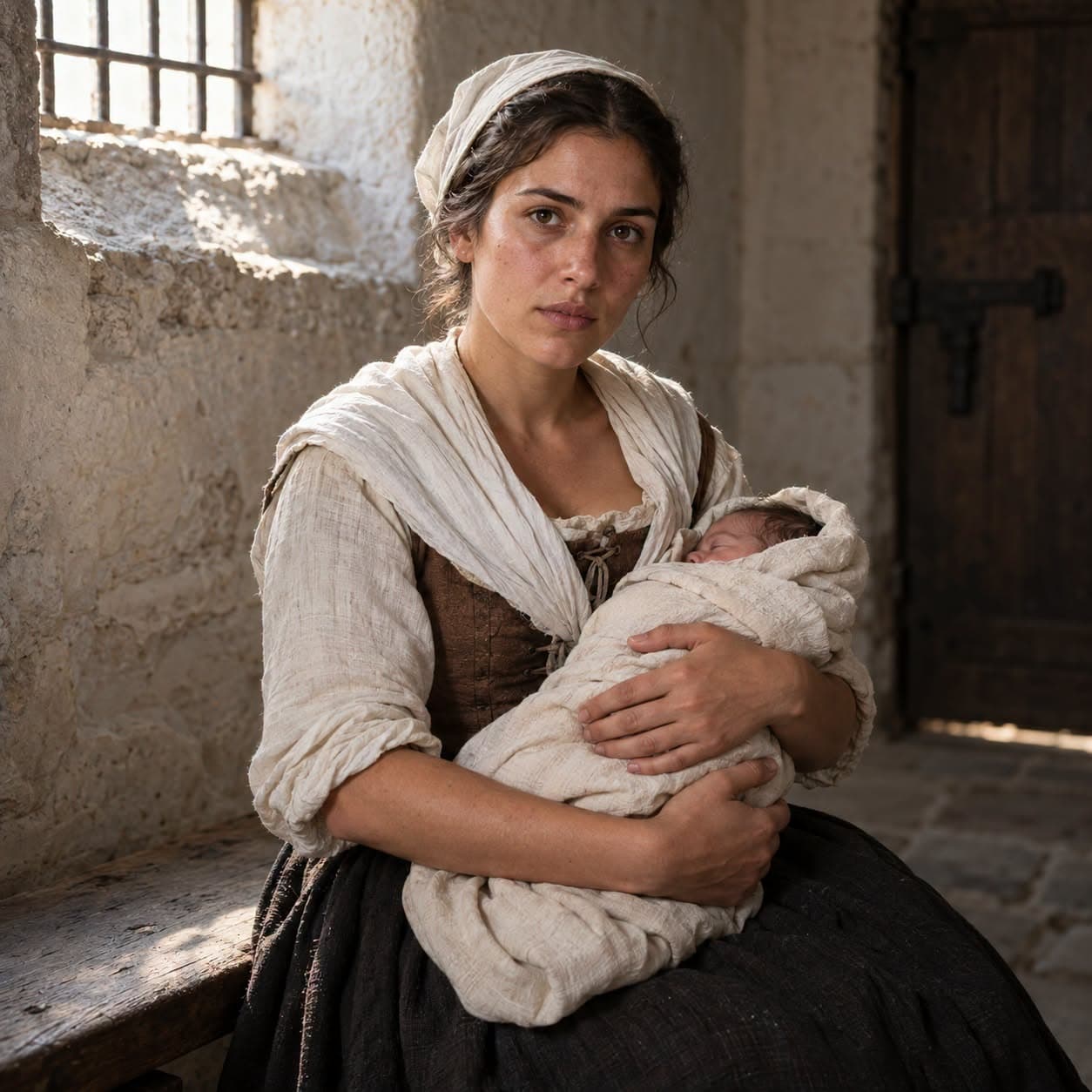
She gave birth in a prison of the Portuguese Inquisition. Her husband was a prisoner too. Leonor Maria de Carvalho would survive the proceedings. He would not.
On 18 October 1739, their names appeared among those sentenced at an auto-da-fé in Lisbon's church of São Domingos. Beside them was his mother, Lourença Coutinho, imprisoned for the third time. António was handed over to secular justice for execution. Leonor and Lourença were sentenced to imprisonment at the inquisitors' discretion. The same ceremony disposed of a husband, a wife and a mother in three entries on a list.
Lourença's first prosecution had begun when António was a child. She came from Rio de Janeiro, where her father owned a sugar estate, and had married João Mendes da Silva, a lawyer. They had three sons, Baltasar, André and António. The family belonged to the people called New Christians, Catholics of Jewish ancestry whose baptism did not spare them investigation for secretly practising Judaism. An ancestor's conversion could be generations old. The suspicion remained available.
In October 1712 Lourença was taken into the prisons of the Lisbon Inquisition. Her husband went with her, and the children came to Portugal. António was seven. In July 1713 she stood at an auto-da-fé, was reconciled to the Church and was sentenced to perpetual prison and the penitential habit. The family remained in Lisbon, where João Mendes practised law and the boys grew up.
Reconciliation did not close the matter.
In August 1726 Lourença was arrested again, along with her sons. António, now twenty-one and a student of canon law at Coimbra, was tortured and reconciled at an auto-da-fé that October. His mother stayed in the cells. Her case ran on for three more years.
When she was taken for torture, she was bound with all eight cords. She called on Saint Rita and begged for mercy through the wounds of Christ. On 16 October 1729 she heard another public sentence, which included three years' banishment to Castro Marim in the Algarve. Questioned by the Inquisition years later, she said she had never left Lisbon.
Leonor brought an earlier prosecution of her own into the family. She was a New Christian from Covilhã, in the hills of central Portugal, and had been reconciled for alleged Jewish practices by the Inquisition at Valladolid, in Spain, in January 1727. She was still in her teens. Before she married António, she had already stood among the penitents at an auto-da-fé. Her experience of the tribunal did not begin with being a playwright's wife.
They married in Lisbon in December 1734. Their daughter was called Lourença, sharing her grandmother's name. Alongside the older woman's repeated imprisonments there was now another household, a marriage and a child, and a few years in which António was writing for the theatre.
His comedies were performed with music and puppets at the Bairro Alto theatre. He turned to Don Quixote, classical myths and the pursuit of love and money. In Guerras do Alecrim e Manjerona, suitors chased wealthy women and servants devised the stratagems that brought the marriages about. There was room in that Lisbon for complicated courtships, ridiculous masters and clever servants. For a few seasons, Leonor's husband was the man supplying them.
In October 1737 the arrests began again. Leonor and António were taken on 5 October, and so was his brother André. Lourença followed a week later, on the twelfth. Leonor was pregnant when she went in, and she gave birth inside the prison.
For Lourença it was the third time. For Leonor it was the second.
Leonor contested the allegations against her and challenged the witnesses. She was tortured anyway, and during the ordeal she called on Jesus and Our Lady of Penha de França. Lourença was tortured again as well. Their earlier reconciliations had brought them back into the Church. They had not kept either woman out of its prisons.
António's case turned on allegations about his conduct inside the prison. Guards and fellow prisoners testified that he had kept Jewish fasts. Other witnesses described his Catholic observance. The tribunal accepted the case against him and condemned him as a relapsed heretic. The family was being prosecuted together, but its members would not receive the same sentence.
At São Domingos, each woman received imprisonment at the tribunal's discretion. That wording left the length of it in the inquisitors' hands. Neither woman was condemned to die.
António was strangled by garrote, and his body was burned. He was thirty-four. The mother whose arrest had brought a seven-year-old boy from Brazil outlived him. So did the wife who had gone into the prison pregnant.
Leonor had given birth while her husband was held by the same tribunal. When the sentences of that October had been carried out, she was a widow, and her own punishment had no number of years attached to it. The record gives the day it began. It gives no day for its end.