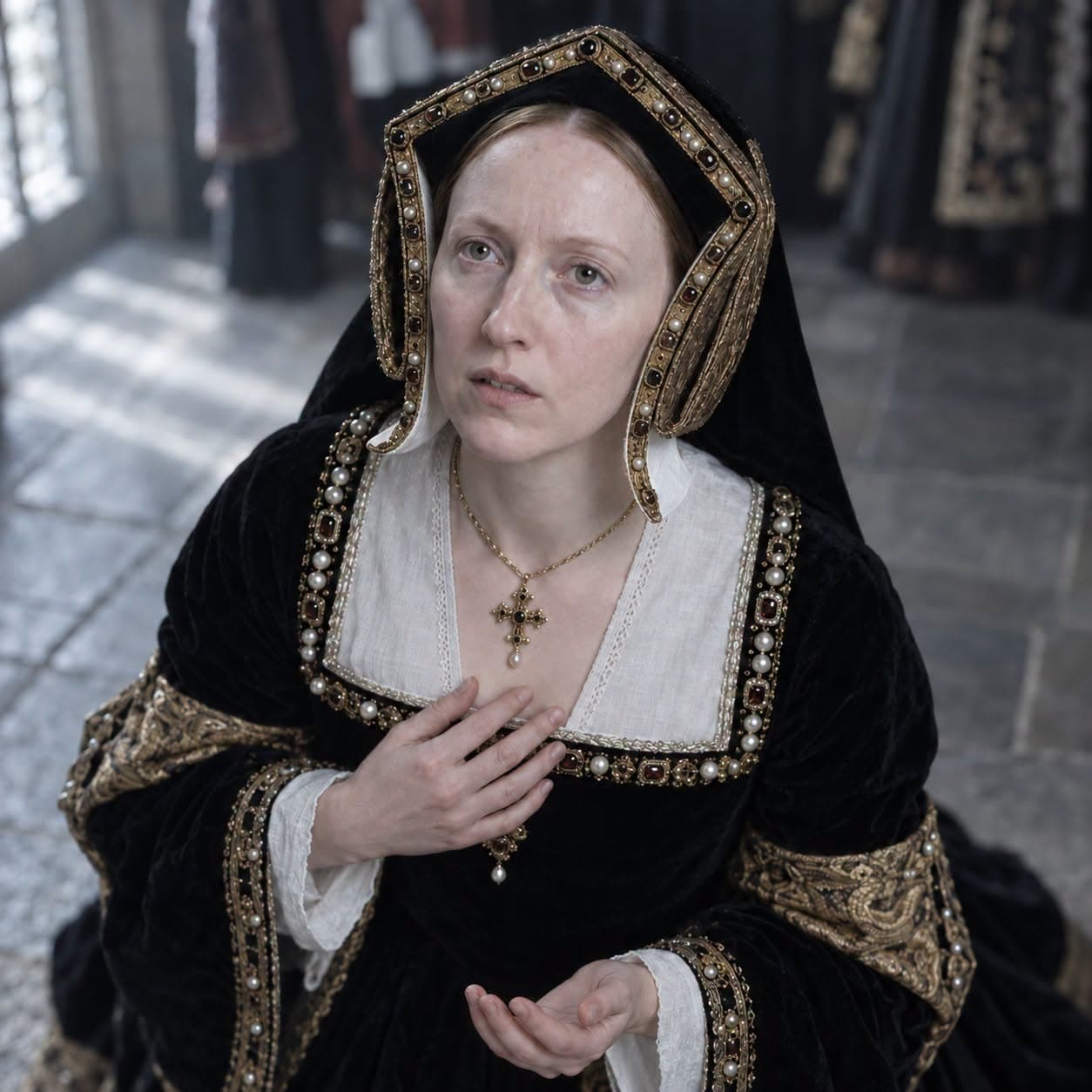

She was queen for nine days. She had not asked to be. On the morning of her execution she was blindfolded and could not find the block. She said quietly, where is it, where is it, and someone guided her hands to it. She was sixteen or seventeen years old. She had spent the nine days writing letters asking to be allowed to go home.
Jane Grey was born in 1536 or 1537, the record is uncertain. She was the daughter of Henry Grey, Marquess of Dorset, and Frances Brandon, who was the granddaughter of Henry VII through his younger daughter Mary. The royal blood was real. It was also, from the first moment her parents understood what it meant, the thing they valued most about her. Jane grew up in a household where that blood was the lens through which every decision about her life was made.
She was educated with extraordinary seriousness. She studied Latin, Greek, Hebrew, French, and Italian. It was the full humanist curriculum that was remaking English intellectual life in the mid-sixteenth century, and it was administered by tutors who recognised almost immediately that their pupil was exceptional. Roger Ascham, who tutored Elizabeth and was not a man given to idle flattery, visited Jane at Bradgate Park in 1550. He found her reading Plato in Greek while her parents hunted in the park. He asked her why she was not with them. She told him that the hunt and the park and everything her parents found pleasurable was, compared to her books, a shadow.
She was thirteen years old at the time. She meant it completely.
Her parents were not interested in shadows. Henry Grey and Frances Brandon were interested in the succession. The succession had been reorganised by Henry VIII's final Act and then reorganised again by Edward's Device in a way that placed Jane ahead of both Mary and Elizabeth if the Device held. Northumberland understood this. He had constructed the Device. He had also, in May 1553, married Jane to his son Guildford Dudley. It was a match Jane resisted and was compelled to accept. Northumberland needed Jane on the throne, and Jane married to his son was Jane whose throne was also, in practical terms, his.
Edward was dying. By the spring of 1553 everyone in the court who was paying attention understood this. Northumberland was paying very close attention. In late June, with Edward clearly fading, Jane was summoned to Syon House. She went expecting she did not know what. What she found was the Privy Council assembled to tell her that Edward had named her his successor and that she was to be queen.
She wept. The accounts are consistent on this point. She said she was not fit for the office. She said the crown belonged to Mary, who was the legitimate heir under Henry's Act of Succession, and that she would not take what was not hers. The councillors told her it was God's will and Edward's will and the law's will. Jane Grey, who had been told what to do since the day she was born by people who valued her blood above her person, did what she had always been trained to do. She complied.
She was taken to the Tower of London on the tenth of July 1553. She went not as a prisoner but as a queen. The Tower was the traditional residence of monarchs awaiting coronation. The crown jewels were brought to her. A crown was held above her head to see how it fitted. Jane said she had not tried it on and did not want to try it on. The men around her tried it on her anyway.
She wrote to Mary that same day. The letter survives. She wrote that the crown had been forced upon her against her will. She wrote that she had been led astray by those in whom she had placed her trust. She asked Mary to understand that she was a victim of the men around her rather than their instrument. It was a precise and careful letter. It was written by a girl who understood, with the clarity of someone trained to think rather than to perform, exactly what her position was and what the only possible outcome was likely to be.
Outside the Tower, the country was deciding. Mary had retreated to Framlingham Castle in Suffolk and was raising an army. The people of East Anglia were coming to her with a speed and a conviction that Northumberland had not anticipated. He had calculated what the Protestant councillors would do. He had not calculated what ordinary English people would do when they were asked to accept that the legitimate daughter of Henry VIII had been set aside for a girl they had never heard of. They came to Mary in their thousands. Framlingham filled. The army grew.
Northumberland marched out of London on the fourteenth of July with six thousand men to intercept her. He left behind a council that had been watching the numbers from Framlingham with increasing attention. On the nineteenth of July, nine days after Jane had been brought to the Tower, the council rode to Cheapside and proclaimed Mary queen. They did it with the specific efficiency of men who had already decided that the distance between themselves and Northumberland was the most important distance in England.
Jane was in the Tower when they told her. The canopy of estate above her chair was taken down. It was the symbol of royal authority. She said, according to the account written afterward, that she was very glad to relinquish a crown she had never wanted. Whether gladness was what she actually felt in that room, with the canopy coming down and the men who had placed her there recalculating their positions around her, is something her letter to Mary had already answered. She had known from the first day. She had simply not been in a position to do anything about it.
She remained in the Tower. Mary's coronation proceeded. Northumberland was tried and executed in August. Jane's own trial came in November. She was convicted of treason for having accepted the crown. Mary did not initially intend to execute her. Jane was a pawn, and Mary was not without intelligence about how pawns worked. In the autumn of 1553 the plan appears to have been imprisonment, perhaps followed eventually by release. Then in February 1554 Jane's father Henry Grey joined Wyatt's Rebellion. It was a Protestant uprising against Mary's planned marriage to Philip of Spain, and the calculation changed. A living Jane Grey, however unwilling a figurehead she had been, was a focus for Protestant rebellion as long as she breathed. Mary signed the warrant.
Jane was told on the eighth of February 1554. She had one day. She spent part of it writing in a small prayer book she had been given. She inscribed messages to the Lieutenant of the Tower, to her father, and to her sister Katherine. To her father she wrote that he had made her and her issue instruments of his unlawful intent. She forgave him and she asked him to die penitently. She was sixteen or seventeen years old and she was writing her father his instructions for how to die. She wrote them with the composed precision of a girl who had been educated to think clearly and was thinking as clearly as she ever had.
On the morning of the twelfth of February 1554, Guildford Dudley was executed on Tower Hill. Jane watched from her window. She had not loved him and had not chosen him. She had been given to him by men who needed the connection he represented. But he was seventeen years old and she watched his body carried back past her window on a cart. She is recorded as having said his name.
She was brought to the scaffold on Tower Green shortly after. She gave a brief speech from the scaffold and acknowledged that she had done wrong in accepting the crown. She maintained that she had done so under pressure and without seeking it. She said the Lord's Prayer. She began to blindfold herself.
She tied the cloth over her eyes and reached for the block and could not find it. The scaffold was not familiar to her. Nothing about this moment was familiar to her. She moved her hands in the darkness and the block was not where she reached. She said quietly, where is it, where is it, and a bystander stepped forward and guided her hands to the wood.
She laid her head down. The executioner took one stroke.
The prayer book she wrote in the night before her death is in the British Library. Her handwriting is very neat.