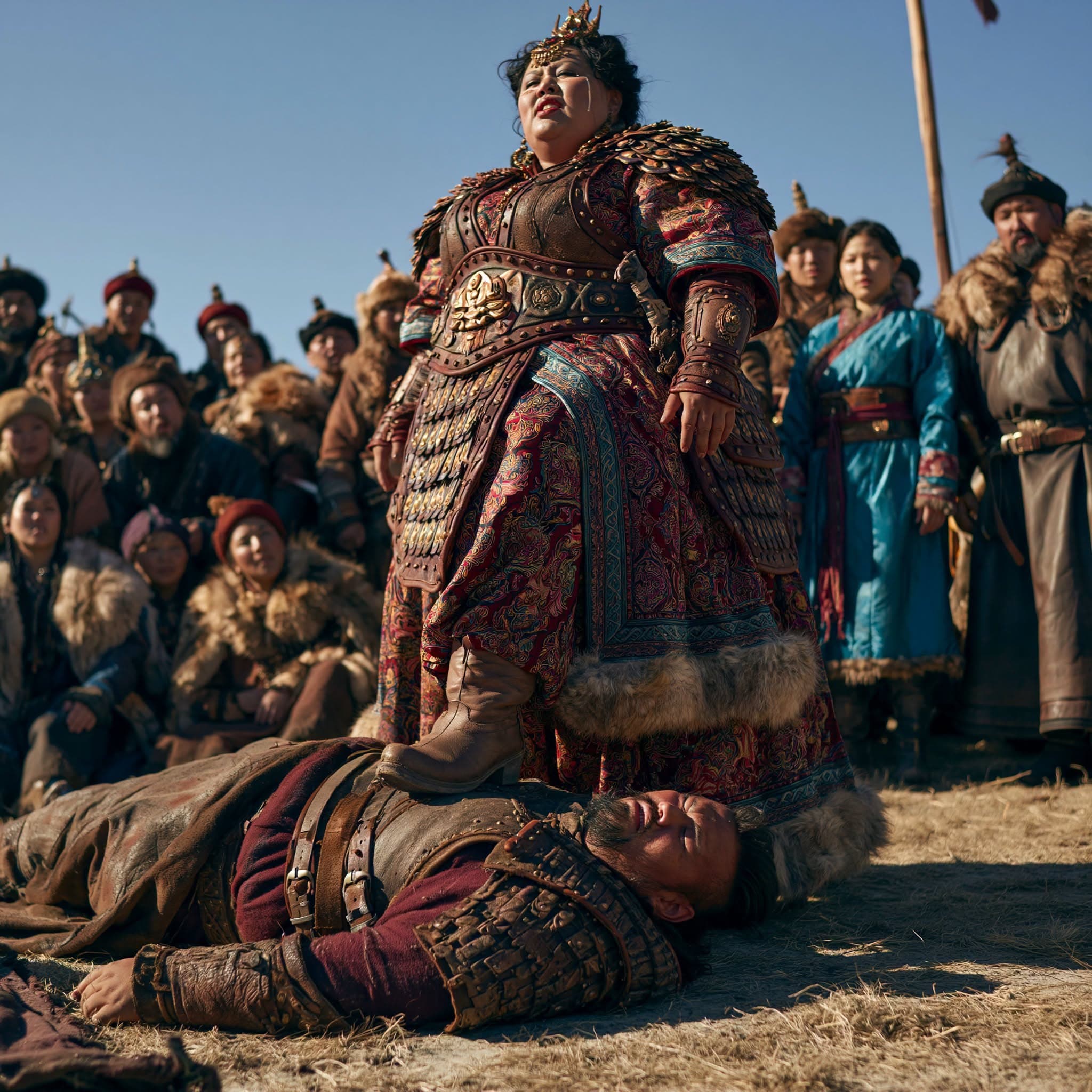
Somewhere in 13th century Mongolia, a young man was having a very bad day. He had arrived confident, probably flexing a little, absolutely certain that this would be the day someone finally beat Khutulun. He was wrong. He was, in fact, so wrong that he was now lying flat on his back in the dirt, staring up at the felt ceiling of a Mongolian tent, mentally calculating how many horses he had left and whether his dignity was recoverable.
It was not.
Khutulun, warrior, wrestler, great-great-granddaughter of Genghis Khan and quite possibly the most dangerous person in Central Asia, had beaten him in approximately the time it takes to boil a kettle. She dusted herself off, accepted his horses with the enthusiasm most women reserve for a particularly good piece of jewellery, and waited for the next one. There was always a next one. Men, it turns out, are eternal optimists.
Khutulun's marriage challenge was elegantly simple. Beat her in wrestling and she would marry you. Lose and you handed over 100 horses. Over the course of her lifetime she accumulated somewhere in the region of 10,000 horses, which tells you everything you need to know about both her wrestling ability and the spectacular overconfidence of 13th century men.
Her father, the powerful Khan Kaidu, absolutely adored her; she rode into battle beside him, served as his most trusted military advisor, and was by most accounts the sharpest strategic mind in his entire court. He wanted her to succeed him as Khan. His male nobles, presumably still smarting from various wrestling defeats, flatly refused.
Khutulun herself was so unbothered by societal expectations that when pressure mounted for her to marry she eventually chose her own husband, not because he beat her, but simply because she decided she liked him. She then almost certainly beat him in wrestling anyway, just to establish the ground rules.
Marco Polo encountered her story on his travels and wrote about her with the barely concealed astonishment of a man who had just realised everything he thought he knew about the world was wrong. The historian Rashid al-Din recorded her military exploits in detail. She was, by every contemporary account, extraordinary, a woman so capable, so fearless and so magnificently unbothered by what anyone thought of her that she essentially invented her own rules and enforced them with her fists.
And then history did what history so often does to extraordinary women; it filed her away, forgot to mention her in the important books, and spent several centuries talking about Marco Polo instead. Khutulun died undefeated, with 10,000 horses and zero apologies. Honestly, that sounds like winning to me.