For nineteen days, Robert Dudley turned his own castle into a proposal. Elizabeth ate the food, watched the pageants, praised the fireworks, and left exactly as unmarried as she had arrived. The queen had understood the invitation perfectly.
By the summer of 1575, Robert Dudley and Elizabeth had known each other since childhood, tied together by decades of danger, favour, and gossip. He had proposed repeatedly in the first decade of her reign, only to be firmly refused at Christmas 1565. His wife, Amy Robsart, had died years earlier in circumstances close enough to scandal that marrying him had never again been a safe or simple thing for a queen to consider. Kenilworth, where she arrived on 9 July 1575, was widely understood at court as Dudley's last serious attempt to change her answer.
He had spent an almost reckless amount preparing for it. Kenilworth Castle was rebuilt around her visit: a new gatehouse, luxurious new lodgings fitted out for a monarch rather than a courtier, gardens laid out below the walls, the grounds landscaped so that the approach itself became part of the performance. Rumour at the time put his daily spending on her entertainment at a scale that would have ruined a lesser man. By the time she arrived on progress, Kenilworth was no longer simply his home. It had become a stage built for one particular outcome.
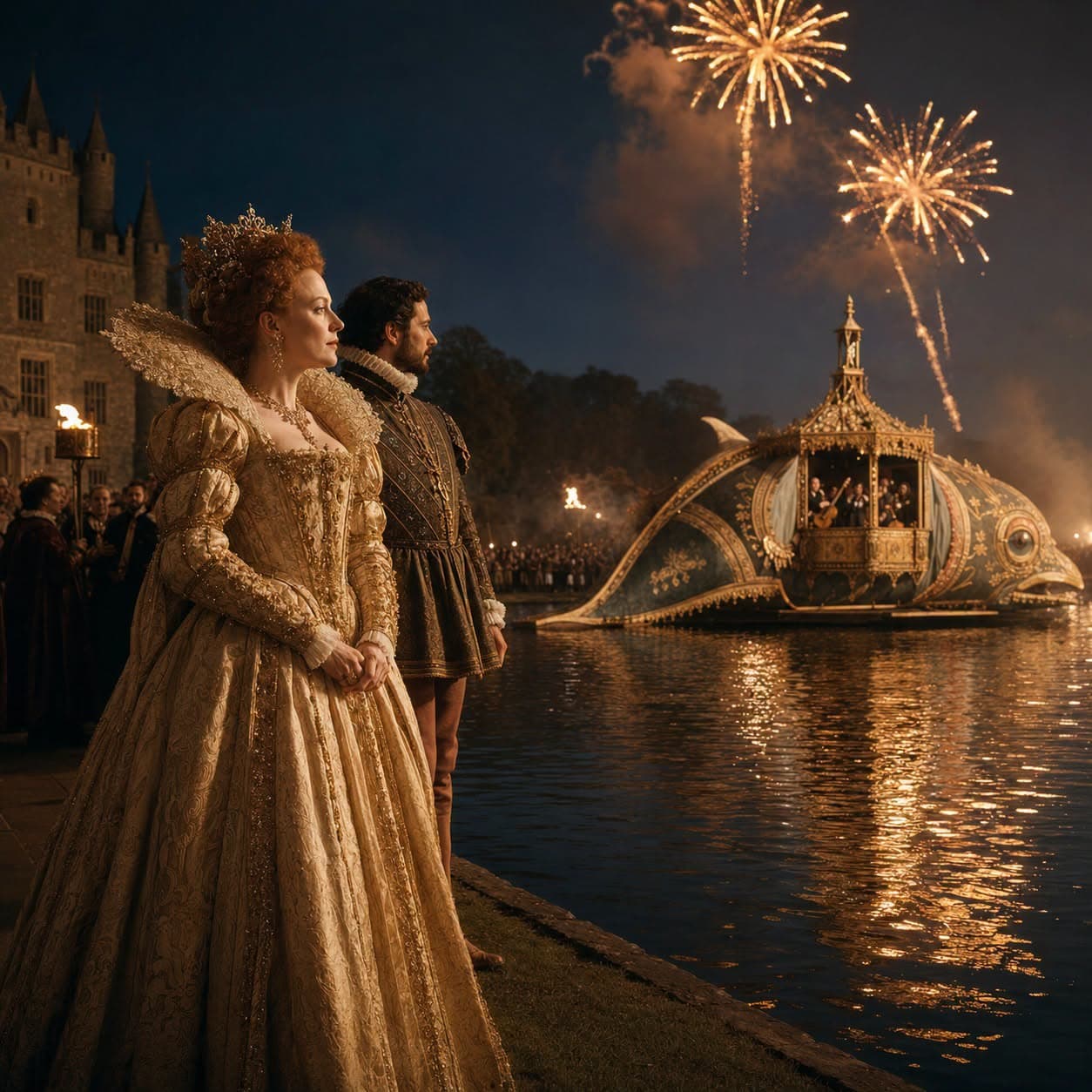
For nineteen days, that stage never stopped performing. Fireworks over the castle grounds were reportedly heard for miles. A floating Lady of the Lake greeted her arrival, gliding out across the water. A twenty-four-foot mechanical dolphin carried hidden musicians, and an enormous mermaid figure rose from the lake as part of the display. There was bear-baiting, acrobats, hunting in the deer park, music and dancing that ran late into the summer nights.
In between the spectacle, Elizabeth continued being the queen: she knighted men, received petitioners, touched the sick who came seeking a cure believed to lie in a monarch's hand. She was not simply a guest being entertained. She was a ruler conducting business inside someone else's elaborate fantasy.
The clearest sign of what all of it was for came near the end of the visit, in a masque written specifically for her. Its subject was Diana and Juno; the goddess of chastity confronted by the goddess of marriage, with a messenger arriving to urge Elizabeth away from Diana's example and toward Juno's. It was staged as the emotional peak of the entire nineteen days, the moment the entertainment finally said outright what all the fireworks and lake shows had only implied. Officially, rain stopped the performance. It was never staged again. Elizabeth left Kenilworth a few days later.
She never returned to Kenilworth after that summer. Dudley kept his place near her for years afterward, trusted, favoured, present at court in ways few men ever were. He did not get the answer the masque had been written to extract. Years later he married Lettice Knollys instead, a marriage that reportedly left Elizabeth furious when she learned of it, though not necessarily for reasons that had anything to do with wanting Dudley for herself by then.
What Kenilworth left behind was not a courtship that failed. It was a demonstration, staged at extraordinary cost, of exactly how much spectacle a queen could enjoy without ever mistaking it for an obligation.