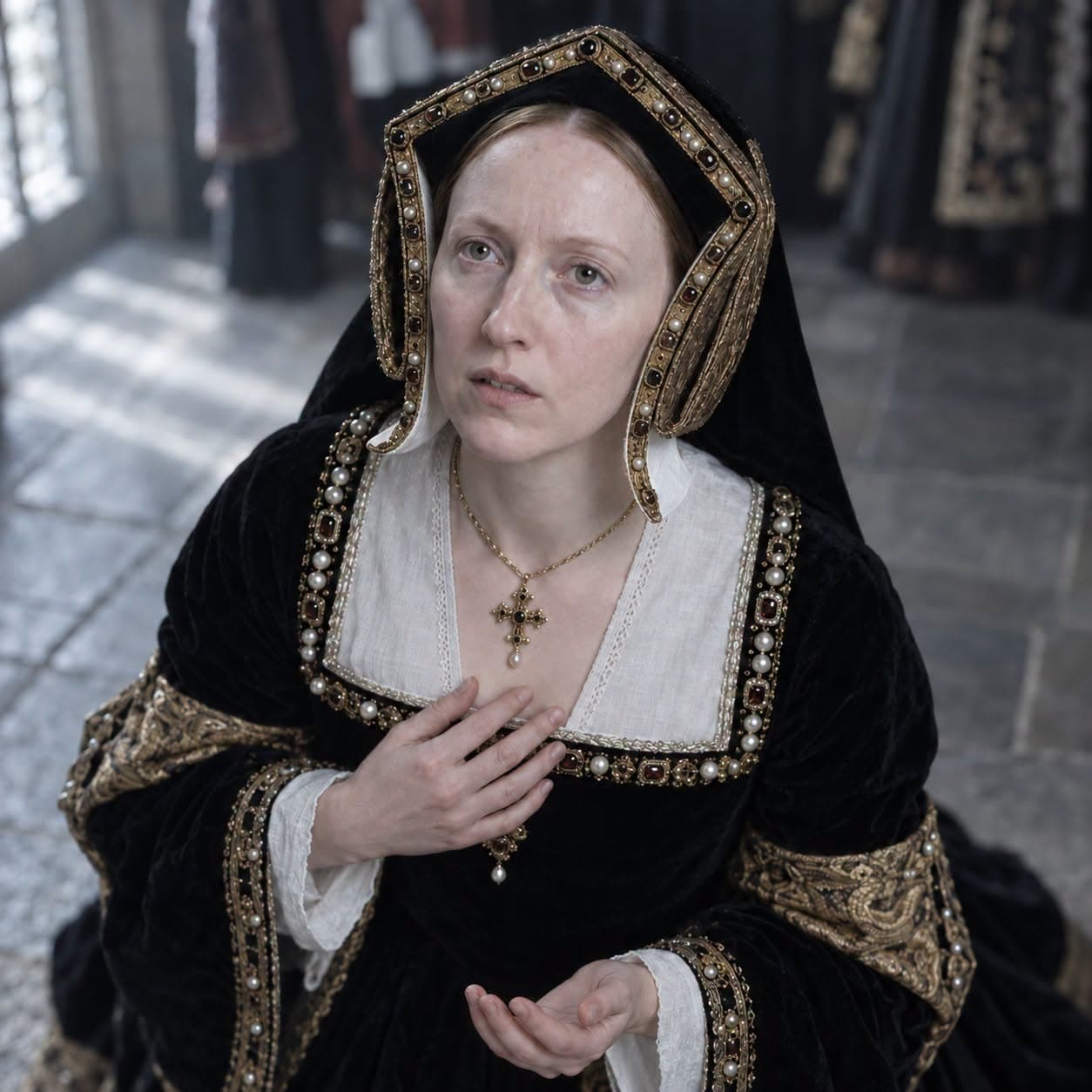
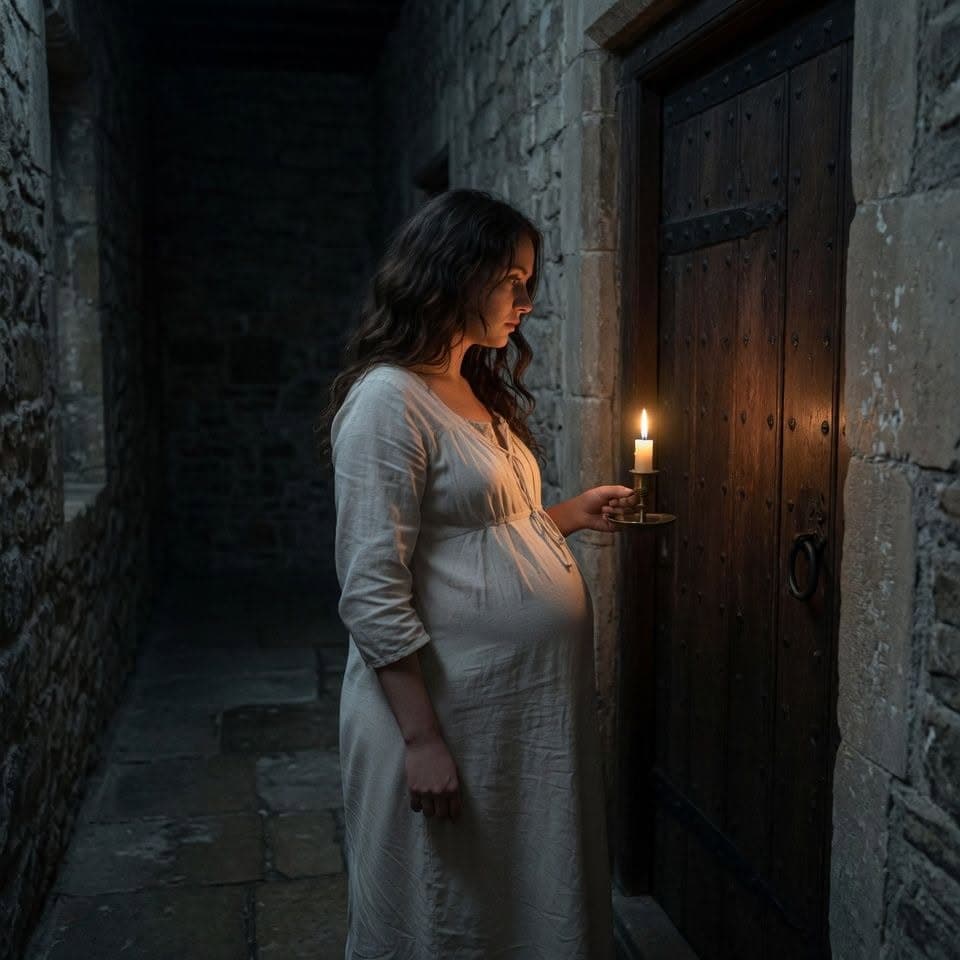
Katherine Grey was twenty years old, eight months pregnant, and standing outside Robert Dudley's bedroom in the middle of the night asking him to help her. She had a secret husband, a missing marriage certificate, and a cousin on the throne who would never forgive her for any of it. She had done nothing except fall in love at the wrong time and with the wrong man. She was trapped in the wrong body. It was a body that carried royal blood she had never asked for and could not give back.
Katherine Grey was born on the twenty-fifth of August 1540 at Bradgate Park, Leicestershire. She was the second daughter of Henry Grey, Duke of Suffolk, and Frances Brandon, who was the granddaughter of Henry VII through his younger daughter Mary. She grew up in a household that understood, with the precision of people who had spent their lives watching the Tudor court consume the careless, that her blood was the primary fact of her existence.
Her older sister Jane was educated with a rigour that produced one of the most intellectually accomplished women in England before she was fifteen. Katherine was educated with the same rigour. The books were always there. The tutors were always there. The expectation that the Grey daughters would be instruments of someone else's ambition was never stated because it never needed to be.
In 1553, when Katherine was twelve years old, her father and the Duke of Northumberland arranged the sequence of events that ended with Jane on the throne for nine days. Jane was then sent to the Tower and executed in February 1554 at sixteen or seventeen years old. Henry Grey was executed the same month. He had joined Wyatt's Rebellion four months after Mary had shown him the mercy of releasing him from the Tower. Katherine was thirteen years old when she lost her sister and her father in the same month to the same machinery of Tudor dynastic ambition that had been operating around her since she was born.
Frances Brandon, her mother, survived. Katherine and her younger sister Mary survived. They remained in the line of succession because their blood remained in the line of succession regardless of what had been done with it. Under Henry VIII's will they were, after Elizabeth, the next Protestant heirs to the English throne. This was not a privilege. It was a condition they had inherited and could not shed.
When Elizabeth came to the throne in November 1558, the dynamics of the Grey sisters' situation shifted again. Elizabeth was unmarried. Elizabeth showed no reliable intention of marrying. Katherine Grey was young, Protestant, and of undeniable royal blood. She was capable apparently of bearing children and was discussed at court as a potential heir. She was even briefly considered as a potential successor Elizabeth might adopt. None of this was Katherine's doing. She was the subject of these discussions, not a participant in them. She was twenty years old and living at court. She was being looked at the way women of her blood were always looked at. She was a piece on a board she had not chosen to play.
In late 1560 Katherine fell in love with Edward Seymour, Earl of Hertford. He was handsome, Protestant, and the son of the late Duke of Somerset who had been Protector during Edward VI's minority. Lady Jane Seymour, his sister and Katherine's close friend, introduced them. The friendship became something else. In late December 1560 they were married in a secret ceremony at Hertford's house at Cannon Row with Lady Jane Seymour as the sole witness. They did not seek Elizabeth's permission because they knew Elizabeth would not give it. They married anyway.
The sole witness died of tuberculosis in 1561. Hertford had given Katherine a document proving the marriage in the event of his death or absence, and Katherine lost it. When Elizabeth sent Hertford abroad shortly after the wedding on a convenient tour of Europe for the improvement of his education, Katherine was left in England with a secret marriage. She had a dead witness, a missing certificate, and a pregnancy she could not explain.
She concealed it for eight months. She was on progress with the royal court when she finally understood she could not conceal it any longer. She needed someone to speak for her to the Queen. She went first to Bess of Hardwick, who refused to listen and berated her for the implication. Then, in the middle of the night, she went to Robert Dudley. He was frightened. His room adjoined the Queen's chambers, and a visibly pregnant woman at his bedside was not a complication he wanted. He got rid of her as quickly as he could. The next morning he told Elizabeth everything.
Elizabeth's response was immediate and total. Katherine and the returned Hertford were both sent to the Tower. An ecclesiastical commission was convened. The Archbishop of Canterbury examined the case and found that without the witness, without the certificate, and without the officiating clergyman, the marriage could not be proven to have taken place. The identity of the clergyman was never firmly established. In 1562 the marriage was annulled. Katherine and Edward Seymour were censured as fornicators. The son Katherine had borne in the Tower, Edward, was declared illegitimate. When the Lieutenant of the Tower permitted the separated couple to meet and Katherine became pregnant again, Elizabeth's fury produced a second illegitimate son, Thomas. He was born in the Tower in February 1563 and the permanent separation of the family followed.
Katherine was removed from the Tower and shuttled between various guardians, including Sir William Petre and finally Sir Owen Hopton at Cockfield Hall in Suffolk. She died there on the twenty-sixth of January 1568, aged twenty-seven, of consumption. She never saw her husband again after the separation. She never recovered custody of her elder son. Her last recorded act was to ask Elizabeth to hold her children blameless for anything that had been done by their parents.
She had married a man she loved. She had not sought the throne. She had not plotted against the crown. She had not agitated for her own succession or encouraged the men who argued for it. John Hales had published a tract supporting her claim to the succession without her knowledge or involvement, yet Elizabeth held Katherine responsible for a pamphlet she had not commissioned and could not recall. Regarding the marriage itself, the historical consensus is that it very probably happened. The ceremony took place. The witness existed. The document existed until it was lost. The Archbishop's commission found it unprovable, which is not the same as finding it did not occur. Elizabeth used the unprovability as a mechanism rather than a conclusion.
What Elizabeth was protecting was not the law. The law was the instrument. What Elizabeth was protecting was the principle that a woman of royal blood could not make her own choices. She could not choose her husband, could not bear legitimate children, and could not exist as a private person rather than a dynastic piece without the crown's explicit permission. Katherine had made those choices and produced two sons. She had demonstrated that she was, in the precise biological sense, everything Elizabeth was not and had decided not to become. Elizabeth never named an heir. She never married. She never produced children. Katherine Grey had done all three things quietly and privately and Elizabeth had taken them all away from her one by one.
Elizabeth had watched her own mother executed on her father's orders. She had watched her stepmother Catherine Howard executed. She had watched what happened to women whose bodies became political problems. She had decided with the specific clarity of a woman who had survived everything by being ungraspable that she would never become that kind of problem herself. The decision was intelligent and it cost her nothing she was not willing to pay. What it cost Katherine Grey was seven years of custody, two sons declared bastards, a husband she was not permitted to see, and a death at twenty-seven in a borrowed house in Suffolk.
Katherine's sons were eventually declared legitimate. In 1608, forty years after her death, under James I, the marriage was confirmed as valid. The ecclesiastical commission had been wrong, or had reached the conclusion it had been arranged to reach. Edward Seymour, the elder son, lived to see his parents' marriage confirmed. Katherine did not.
She was buried first at Yoxford in Suffolk. Her body was later moved to Salisbury Cathedral, where she lies beside the husband she was not permitted to see for the last five years of her life. The marriage is carved on the tomb as the real thing. By the time the tomb was made, it was safe to say so.