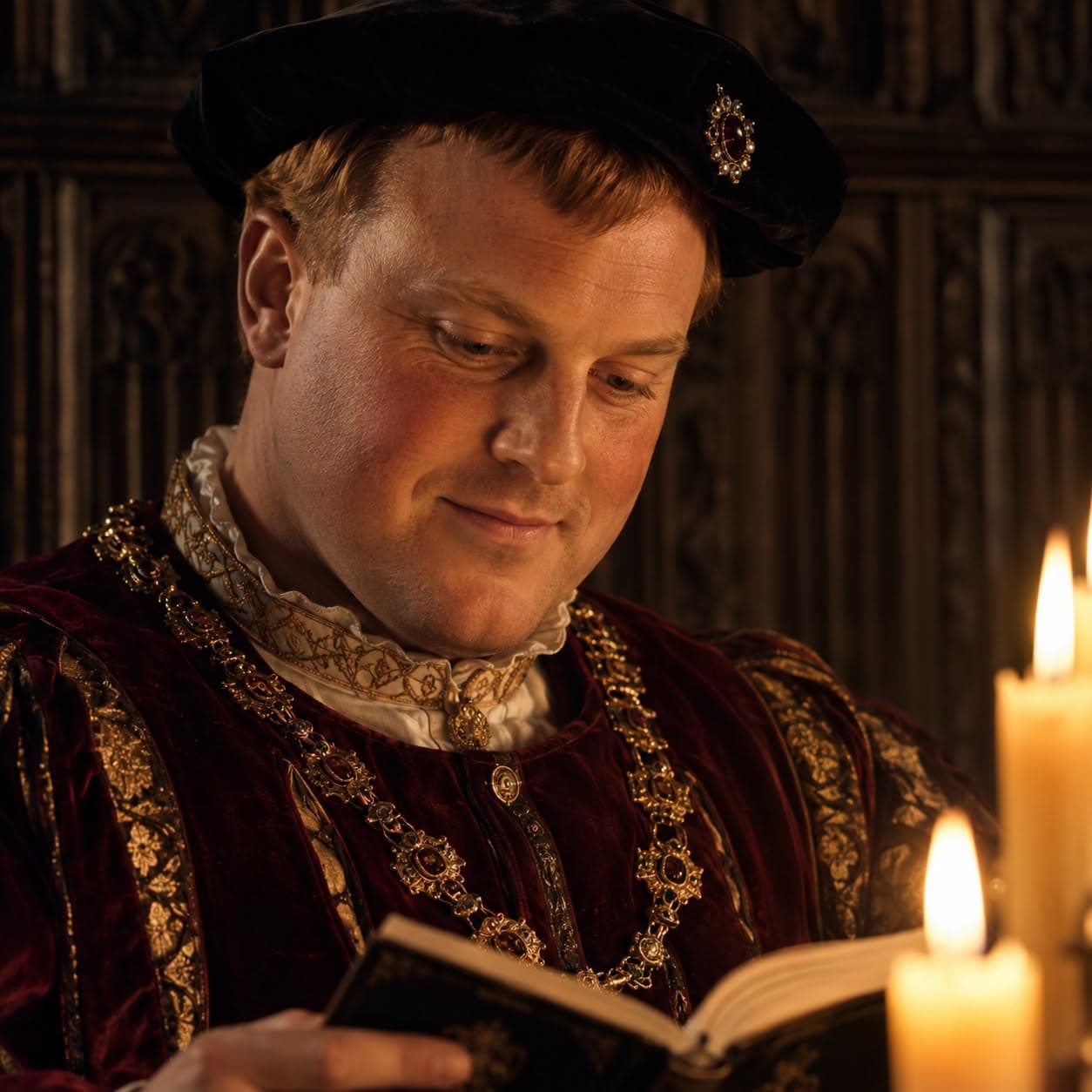
John Fisher looked at the demand then looked at it again. He put his pen down. He was the only one. Every bishop in England signed. Every single one. The most powerful churchmen in the country, men whose entire lives had been devoted to the authority of the Church, looked at what Henry was demanding and picked up their pens.
John Fisher was born in 1469 in Beverley, Yorkshire, the son of a mercer, educated at Cambridge, ordained at twenty-two, and by the time he was thirty he was the most intellectually formidable churchman in England. He became Chancellor of the University and then President of Queens' College Cambridge, a position as Chancellor he held for thirty-one years. He was confessor and chaplain to Lady Margaret Beaufort, the formidable mother of Henry VII, and it was at her direction and with her money that he refounded two Cambridge colleges, Christ's and St John's.
He preached the funeral sermons of both Margaret Beaufort and Henry VII. He was Bishop of Rochester from 1504. He was small, thin, and ascetic in a court that was none of those things, and he was the closest thing England had to the kind of scholar-churchman that the continent produced and admired. Erasmus, who did not admire many people easily, admired him. Thomas More, who was not easily impressed, considered him a man of singular holiness.
Henry VIII grew up knowing who Fisher was. Fisher had been woven into the fabric of Tudor family piety since Henry was a child. He was the confessor his grandmother had trusted with her soul and the preacher who had sent his father into the ground with dignity. This was not a political opponent who had wandered into the king's path. This was a man the king had known all his life, whose presence at court carried the specific authority of someone who had been trusted by every Tudor so far.
Henry knew exactly who he was signing the warrant for. He signed it anyway.
The break with Rome was the issue. Henry had decided, by the early 1530s, that the Pope's authority over the English Church was an inconvenience he no longer intended to tolerate, and he required his bishops to acknowledge him as Supreme Head of the Church of England. The bishops assembled, understood the situation with perfect clarity, and signed. Fisher refused.
He had been refusing, in various forms, since 1527, when the annulment proceedings against Catherine of Aragon had first begun. He had defended Catherine's marriage publicly and in print. He had told Henry, with the calm authority of a man who had been thinking seriously about theology since before Henry was born, that what he was proposing was not within the power of any secular monarch to do.
He was not defiant in the manner of a political opponent calculating the odds. He was defiant in the manner of a man who had a clear view of what was true and could not pretend otherwise, and who found the pretence more terrifying than the Tower.
He also understood what opening the door would cost. Fisher was no Protestant sympathiser. He had watched the Reformation spreading across Germany and the continent with the specific alarm of a man who understood that once the authority of Rome was broken, the question of what replaced it did not have a clean answer. He warned, repeatedly and to audiences who did not want to hear it, that removing the Pope's authority would not simply transfer that authority to the king. It would open a crack that could not be controlled, through which any reading of scripture, any doctrine, any reform could walk and claim the same legitimacy.
He was right. He would not live to see it, but within a decade of his death England was burning Protestants and Catholics in the same reign, and within a century it would fight a civil war over the question he had been executed for raising. He said what he saw coming.
Nobody listened. Nobody was required to.
He was arrested in April 1534 and sent to the Tower. He was sixty-four years old, already frail, and the Tower did the work that frailty had not yet finished. He lost weight. He was cold. His letters from inside describe a man who was not performing suffering but experiencing it with the same precise attention he had given to everything else in his life.
He waited. Henry waited. There was no urgency, and the old man in the Tower was not going anywhere, and the matter might have resolved itself through the simple operation of time and cold if the Pope had not intervened.
In May 1535, Pope Paul III appointed John Fisher a Cardinal. He was to be Cardinal Bishop of St Vitalis. The red hat was a statement of solidarity, a signal to Henry that Rome considered Fisher under papal protection, that his execution would carry consequences the English king might wish to consider. Henry's response has come down through the historical record with the clarity of a line that required no embellishment.
Fisher would have no head to wear a hat on.
The papal appointment, intended to save him, ended whatever possibility of delay remained. The man who might have been left to die quietly in the Tower of old age and cold was now a symbol that Henry needed to destroy. The Pope had handed Henry the reason he required to act immediately.
Fisher was tried on the seventeenth of June 1535 under the Treason Act, which had made it treasonous to deny the Royal Supremacy in word as well as deed. He was convicted on the testimony of Richard Rich, Solicitor General, who claimed Fisher had denied the Supremacy in a private conversation. Rich would give the same testimony against Thomas More two weeks later.
It is possible he was telling the truth in both cases. It is also possible that a man who rose through the Tudor legal machinery by being useful understood the specific usefulness of being the man who remembered things that others had not witnessed. Fisher was convicted. He was beheaded on Tower Hill on the twenty-second of June. He was sixty-five years old. His body was left on the scaffold for several hours before burial.
His head was displayed on London Bridge, where it was noted by those who saw it that it seemed, after two weeks, to grow fresher rather than more decayed, which the Catholic-minded understood as a sign and which the Protestant-minded understood as nothing at all.
The reaction across Europe was immediate and sharp. Charles V, the Holy Roman Emperor, sent word that Henry had done more damage to himself than Fisher could ever have done. Erasmus wrote of Fisher's death with a grief that the years have not flattened. The Pope was appalled. None of them did anything.
The execution of the most respected churchman in England had demonstrated, with perfect clarity, that Henry would not stop, that the machinery built for Stafford in 1521 and refined on Elizabeth Barton in 1534 would process whatever names were required of it, and that the community of Christendom that Fisher had spent his life serving could watch and grieve and write letters and nothing would change.
Thomas More watched it all from the Tower, where he had been since April. He had fourteen days left.
Henry VIII was not a Protestant. He believed in the Catholic Mass, in transubstantiation, in the structure and doctrine of the Church he had grown up in. He burned Protestants throughout his reign. What he wanted was not the Reformation. What he wanted was Catholicism without the Pope, which was a theological position that Fisher had explained at length was incoherent, and which Henry had adopted anyway because it gave him what he needed.
The door he opened did not stay the size he cut it. The reformers who came after him walked through it and kept walking, and the England that emerged from the century after Fisher's death was not the England Henry had intended or Fisher had feared but something neither of them had imagined. Fisher had been right that the crack could not be controlled. He had simply been wrong about where it would end.
He was sixty-five years old. He had spent his life in service to the Church, the university, and the family of the king who killed him. He had known Henry since the king was a boy. In the end Henry signed the warrant with the same hand he had used to write theology in his youth, the same hand that had accepted the title Defender of the Faith from a grateful Pope for a treatise defending the very authority he had just executed a bishop for refusing to abandon.
The irony was precise. History has a way of being precise about things like that.