Jessie asked to study medicine so that she could care for wounded men. The answer was no. Jessie went to Italy and cared for them anyway.
On 3 November 1867, Garibaldi's volunteers were defeated at Mentana, outside Rome, by Papal and French troops. Jessie White Mario, an Englishwoman of thirty-five, had joined the campaign as a nurse. Eleven years had passed since London refused to train her. In that time she had helped run hospitals, assisted surgeons and raised money for men whose survival required rather more than enthusiasm for a flag.
Rome was still outside the new Italian kingdom, ruled by the Pope under French protection. Garibaldi wanted to bring it into Italy. Jessie supported that cause with a commitment that had taken her a long way from the Hampshire coast where she grew up. She wrote for it, spoke for it and collected money for it. When its volunteers were wounded, she worked among them.
Her involvement began before there was an Italian kingdom to celebrate. Born at Gosport in 1832, she met Garibaldi in 1854 while travelling with an English friend. Back in England she threw herself into the movement for Italian independence. Public meetings and newspaper articles could win sympathy abroad, but she had resolved to nurse the wounded in the struggles to come, and for that she wanted proper preparation.
In 1856, aged twenty-four, Jessie applied to study medicine in London, meaning to use the training to nurse Italian volunteers. Her application met an obstacle that was obvious before anyone looked at her abilities: she was a woman.
London turned her down.
A refusal could keep her out of a lecture hall. It could not stop her going where the help was needed. The following year she was arrested in Genoa during a failed rising and spent four months in prison. Before 1857 was out she had married Alberto Mario, an Italian patriot arrested with her. In 1860 she sailed to Sicily to join Garibaldi's expedition. She tended the wounded, assisted the doctors during operations and went on to run field hospitals at Caserta and Santa Maria Capua Vetere. The woman who had asked to be taught was now keeping hospitals running.
In Palermo that July, she wrote to the members of a London committee raising money for the volunteers. Their letter had reached her among the sick and wounded, and a steamer was leaving the next day. She used the chance to explain exactly how the donations should reach her. They should go through the banker whose name she enclosed. She would send a daily account of spending, signed by Garibaldi himself, and a receipt for every payment.
There was room in a patriotic appeal for a banker's address and a promise to keep the accounts. Affection for the volunteers was useful. Getting the money to them was better.
The hospital was in a former Jesuit college, chosen by the army's chief doctor, Pietro Ripari, for its space and air. Jessie explained that British money would pay for things the wounded would otherwise go without: comforts which, in England, would be considered necessities. The distance between those two words was part of her work.
She went back in 1866, attached to Garibaldi's medical corps. A year later, during the advance on Rome, she was among his volunteers again. At the camp at Monterotondo she moved between the columns to help the wounded, putting her own life at risk, and she was writing for British and American newspapers at the same time. One volunteer remembered her as nurse, doctor and diplomat all at once. London had refused to train her as a doctor. The volunteers called her one anyway.
This campaign was no repeat of the victories in Sicily. Garibaldi had taken Monterotondo, but the hoped-for rising inside Rome failed to open the city to him. Papal resistance bought time for French troops to land. On 3 November the expedition was defeated at Mentana, and Rome stayed outside the kingdom.
For Jessie, nursing was part of the same cause as the speeches and the newspaper columns. She was openly committed to the volunteers' politics, and she was experienced in the practical work their campaigns demanded. A victory might fulfil an expedition's purpose. A defeat left wounded men too.
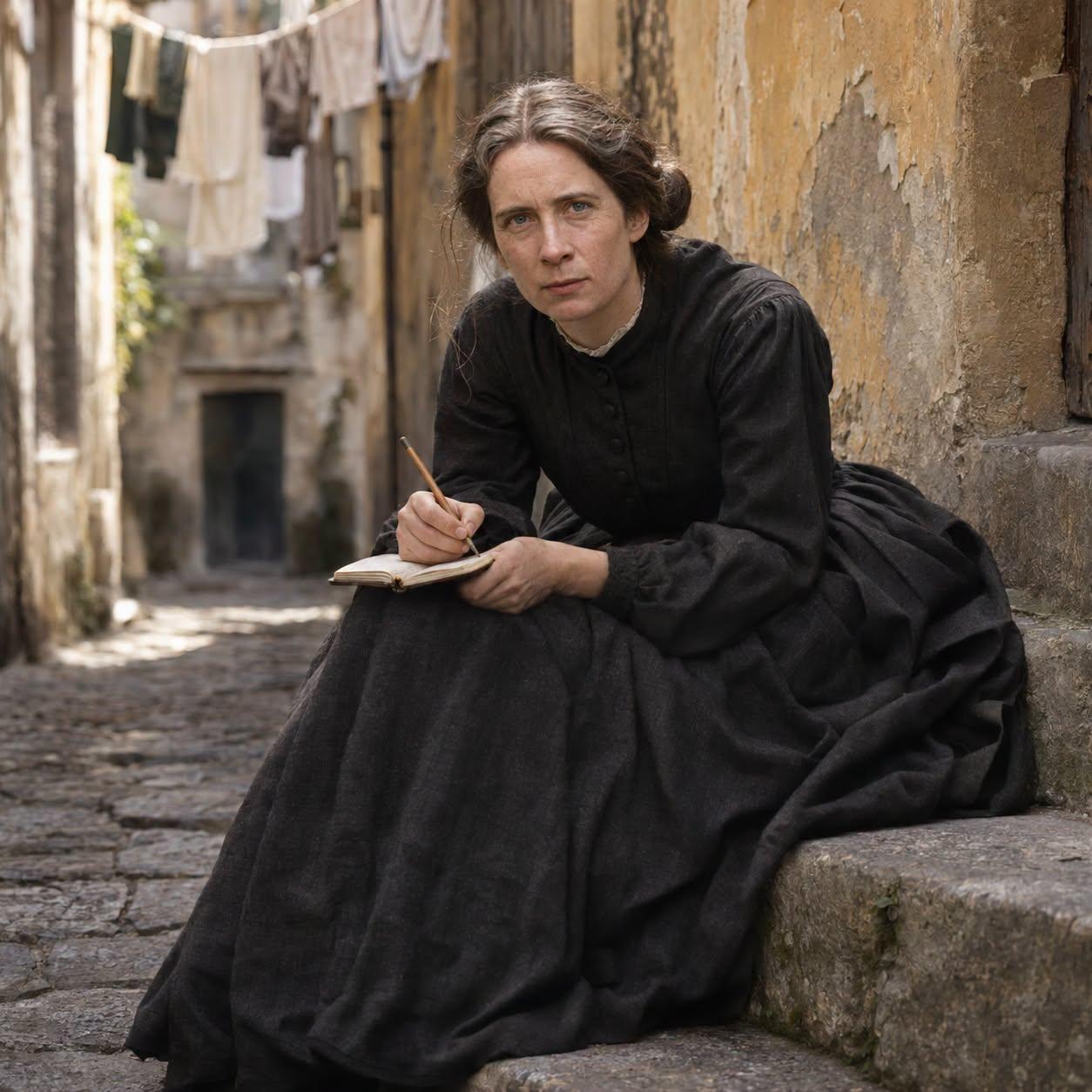
Her concern with how Italians lived didn't end with the campaigns. In Naples she went into the poorest quarters to see how people lived now that they belonged to a united country. She had helped argue for that country's existence. Its poverty was still there to be examined.
The investigation became La miseria in Napoli, published in Florence in 1877. In 1860 she had written from a hospital to explain what the wounded went without. Now she was writing down what the poor of a great city went without. Twenty-one years after London refused to teach her medicine because she was a woman, Jessie put her name to a book about the living conditions of the poor.