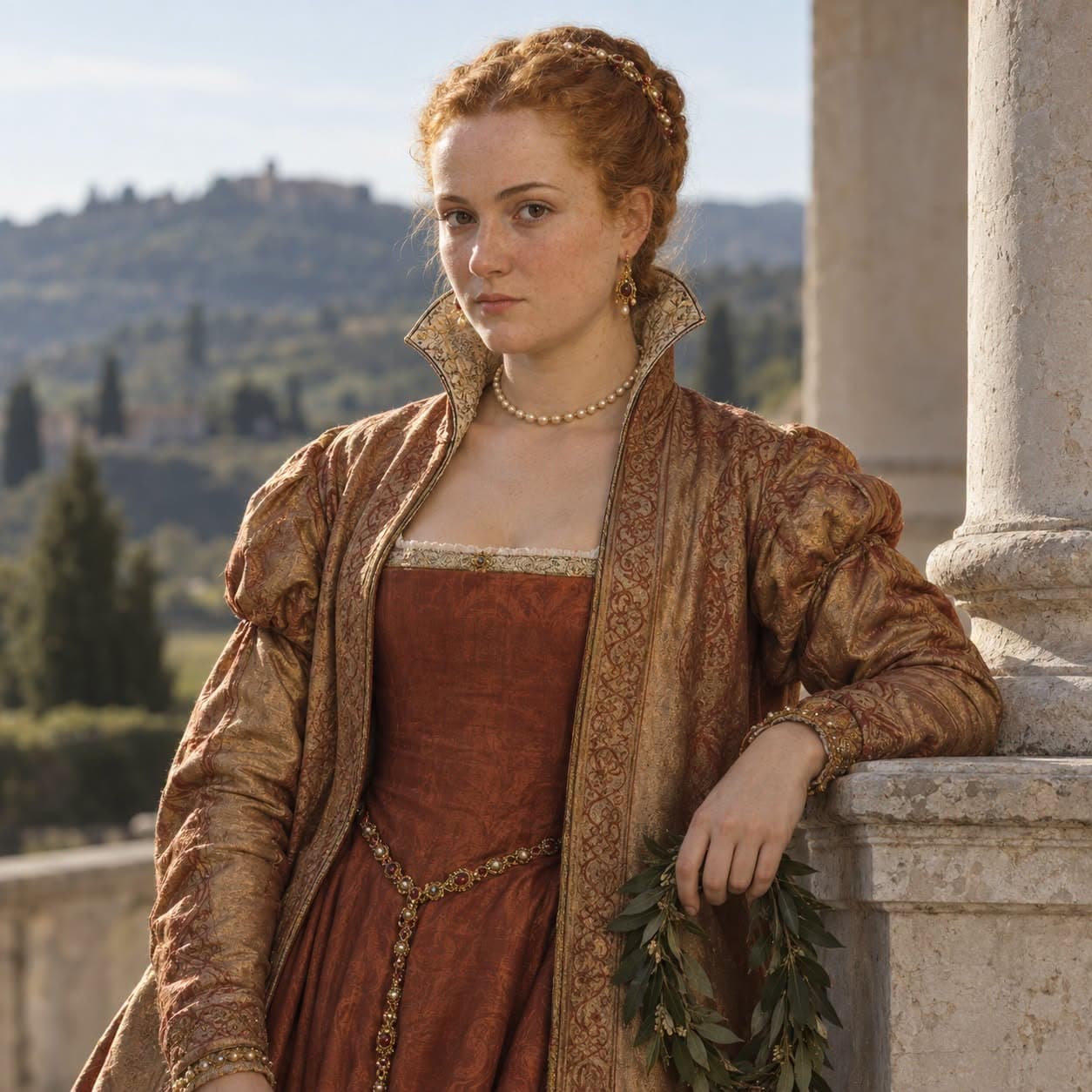
She rests one arm on a stone column, a wreath of leaves in her hand. Carved into the stone below are three Latin words. They mourn a future she did not live to have.
Irene di Spilimbergo was born on 17 October 1538 in Spilimbergo, in Friuli, into a family that could give a girl books, music and the time to learn. Her father, Adriano, belonged to the local nobility. Her mother, Giulia da Ponte, was the daughter of a Venetian patrician. Irene would grow up with access to both worlds, and with an elder sister, Emilia, who shared her education and eventually her interest in painting.
Her father died in September 1541, a month before her third birthday. After her mother remarried, responsibility for Irene's upbringing passed to her maternal grandfather, Gian Paolo da Ponte. He took the business seriously. The education he planned ran from grammar and rhetoric to music, the accomplishments by which a young noblewoman would be judged in company. There were expectations attached to the opportunities. She was being educated for the world her family occupied.
But there were books enough to take her beyond the business of behaving well in it.
She read classical writers in Italian translation, including Plutarch, and works on education and conduct. Castiglione's Book of the Courtier was a favourite, with its model of the accomplished woman who could hold her place in cultivated conversation. Irene read with a pen to hand, marking the margins and copying out passages she thought worth keeping. Plenty of noble girls were given the right books. Not all of them read with a pen.
Music also belonged to this upbringing. She learned to sing and play, and her grandfather recorded concerts in which she performed on lutes, viols and the harpsichord. The household provided an audience as well as instruction. Her accomplishments could be practised, heard and encouraged by people who had the resources to make room for them.
Emilia was part of that education. When the sisters took up drawing and painting, neither had to begin alone. Their grandfather celebrated their progress, including the admiration it drew from Titian. His pride embraced both girls. The two portraits through which they are now best known preserve that pairing.
By then Irene was living in Venice, where she settled for good in 1554. Titian was already connected with the family, having painted her grandfather and her mother. An interest in painting could be encouraged here by people who knew painters, and who already valued the arts enough to pay for them. Painting grew out of her education. It was something she did, alongside reading and music, while she still had time to discover how far she could take it.
The portraits show the sisters richly dressed and jewelled. Irene stands beside her column, holding her wreath, with a white unicorn resting on a hill in the landscape behind her. Emilia is posed by a window, beyond which a ship struggles on a troubled sea. The pictures were probably begun with marriages in mind. They present two young women of rank, ready to be looked at. Yet the young women in them had also been learning how to make images themselves.
Late in 1559 Irene fell gravely ill. Her grandfather recorded twenty-two days of illness and a fierce fever. She died in Venice in December, aged twenty-one.
The people around her then undertook a different kind of work.
In 1561 a memorial volume appeared containing nearly four hundred poems in Italian and Latin, by more than a hundred and forty poets. Among them were Torquato Tasso and Lodovico Dolce. A biography accompanied the verse. Irene's beauty, virtue and accomplishments supplied the subjects; her death supplied the occasion. The young woman who had read with a pen in her hand was now being written about. There was room in the book for a great many voices.
Hers was not among them.
The effort preserved her name with remarkable success. It also left an uneven inheritance. We can still read the poems composed in her honour. Finding the work she made is another matter.
Three small religious paintings were once attributed to her: Noah's Ark, the Flood and the Flight into Egypt. They were last recorded in a family palace at Maniago, and they have since disappeared. She wrote verse of her own, and none of it has survived. We have the subjects of pictures, the memory of music, the accounts of a young woman learning and practising. We do not have a securely identified collection of her paintings to put beside the praise.
Emilia lived on, and married in 1561, the year the memorial book appeared. Her portrait and Irene's remained together in the family for centuries. In the pictures they are still two richly dressed young women, each occupying her own canvas, each given the space and dignity of a formal portrait. One went on into a life beyond it. The other's image became a memorial.
The portrait still preserves her face, her jewels and the wreath in her hand. Carved into the column below are the words SI FATA TVLISSENT: "If the fates had allowed."