They killed her while Pedro was away. They made sure of that.
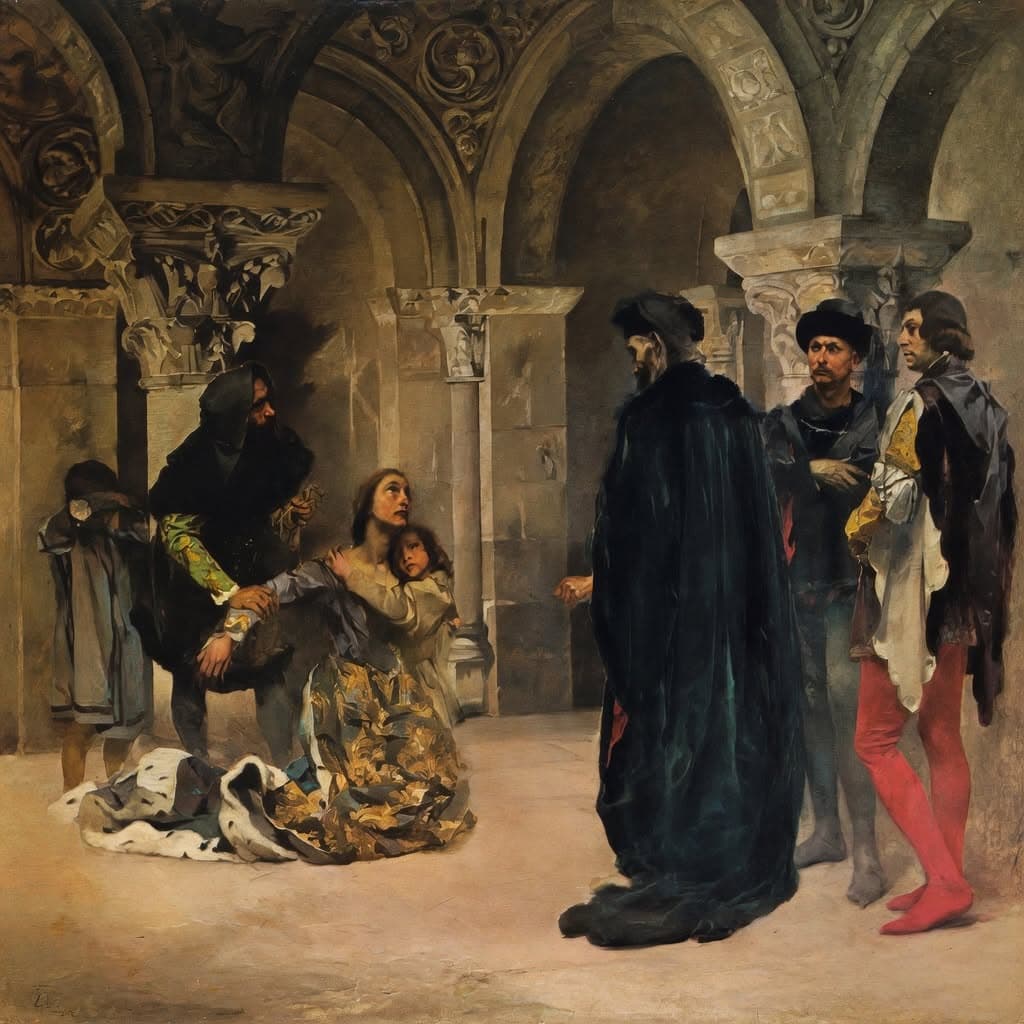
Three men rode to the Monastery of Santa Clara in Coimbra on 7 January 1355. They had come from the king. They found Inês de Castro where she lived, with her children around her. They killed her there. A single blow to the throat. In front of her children.
Then they rode back and told the king it was done.
This is the story of Inês de Castro. A Galician noblewoman. Thirty-two years old. Killed not because she had committed a crime, not because a court had found her guilty of anything, but because the most powerful men in Portugal had looked at her and decided that her continued existence was politically inconvenient.
They had no idea what they had just set in motion.
Inês was born around 1325 in Galicia. She was the illegitimate daughter of a Galician nobleman. She came to Portugal as a lady-in-waiting to the Infanta Constança, who was to marry Prince Pedro, heir to the Portuguese throne. Pedro fell in love not with his bride but with her companion. When Constança died in 1345, Pedro and Inês made no secret of what they were to each other. They lived together in Coimbra. They had four children. By most accounts, though it could never be publicly confirmed, they married in secret.
King Afonso IV watched all of this with growing unease.
The concern was not moral. It was political. Inês's brothers were Galician nobles with powerful Castilian connections. If she became Pedro's recognised consort, if their children were legitimised, the future king of Portugal would be surrounded by her family's influence. The advisors pressed. The king listened. The calculation was made.
In January 1355, Afonso sent three men to Coimbra.
Their names were recorded. Álvaro Gonçalves. Pero Coelho. Diogo Lopes Pacheco. Three men who looked at a woman living quietly with her children and put a blade to her throat because a king asked them to.
She was thirty-two years old.
Pedro was hunting when it happened. He returned to find her dead. What he felt in that moment, the chronicles do not record with any precision. What they record is what he did next.
He attempted to raise a rebellion against his own father. It failed. A truce was brokered. Pedro outwardly reconciled with Afonso. He waited.
Afonso IV died in 1357. Pedro became king.
He waited a little longer.
Then he found two of the three men who had killed her.
Álvaro Gonçalves and Pero Coelho were extradited from Castile, where they had fled. Pedro had them publicly executed in the plaza at Santarém. He had their hearts removed from their bodies. One from the chest, one from the back. He watched. The third man, Diogo Lopes Pacheco, escaped to Castile and was the only one who avoided what was coming.
But Pedro was not finished.
He declared publicly, before witnesses and under oath, that he and Inês had been secretly married before her death. The Church accepted the declaration. Inês de Castro was declared, posthumously, Queen of Portugal.
Then Pedro had her body exhumed.
She had been dead for two years. He dressed her in royal robes. He placed a crown on what remained of her. A procession was assembled. By some accounts a thousand men carrying candles through the night. Her body was carried the full length of Portugal, from Coimbra south to the Monastery of Alcobaça, where the kings of Portugal were buried.
Every town along the route came out to witness it. A dead queen, carried by candlelight, through the winter dark of medieval Portugal.
Some chronicles say that at the ceremony, Pedro required the court to kneel and kiss the hand of their dead queen. That every nobleman in Portugal was made to pay homage to the woman they had allowed to be murdered. History cannot confirm this with certainty. The story has been told for six hundred years. Make of that what you will.
At Alcobaça, Pedro commissioned two tombs. They stand there still. They are among the most beautiful Gothic sculptures in Europe. On one lies Inês, carved in white limestone, her face composed, surrounded by angels. On the other lies Pedro.
They are positioned foot to foot.
Pedro said that he did this so that on the day of resurrection, the first thing each of them sees when they rise will be the other's face.
She was thirty-two years old when they killed her. A woman whose only offence was being loved by the wrong man at the wrong moment in the wrong political climate. No trial. No charge. No mechanism of law even reached for her. Three men on horses and a king's decision and it was done.
The men who killed her had their hearts torn out in a public square.
The king who ordered it died in his bed and is buried with honour.
The body of the woman they had murdered was exhumed, crowned and became a queen posthumously.
Her name was Inês de Castro. Six hundred years later, her tomb still draws people who stand in front of it in silence and cannot quite explain why.