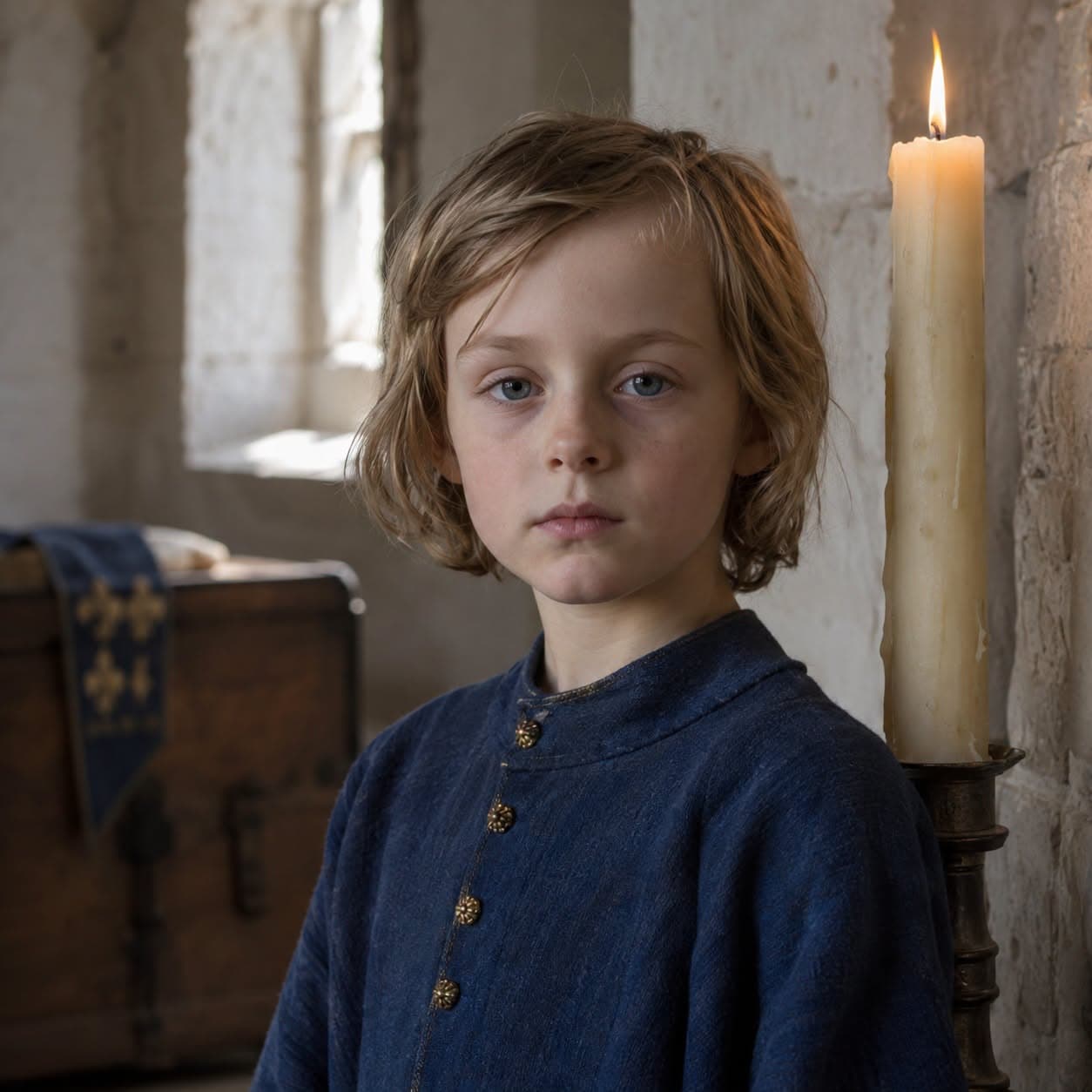
The little boy at Guildford had a nurse, a toy cart and a claim to England's throne. His grandmother could provide for almost everything except the years he needed to reach it.
Henry, the eldest surviving son of Edward I and Eleanor of Castile, died at Guildford on 16 October 1274. He was six. For much of his short life his parents had been abroad, and the grandmother who helped bring him up was Eleanor of Provence, widow of Henry III and mother of the new king.
There were two Queen Eleanors in his family. One had followed her husband overseas. The other had stayed in England, where there were grandchildren to look after. A death had already changed Henry's place in the succession. His elder brother John died in 1271. When their grandfather Henry III died the following year, Edward became king and Henry became his heir, while Edward was still far from home.
The crown had passed to a man abroad. Its future now rested on a little boy in England.
Henry lived with his sister Eleanor and their cousin John of Brittany, another of the older queen's grandchildren. Each had a nurse. Henry's was Amicia de Derneforde, and the household also employed a woman whose job was to rock the children. There were cooks, a tailor, an usher and a washerwoman, with clerks to keep track of what everyone cost. From the autumn of 1273 the children lived with their grandmother.
Eleanor had been a queen for thirty-six years before she became a widow, and nursing a sick child was nothing new to her. In 1246, when the young Edward fell seriously ill at Beaulieu Abbey, she stayed with him there until he was fit to travel. Now it was Edward's son who needed tending. The household around Henry was an expensive one, but much of the money went on things any grandmother would recognise: linen for his shirts, shoes and slippers, towels for his hands and feet.
His clothes and those of his sister and cousin were cut on much the same lines. They had caps of peacock feathers and fine gloves, and gilded buttons were bought for their garments. Henry received a brooch from the Archbishop of Canterbury, which was soon broken. Someone gave him trumpets. Someone else sent pink sugar. A little cart was bought for him to play with.
He was being prepared to inherit a kingdom, but there was still a broken brooch to be dealt with.
He was a delicate child, and his health brought other errands. Candles were made to his measure, each the height of the boy himself, and carried to saints' shrines to ask for his recovery. Widows were paid to keep watch in prayer for him. His grandmother's household could pay for medicine and devotion alike.
In the summer of 1274 his parents came back to England after four years away. Henry and the other children were taken to Canterbury to meet them. In August clothes were sewn and shoes bought for Edward and Eleanor's coronation at Westminster Abbey. Henry was there for the ceremony that crowned the father he was expected to succeed.
By September he was ill at Guildford.
Sugar remedies and other medicines were bought for him. Servants were sent into the countryside around Guildford to look for herbs. For more than a month the household tried every remedy it could think of for a child who was not getting better. Once again widows were paid to watch in prayer for him, thirteen of them.
During his illness his mother sent him a white palfrey, a riding horse of his own. He did not live to ride it.
Then the accounts changed. Linen and wax were bought, and a bier, and cords. He was taken from Guildford to Westminster, and the same household that had paid for his shoes now paid to carry him there.
Henry was buried in the Abbey where his parents had been crowned two months earlier. His younger brother Alfonso took his place as heir. The succession had another son to put forward, but the arrangements for Henry did not end when his name stopped standing first.
Eleanor of Provence had paid for his shirts, his candles and the widows who prayed for him. At Guildford she became patron of a new house of Dominican friars, and it was there that Henry's heart was buried. His body lay among his royal kin at Westminster. His heart stayed in the town where his grandmother had kept him, and every year, as the anniversary of his death came round, the friars set it out in solemn display once more.