He lived for fifty-two days. In those fifty-two days he was the most important person in England. Everything that came after him was the consequence of his absence.
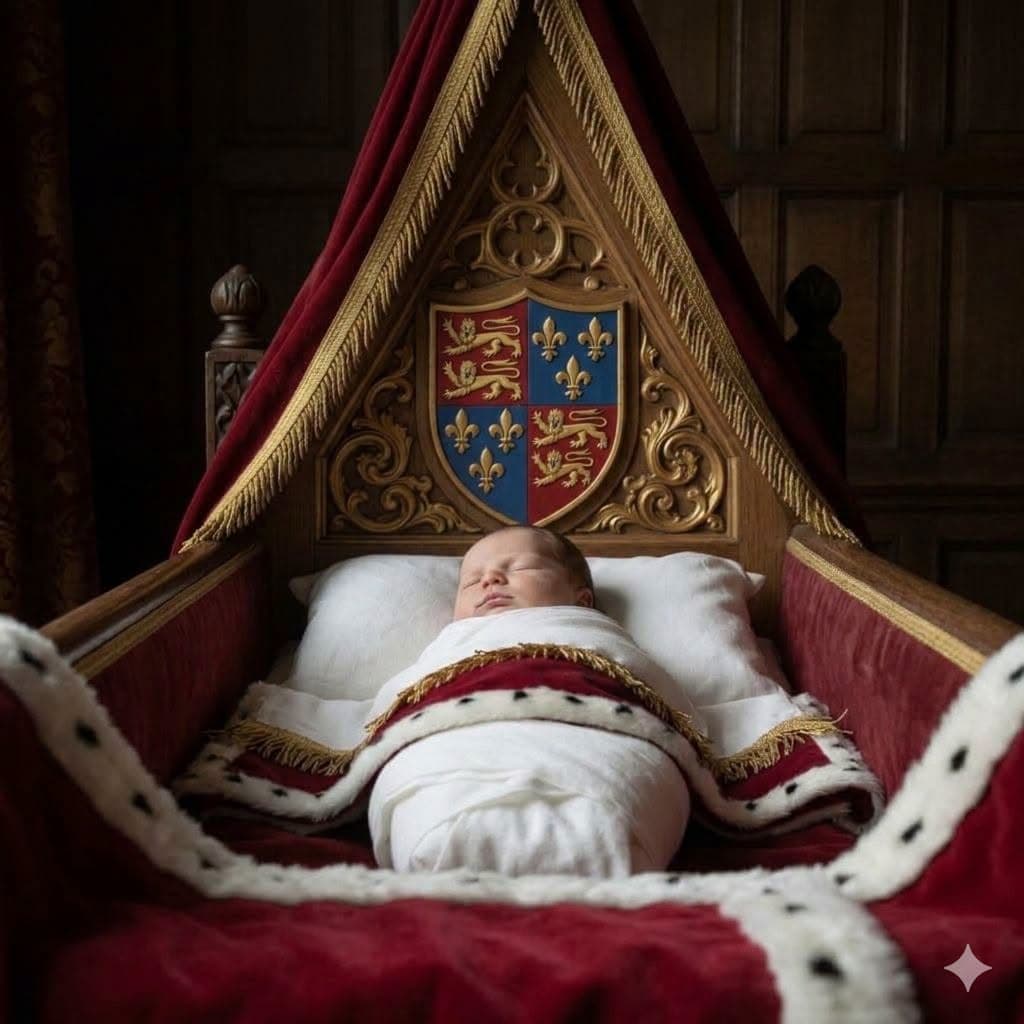
Henry, Duke of Cornwall, was born on the first of January 1511 at Richmond Palace, the first surviving son of Henry VIII and Catherine of Aragon, and the court received the news with the specific hysteria of people who had been waiting for something so long that its arrival felt like a miracle.
Bonfires were lit across London. The Tower guns fired. The streets filled with people who had no particular reason to celebrate the private dynastic business of their king and celebrated anyway, because a male heir meant continuity and continuity meant that the particular violence of the previous century, the wars and the reversals and the attainders and the heads on poles, was over.
He was given the title Duke of Cornwall, which is the title given to the heir apparent of England. He had been alive for one day.
Henry VIII was nineteen years old, newly married, newly crowned, at the peak of his physical beauty, and he held his son in his arms and understood for the first time what all of it was for. The tournaments and the music and the languages and the theology and the magnificent performance of Renaissance kingship were the frame. This was the painting.
A living son, legitimate, undeniable, carrying the Tudor name into the future that his grandfather had purchased at Bosworth for the cost of other men's blood. He held the boy and the court watched him hold the boy and the court understood that this was the version of Henry VIII that England had been promised. Strong. Secure. Generous. A king who had everything he needed and therefore had no reason to take anything from anyone.
The boy died on the twenty-second of February 1511. He was fifty-two days old. The cause is not recorded with any precision that survives. He was there and then he was not there, and the court fell silent with the specific silence of people who do not yet understand what the silence means.
What it meant was everything.
If Henry, Duke of Cornwall, had survived infancy and grown into the prince his father needed him to be, the question that consumed the next thirty-six years of English history simply does not arise. There is no need to set Catherine of Aragon aside. There is no need to petition Rome for an annulment. There is no break with the Church. Wolsey does not fall. Thomas More does not have to choose between his conscience and his king, and therefore does not lose his head in the summer of 1535.
Anne Boleyn remains a clever woman at a glittering court, marries appropriately, raises children who are not the children of a king, and dies in her bed. George Boleyn lives. The men executed on Tower Hill in the week before Anne Boleyn's death live. Thomas Cromwell, who rose entirely on the wreckage of Wolsey and the machinery of the break with Rome, never becomes the man he became, and therefore does not die on Tower Hill in 1540 with the headsman making a mess of it.
Katherine Howard, a girl of sixteen placed in a king's path by a family desperate for influence, is never placed in anyone's path at all, because the king has a son and the king has no vacancy and the Howard family has no opening to exploit. She lives. She grows old in Norfolk and nobody writes her name down.
Margaret Pole, who was sixty-seven years old and took eleven blows to die, is not executed because the climate that produced her execution, the paranoid last decade of a king who has no legitimate male heir and suspects conspiracy in every corner, does not exist.
Edward Stafford, Duke of Buckingham, might still have died, because the specific anxiety that drove Henry to remove men of royal blood did not require the absence of a son to operate. But it might have been containable. A king with a living heir is a different kind of frightened from a king without one.
The question of whether Henry VIII would have been a better man is harder. The capacity for the things he did was always in him. The vanity, the cruelty, the specific solipsism of a man who had been told since childhood that his desires were the measure of the world. A living son would not have removed those qualities. It would have removed the justification they needed to become policy. The difference between Henry VIII with a male heir and Henry VIII without one is not the difference between a good man and a bad man. It is the difference between a bad man with nowhere to aim and a bad man with a target.
He was fifty-two days old. He never spoke. He never learned his father's name. He never stood at a window and looked out at England and understood that it was his. He never had to become anything. He never had to disappoint anyone. In the long and violent history of the Tudor dynasty, crowded with people who were used and discarded and executed and forgotten, Henry, Duke of Cornwall, is the only one who never paid a price.
His death was also, in the end, was perhaps the one death that cost everyone else the most.