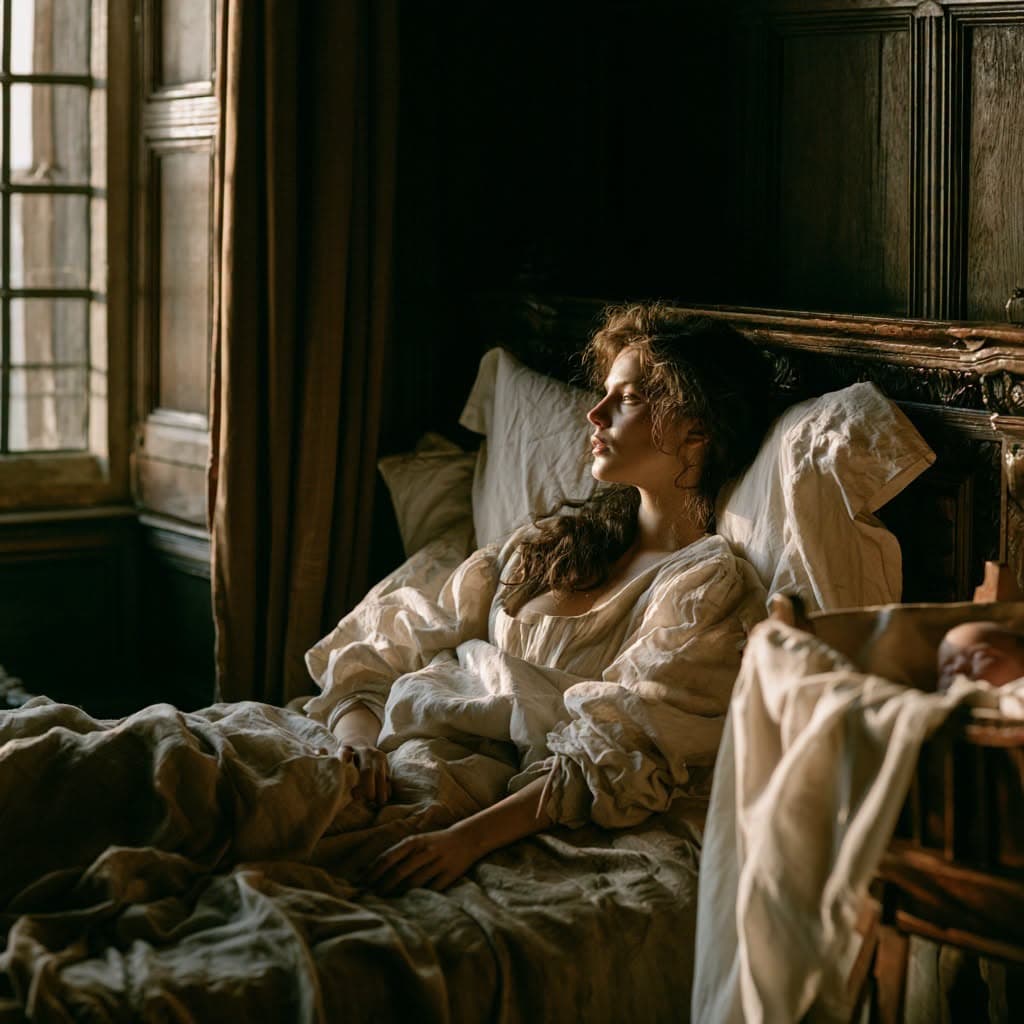
She was still in bed when the north fell. Her daughter was barely two weeks old and she had not seen her husband for seventy-five days. She had no idea she would never see him again.
Henrietta Maria had given birth sixteen days earlier at Bedford House in Exeter, to a daughter she named for herself, and she had not yet found the strength to travel. The city around her was already surrounded. Parliamentarian forces under the Earl of Essex had closed in on Exeter through the spring, and the queen of England was lying in confinement inside a besieged town, two hundred miles from a husband who was fighting a war she could no longer help him win. She did not know, on the second of July, that the war had effectively ended that afternoon on a moor outside York.
The armies had gathered through the day without fighting. Prince Rupert had relieved York and joined his forces to the Marquess of Newcastle's northern army, together numbering some eighteen thousand men, and they faced a combined Parliamentarian and Scottish Covenanter force of nearly thirty thousand on the open ground of Marston Moor. The two sides watched each other across the fields through the afternoon. By early evening Rupert believed the day's fighting was done and had gone to eat. It was then, at around seven in the evening, with a thunderstorm breaking over the moor, that the Parliamentarian and Scottish infantry advanced.
The fighting lasted perhaps two hours. On the Royalist right, Rupert's cavalry broke and scattered under a countercharge from Oliver Cromwell's disciplined horse. On the left, the Royalist cavalry collapsed even faster. Only the infantry held, and among them the Marquess of Newcastle's regiment of Whitecoats, so named for the plain undyed coats they wore into battle because their commander had run out of money to dye them, stood their ground in a walled enclosure called White Syke Close and refused to surrender. They were killed almost to a man.
By the time the light failed, some four thousand Royalist soldiers lay dead on the field and fifteen hundred more had been taken prisoner. The Parliamentarian side lost fewer than three hundred. It was the largest battle of the entire English Civil War, and it was over before most of the men on either side had understood what was happening to them.
York surrendered within two weeks. The whole of the north, which had been the foundation of Charles's military strength and his surest source of men and money, was gone. Rupert gathered the remnant of his cavalry, some six thousand men, and rode south, away from the disaster he could not undo. The King's war, which had seemed uncertain but not yet lost, had lost its foundation in a single evening.
In Exeter, Henrietta Maria was still weak from childbirth when the news began to travel south. She had spent the war raising money and arms for her husband's cause, crossing the Channel the previous year with a shipment of weapons and gunpowder that she personally delivered to the Royalist army, riding through danger she did not have to face. She had done everything a queen consort could do for a losing cause. Now she could not even sit up for long periods, and the city around her was tightening under siege, and the north her husband needed was already lost before the messengers reached her with the details.
She left her infant daughter behind in Exeter and sailed for France within weeks, in July 1644, aboard a ship that came under fire from Parliamentarian vessels as it left the English coast. She would not see that child again for two years. She would never see her husband again at all.
Charles Stuart fought on for nearly two more years after Marston Moor, losing ground steadily until his final surrender in 1646. He was tried and executed outside the Banqueting House at Whitehall on 30 January 1649. Henrietta Maria was in France when it happened, still waiting, as she had been waiting since the summer of 1644, for a version of the war that no longer existed.
The battle at Marston Moor took two hours. The marriage it ended took five more years to finish.