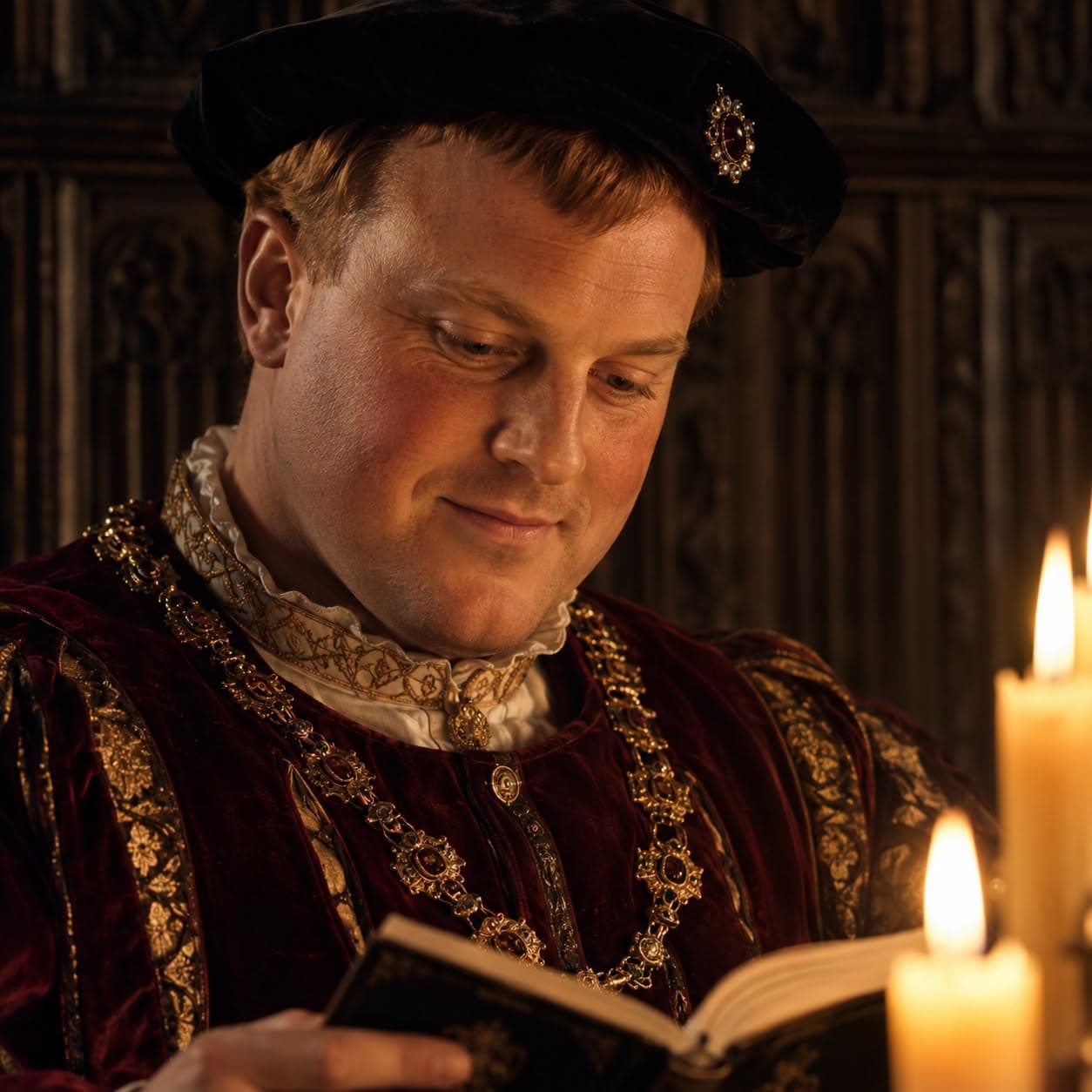

He was a poet, a diplomat, and the most trusted male voice in his sister's court. Henry VIII sent him to France to negotiate with kings.
Three months after his sister was arrested, he stood in a courtroom and read aloud the one sentence that guaranteed he would not leave it alive. Whether that was defiance or despair or something that has no clean name is the question the evidence has never answered.
George Boleyn was born around 1503 or 1504, the youngest son of Sir Thomas Boleyn and Elizabeth Howard. His father was one of the most relentlessly ambitious men in England, a diplomat who had served Henry VII and attached himself to Henry VIII with the specific skill of a man who understood that royal favour was a currency and spent it carefully. His mother was the daughter of the Duke of Norfolk, which made George nephew to the most powerful nobleman in the country. He grew up in a family that had been playing the court game at the highest level for two generations, and the education that environment produced was not simply academic. It was a precise and early understanding of how proximity to power worked, what it cost, and what happened when it was withdrawn.
He was educated for the court rather than for the battlefield, which was unusual in a period when military reputation was the most durable foundation a young nobleman could build. George spoke French fluently. He wrote verse. He played music. He moved through court circles on intelligence and charm rather than on campaign record, which made him quick and visible and valuable in ways a soldier could not be.
He appears in the court records from 1522 onward, already attached to the household alongside his father. By the mid-1520s he was present at court functions, visible in the orbit of Henry VIII, a young man being positioned by a father who had spent twenty years learning how the machinery worked. He was married in 1524 to Jane Parker, the daughter of Henry Parker, Lord Morley, an arrangement made between two families calculating the mutual benefit of an alliance. George was approximately twenty years old. Jane was of similar age. The marriage produced no children. No love letters between them survive. No contemporary account describes warmth between them. Two people placed in a room together by their families and left to make what they could of it, which appears to have been very little.
His career accelerated as his sister's position at court rose. Anne Boleyn had returned from France in 1522 and by the late 1520s had become the consuming preoccupation of Henry VIII, the woman the king was dismantling the religious settlement of England to marry. George's advancement and Anne's were not separate events. They were the same event. In 1529 he was made a Knight of the Bath. In 1530 he was sent to France as Henry's personal envoy, carrying the king's arguments for the annulment to Francis I. In 1532 he was elevated to Viscount Rochford. In 1533, the year Anne was crowned queen, he was dispatched to France again, this time to deliver the news of the marriage formally and to secure French support for the new religious settlement. Henry VIII was sending his queen's brother to argue his case before the most powerful monarch in Europe. George was thirty years old and the court had given him everything it had to offer a man of his background.
He translated reformist texts from French into English. He used his position to support reformist preachers and to circulate literature that the conservative faction at court found threatening. He was publicly visible in his theological convictions at the centre of power, which made him enemies among exactly the people who would, within a few years, be assembling the case against his sister.
The arrests came in May 1536. Anne was taken to the Tower on the second. George was taken four days later. The charge against him was incest with his own sister. He was tried on the fifteenth of May 1536 before a panel of peers that included his own father.
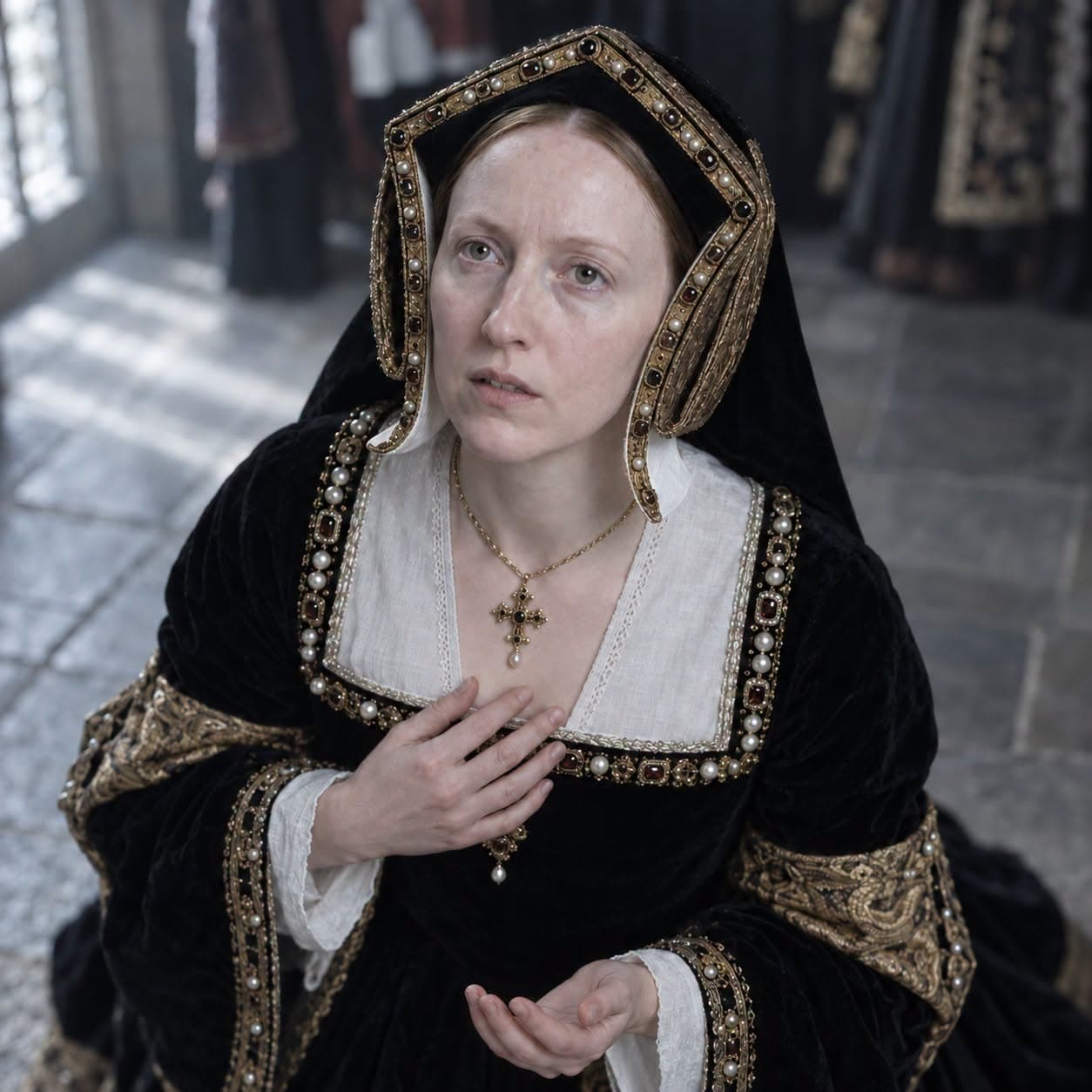
The testimony that formed the core of the case against him had come, at least in part, from Jane Parker. She was brought in for questioning in the weeks following the arrests. She was a woman attached to a family whose fall was already in motion, being questioned by men who needed evidence and who held her future entirely in their hands. She had no legal representation. She had no independent standing. The specific content of what she told them, and whether the words she gave them were hers or ones she had been steered toward, was not recorded in any form that survives. What is recorded is that her testimony was used. What the record cannot answer is what she believed would happen to her if she refused.
During the trial the judges passed George a folded piece of paper. It contained a statement he was instructed to read silently to himself and answer yes or no. The statement described something Anne had allegedly said to Jane Parker about Henry VIII's sexual performance. Reading it aloud would constitute the final confirmation of the charges against him. It would remove any remaining possibility of acquittal. George Boleyn read it aloud to the open court.
The room understood what he had done. The imperial ambassador Eustace Chapuys, who was present, recorded that the crowd shifted when he read it, that the moment was visible in the faces around him. Some historians have read the act as defiance, a man using his last public platform to humiliate the king who was killing him. Some have read it as loyalty to Anne, an attempt to discredit the charges by demonstrating their absurdity in open court. Some have read it as the act of a man who had looked at the evidence assembled against him and understood that the verdict was already written, and who chose how he conducted himself inside a proceeding whose outcome he could not alter. The court found him guilty. He was executed on Tower Hill on the seventeenth of May 1536, two days before his sister.
He was approximately thirty-two years old. He had been at the height of his career eighteen months earlier. He left behind no children, a wife who outlived him by five years before her own execution under a different charge, and a body of verse that survived him in manuscript circulation for decades. The charge against him has been rejected by most serious historians as a fabrication assembled to make Anne's conviction easier to secure and more complete in its devastation.
Whether Jane Parker gave her testimony freely or under a pressure that left her no alternative is the question she took with her when she died on the block in 1542, convicted for her role in the affairs of Catherine Howard.
Nobody asked her.