His face was on every coin in France. Their plan relied on nobody knowing what they looked like.
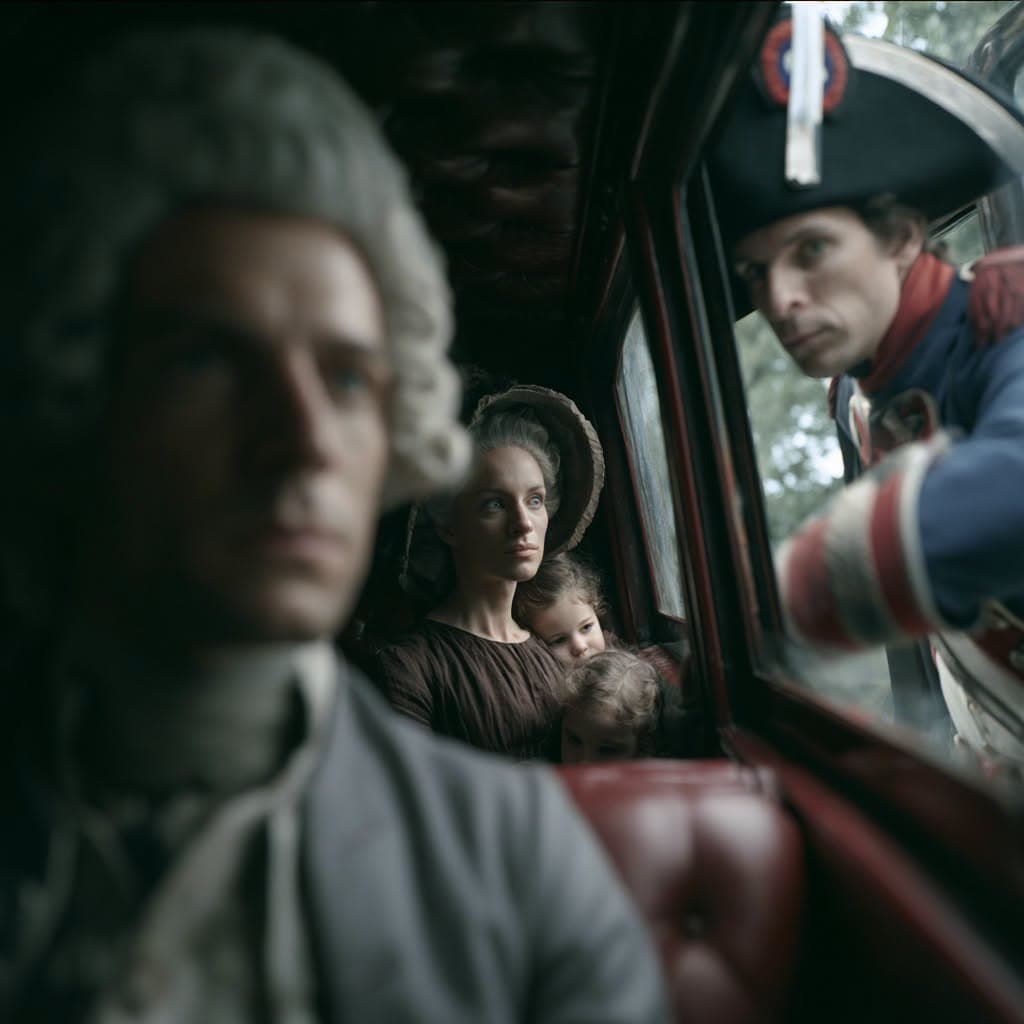
On the night of 20 June 1791 Marie Antoinette put on a plain dress and called herself Madame Rochet. The title was false. The rank was false. The journey was not. For seventy-two hours the whole plan rested on a chain of borrowed identities held together by a passport made out for the Baroness de Korff, with Madame de Tourzel, the real governess, standing in for the lady of the house, Louis XVI disguised as a servant, and the dauphin in girls’ clothing so the family could pass as an ordinary party on the road.
The carriage was too large for the road, too slow for the timetable, and too conspicuous for the role it had been given. Royalist cavalry units had been stationed at relay points along the route to Montmédy, there to provide protection once the family was clear of Paris. They had been waiting for hours. When the carriage did not arrive on schedule they could not hold their positions without drawing attention. They left Paris behind a military escort that had already begun to drift away. The night had been chosen for secrecy, but secrecy was not enough to make a heavy coach move faster. Every delay made the fiction thinner. Every checkpoint brought the family closer to the moment when somebody would look too closely.
That moment came.
The assignats were the paper currency the revolution had been printing since 1789. The king’s face was on them. Jean-Baptiste Drouet looked at the man in the carriage and looked at the note in his hand. At Sainte-Menehould he recognised Louis XVI from the money itself, and rode ahead to Varennes to raise the alarm. By the time the carriage reached the town the road was already sealed in front of it.
The royal family was taken into the house of Jean-Baptiste Sauce, the town's procureur, grocer and candlemaker, while the local officials gathered. The king's daughter, twelve years old, watched her father the king, begging a grocer to assist them. Her mother held herself together for the children while the town outside decided what came next.
They were stopped, identified, and held. The journey back began in heat and ended in humiliation. For four days the carriage crawled toward Paris while crowds came out to stare, shout, and mock the fugitives passing under guard through the summer road.
For as long as anyone could remember, men in France uncovered their heads when the king passed. It was not law. It was the physical grammar of monarchy, the gesture by which a people acknowledged what was above them. In the days the family was gone, the Assembly had sat in emergency session, placards had gone up, and the word traitor had appeared in print beside the king’s name for the first time.
The city that had not seen them leave was not the city waiting for them to return. On the twenty-fifth of June the carriage entered Paris under guard through streets lined with people who had come to watch. The crowd was silent. The men kept their hats on.
They had left in disguise. They returned under escort.