Joane Williford confessed that the Devil had come to her as a little dog named Bunne. Three women were hanged in Faversham for it.
On Monday 29 September 1645, Joane Williford, Joan Cariden and Jane Hott died together beneath a tree near the Guildhall in Faversham's marketplace. A fourth woman, Elizabeth Harris, had been convicted alongside them but was not executed that day. What became of her afterwards was never recorded.
The trouble began, the story goes, with a fall from a window.
A Faversham man named Thomas Gardener fell out of one, landed rather unceremoniously on his behind and was hurt. Mirth rather than sympathy greeted his misfortune, and Gardener, perhaps to recover his dignity, blamed the Devil. He then blamed Joane Williford for asking him to do it.
Williford was taken in for questioning. Once the accusation existed, she could not escape it. What followed was interrogation of the kind that reliably produced confession regardless of guilt.
She gave the Devil a name. Bunne.
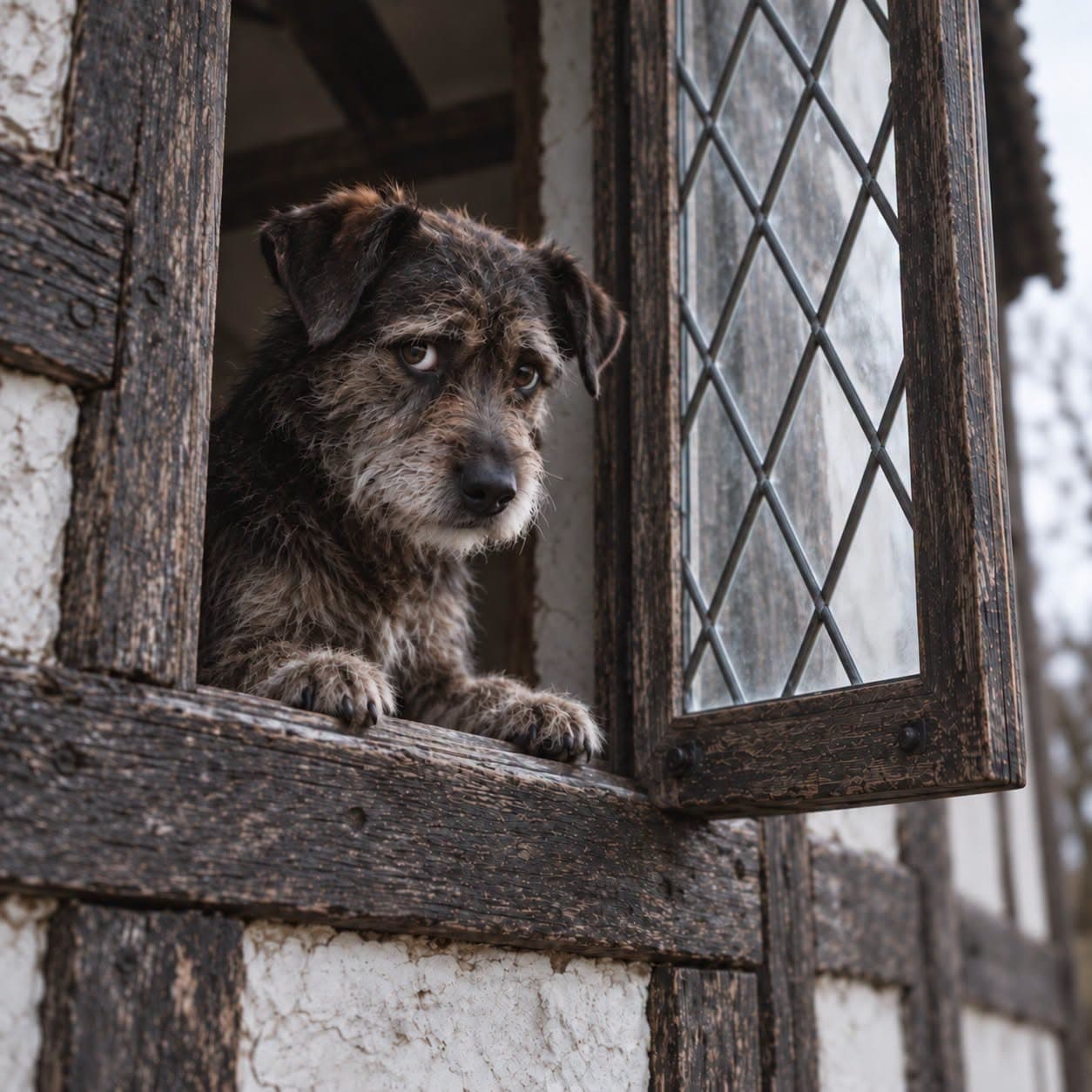
According to the pamphlet printed within days of her death, Williford confessed that seven years earlier, the Devil had appeared to her in the shape of a little dog and asked her to forsake God. She said she had refused at first. She described a small animal she called Bunne, who brought her occasional coins, sometimes a shilling, sometimes eightpence, never more. And she said that Bunne had been the one to carry Thomas Gardener out of the window.
She also confessed to giving the Devil her blood, so that he could write out the terms of their arrangement. She said their contract was for twenty years, and that the time was nearly up.
Under questioning, Williford implicated others. Joan Cariden was accused next. She described a black, rugged dog that came into her bed at night and spoke to her in a mumbling language. Jane Hott spoke of a hedgehog, soft to the touch like a cat.
They were the vocabulary interrogators expected to hear, produced by frightened people who had learned what confession required. A witch needed a familiar, and a familiar needed a name, a shape, a habit. Once Williford had supplied hers, the others found their own.
Jane Hott resisted longer than the rest.
When she was first brought into the gaol, she urged the other women to confess if they were guilty, while insisting on her own innocence. She told them that if they threw her into the water to test her, she would sink, proving she was no witch. She was so confident that she offered a gentleman present odds of twenty shillings to one that she could not float.
She was thrown into the water anyway.
She floated.
Afterward, the gentleman she had offered the wager to asked how she could be so impudent as not to confess herself, when she had so urgently persuaded the others to confess. Hott answered that the Devil had walked beside her the whole way and told her she would sink. Instead, she said, he had perched on a crossbeam and laughed at her.
It is a strange, almost theatrical detail to survive in a legal record: an accused woman describing the Devil's amusement at her failure to sink.
The trial was conducted by Robert Greenstreet, the mayor of Faversham, who afterward arranged for the confessions to be published as a pamphlet advertising the women's "evil lives and wicked deeds." It appeared in London on 2 October 1645, just three days after the executions, giving readers across the country a fast, detailed and thoroughly one-sided account of what had happened in Kent.
Strip away the devils, the familiars and the covenants written in blood, and what remains is more ordinary and more troubling: an injured man, a woman fond of a small dog, a dog in a bed at night, a hedgehog as soft as a cat. None of it required supernatural explanation. All of it was made to seem like evidence of a pact with Satan.
Faversham was not unusual in this. Between 1645 and 1647, England endured its most intense wave of witch persecution, driven substantially by the self-appointed "Witchfinder General" Matthew Hopkins and his associate John Stearne, who worked through East Anglia identifying suspects and overseeing exactly this kind of interrogation and water trial. Between 1563 and 1735, some two thousand people were tried for witchcraft in Britain, more than five hundred of them in the South East, mostly in Kent and Essex.
The swimming test itself rested on a piece of theological logic that was as circular as it was cruel: since witches had supposedly renounced their baptism, water was believed to reject their bodies. A suspect who sank was, in a horrifying sense, vindicated, though not always alive to appreciate it. A suspect who floated, as Jane Hott did, was condemned by her own body's refusal to sink. Faversham's women were swept up during the peak of this method's use.
In September 2024, Faversham placed a stone by the Guildhall, near where the women were hanged. It names the three who died and acknowledges that Elizabeth Harris's fate remains unknown. The inscription closes with a plain hope: that their names might be spoken again, this time in service of a world free of persecution.
No one now believes a small dog named Bunne pushed a man out of a window. What survives is the record of how easily an accusation could become a confession, and how completely a confession could become a rope.