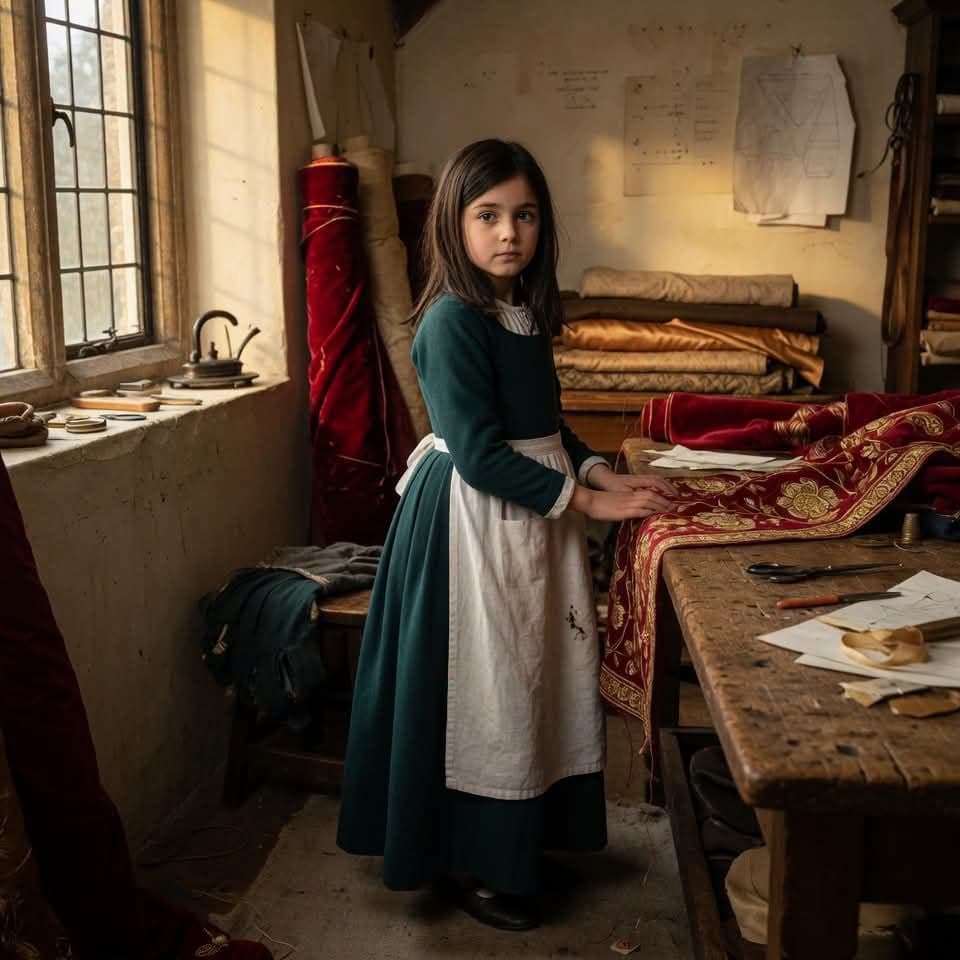
Henry VIII paid his tailor to claim his daughter. The tailor put it in his will... Ethelreda Malte was born around 1535, the daughter of John Malte, Henry VIII's personal tailor, a man whose work required him to stand in closer physical proximity to the king than almost anyone else at court. He measured him. He fitted him. He stood in silence while Henry VIII decided what kind of king he wanted to look like that day.
John Malte was good at his work and Henry kept him close for it, granting him properties and annuities over many years, the specific rewards of a man whose discretion was as valued as his skill with cloth.
Ethelreda's mother is not recorded anywhere. Not in the will. Not in any court document. Not in any letter or account that has survived. She was a woman whose name was either not considered worth writing down or was considered too dangerous to write down, and the distinction between those two possibilities is the one that matters. She left behind a child and a silence and nothing else.
John Malte died in 1546. He left a will. The will recorded that Henry VIII had given him money and property in exchange for acknowledging Ethelreda as his own daughter. Not as a gift. Not as a pension. As a payment for a specific act, the act of standing in front of the world and saying this child is mine, and accepting in return what the king considered the appropriate price for saying it.
Henry VIII was fifty-four years old in the year that provisions for Ethelrelda's inheritance were conceived. He had been married to Catherine Parr for less than a year. He was by this point enormously heavy, ulcerated at the legs, moved between rooms by mechanical devices, and conducting himself in ways that required financial management of the kind that John Malte's will describes.
Ethelreda grew up in the Malte household in London, a tailor's daughter in a prosperous trade, surrounded by the fabrics of the court she was officially no part of. After Henry died in January 1547 the crown granted her properties consistent with the kind of quiet provision that had been extended to others in this series whose connection to the king could not be publicly named.
Nobody said anything. The provision was made in the language of property transfer, which was the only language available for things the Tudor court could not say in any other way.
She married twice and lived into the reign of Elizabeth I. She did not petition for recognition. She did not claim a royal name or a royal inheritance or anything that would have required the question to be answered in public. She lived as John Malte's daughter in a world that had been specifically arranged and specifically paid for to make sure that was all she would ever officially be.
The arrangement held. The silence held. The will did not hold, because John Malte wrote down what had happened in the last document he ever produced, at the moment in a person's life when they have least reason to lie, and the ink has not faded in five hundred years.
Henry VIII spent his reign arranging the world around the children he would not name. He paid in property and money and silence and the careful management of other people's official records. John Malte accepted the payment, raised the child, and then at the end of his life wrote down exactly what the arrangement had been. It was the most honest sentence in this entire tale.
The king paid. The tailor accepted. The child was claimed. The mother was never named. The will survived.