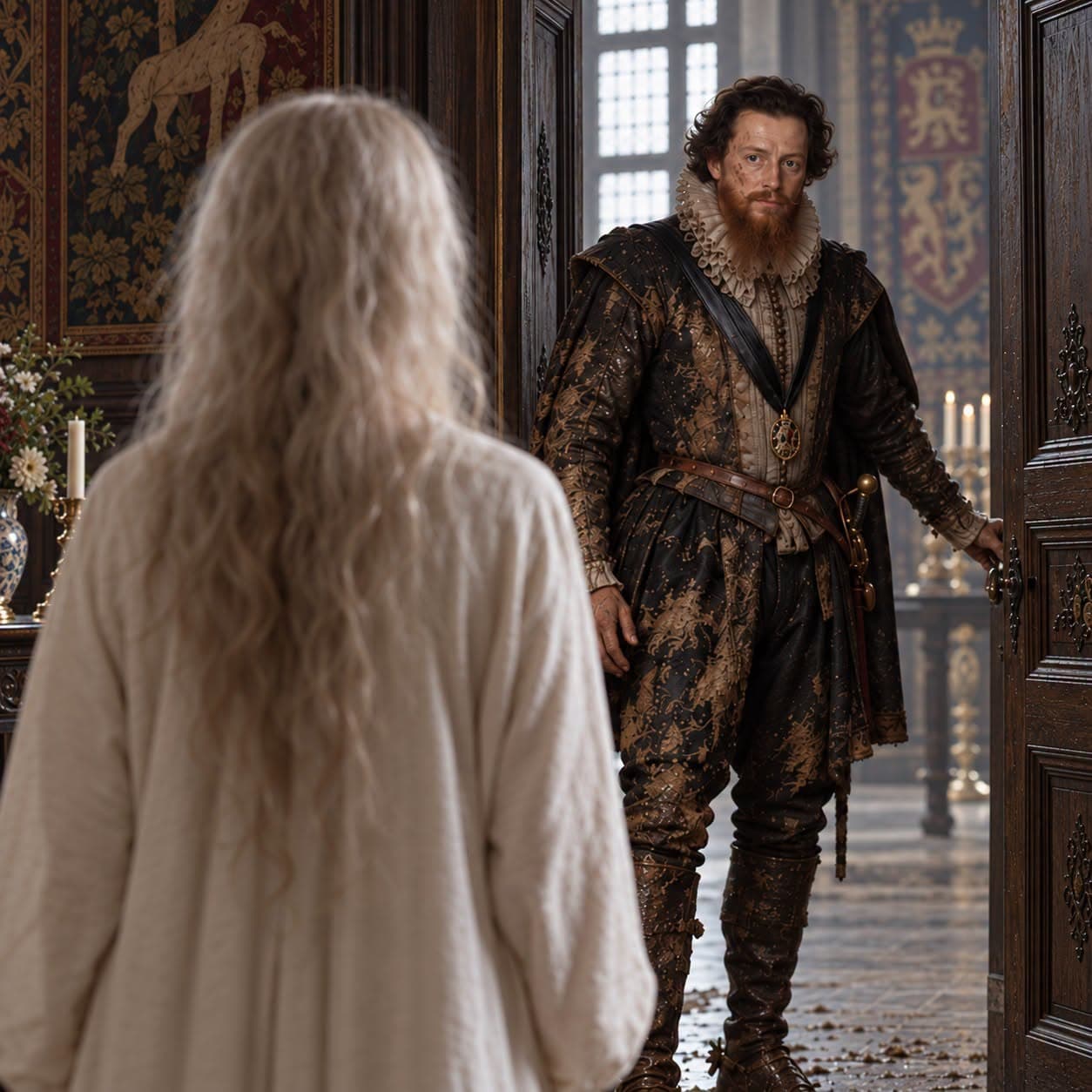
Queen Elizabeth I had not even got dressed when he burst into her bedchamber. Robert Devereux believed that if he could reach Elizabeth I before his enemies did, she would save him. For a few hours on 28 September 1599, he thought it had worked.
Essex arrived at Nonsuch Palace at about ten in the morning, carrying the road on his clothes and face. He had travelled from Ireland with such urgency that he had not stopped to make himself presentable. Rowland Whyte, who recorded the events at court, described him as so covered in “dirt and mire” that even his face was filthy.
He passed through the palace without waiting to be summoned.
First came the Presence Chamber, where the queen appeared before the wider court. Beyond it lay the Privy Chamber, accessible only to those granted closer attendance. Beyond that was the bedchamber, part of the most restricted space surrounding the monarch.
Essex crossed them all.
Elizabeth had only recently risen. Whyte found the detail worth recording: Essex reached the bedchamber to find the queen “newly up, and the hair about her face.” The queen had not prepared herself to receive him. Essex had not prepared himself to appear before her. They met outside the forms that usually governed access to the sovereign, she with her hair still unarranged, he with the mud of his journey still upon him.
Essex fell to his knees and kissed Elizabeth’s hands. They spoke privately.
It is unknown what passed between them, but Essex emerged from the bedchamber delighted. The queen had received him. She had listened. Whatever she had said gave him enough confidence to believe that the danger had passed. After the storms he had endured abroad, he declared, he had found “a sweet calm at home.”
Essex had gone to Ireland earlier that year with one of the largest English armies ever sent there. He had left London in March amid immense public excitement, riding through streets crowded with people calling for God to bless and preserve him. He was the queen’s favourite, a celebrated soldier and the man expected to crush the rebellion led by Hugh O’Neill, Earl of Tyrone.
Instead, the campaign consumed men and money while producing little that could be presented as decisive victory. Essex marched through the south rather than striking immediately at Tyrone in Ulster. His army was weakened by fighting, sickness and desertion. When he finally moved north, he was no longer in a position to force the conclusion England expected from him.
On 7 September, Essex met Tyrone at a ford. The two men spoke privately before further negotiations produced a renewable truce. Elizabeth was furious. Essex had been sent to defeat Tyrone, not to meet him alone in the middle of a river and negotiate terms.
Her reply reached Essex in Dublin on 24 September. He responded by transferring authority to others and leaving Ireland, although his permission to return had been revoked. He was not merely coming home after an unsuccessful command. He was abandoning his post in the middle of a war and returning to the queen without her knowledge.
He knew what would be waiting for him if his enemies reached her first.
At court, Essex’s principal rival was Sir Robert Cecil. Every hour that Essex remained away gave Cecil and his allies another opportunity to describe the Irish campaign as they wished. Failure could be made to look like incompetence. The truce could be presented as disobedience. His sudden departure could be treated as desertion.
Essex’s answer was to outrun the accusation.
He travelled through Wales and England with a small group of followers, reached Westminster, crossed the river to Lambeth and took whatever horses he could find. Lord Grey of Wilton, one of Essex’s political opponents, was already riding towards Nonsuch.
Sir Thomas Gerard overtook Grey and told him that Essex was following close behind. Gerard asked Grey to allow Essex to pass so that he might carry the first news of his own return.
“Doth he desire it?” Grey asked. Gerard replied that Essex had made no such request. Grey refused and rode even harder. He reached Nonsuch about fifteen minutes before Essex and went directly to Cecil.
But Essex was inside the palace before word of his arrival could be carried upstairs.
That was the advantage he had ridden across the country to secure. He had passed through the court and entered Elizabeth’s private chamber before Cecil, Grey or the machinery of government could place anyone between them. He had spoken to her alone and she had been gracious.
Essex went away to wash and change his clothes. At about eleven, now dressed for court, he returned to Elizabeth. They spoke until half past twelve. Whyte reported that all was still well and that the queen continued to treat him kindly.
Essex went to dinner in high spirits. He talked cheerfully about his travels in Ireland while lords, ladies and gentlemen came to see him. After months of frustration abroad and days of desperate travelling, he was once again at the centre of the English court. The favourite had returned. The queen had received him twice. His enemies had not managed to keep him from her.
Then he went to Elizabeth for a third time.
In the intervening hours, the queen had begun to consider what his return meant. Elizabeth called him to account. Why had he left Ireland? By whose authority had he abandoned his command? Why had he left the country in such danger? What had he agreed with Tyrone, and why had he acted against the instructions sent to him?
Essex had returned believing that the crisis was personal, something that could be settled through access, intimacy and the restoration of Elizabeth’s affection. Elizabeth now treated it as a matter of government.
That afternoon, she ordered four members of the Council to hear him: the lord chamberlain, Lord North, Sir Robert Cecil and the comptroller of the royal household. Essex went with them and answered questions for about an hour. No decision was announced, but the rest of the Council was summoned to Nonsuch for the following day.
Between ten and eleven that night, Elizabeth’s order arrived. Essex was to remain in his chamber. The sweet calm had lasted only a few hours.
The following afternoon, Essex stood before the assembled Privy Council. The councillors sat while he remained bareheaded at the upper end of the table. For three hours, from two until five, the charges were set before him: his disobedience of the queen’s letters, his conduct of the Irish campaign, his unauthorised return, the extraordinary number of knighthoods he had granted and his “overbold” entry into Elizabeth’s bedchamber.
Essex answered with such temper, gravity and discretion that even Whyte recorded the impression he made. It did not free him. He returned to his chamber while the councillors carried an account of the hearing to Elizabeth. She said that she would pause and consider his answers.
Within days, Essex was removed from court and placed in the custody of the lord keeper at York House. The queen’s former favourite found himself cut off from the presence upon which his political power had depended.
Over the following months, confinement hardened his fear and resentment. He was deprived of office and denied renewal of the valuable monopoly on sweet wines that had supplied much of his income. In February 1601, convinced that his enemies controlled the queen and that only force could restore him, Essex attempted to raise London.
The city did not rise with him.
He surrendered that evening, was convicted of treason and was executed inside the Tower of London on 25 February 1601. His downfall did not begin because he saw Elizabeth without her public face. It began because he believed that seeing her privately placed him beyond the rules that governed everyone else.
For years, Essex had enjoyed unusual access to the queen. He had quarrelled with her, defied her, withdrawn from court and returned to favour. Each reconciliation taught him that the personal bond between them could survive another act of disobedience.
On 28 September 1599, he wagered everything on that belief. He reached Elizabeth before his enemies could speak and for a few hours, he believed that was enough. He had mistaken access for immunity and affection for power.
The queen he found was not yet dressed for the court.
She was still the queen.