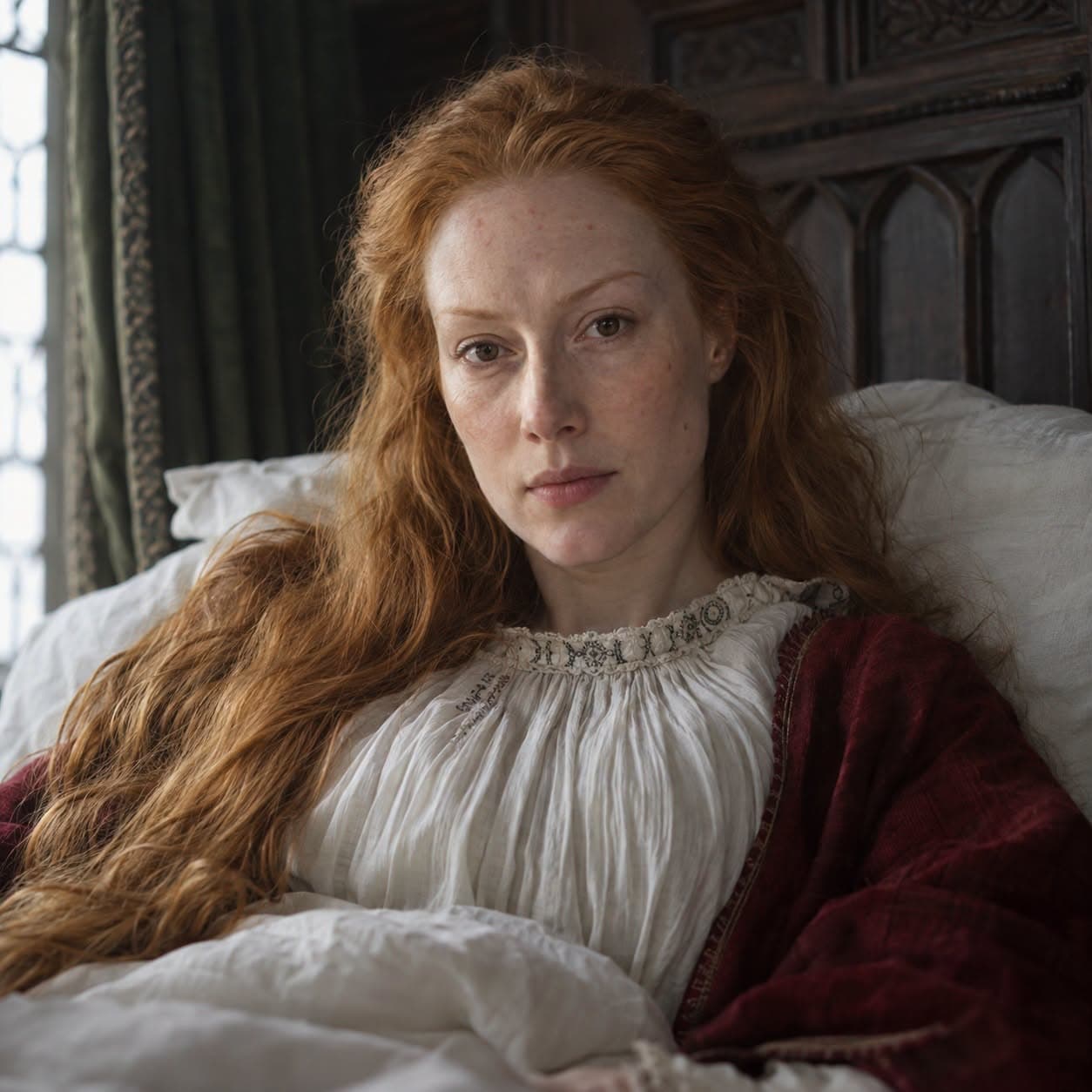
Elizabeth was twenty-nine. She lay unconscious at Hampton Court while her councillors discussed who should have her crown. The men who needed her decisions were having to make provision for a country without her.
By 17 October 1562, she had regained consciousness and the immediate crisis was easing. The night before, people at the palace had been mourning her as though she were already dead. Smallpox had brought the young queen close enough to death for the succession to become urgent business, conducted while she was still alive.
She had been queen for less than four years. Her father, Henry VIII, was dead, and so were both the children who had ruled between his death and her accession, her younger brother Edward and her elder sister Mary. Elizabeth was the last of Henry's children. She had no husband, no child, and no acknowledged heir waiting to take her place. The crown had passed between siblings twice. There were no siblings left.
Until the fever stopped her, she had continued to work. On 15 October she was writing in French to Mary, Queen of Scots, her cousin and a woman with a claim to the English throne. The letter ended with an explanation: "The hot fever which is upon me prevents me writing more at present." Even ill, she was explaining why a letter was short. Within a day she had lost the power to speak.
William Cecil, her secretary, was summoned from London at midnight. The illness had been recognised as smallpox, but the eruption had not yet appeared. Those attending her understood that as a dangerous sign. In the palace, the question of whether she would live had become inseparable from the question of what would happen if she did not.
Her councillors could agree that the country needed a successor. Agreement ended when a name was required. Some looked to Lady Katherine Grey, a Protestant and a granddaughter of Henry VIII's younger sister. Others looked to Henry Hastings, Earl of Huntingdon, who traced his descent from Edward III. The Queen of Scots, the cousin Elizabeth had been writing to one day earlier, had her own claim through Henry's elder sister, and she was Catholic. Elizabeth had restored Protestant government after her Catholic sister's reign. The death of the woman in the bed could put that settlement in danger as well.
There were fifteen or sixteen councillors, and by one report nearly as many opinions. The same men who had spent nearly four years urging their queen to settle the succession were discovering how difficult it was to settle without her.
Then, in the night, the eruption her attendants had been waiting for finally came out. By 17 October Elizabeth was better. She had come through the worst of the crisis, although improvement was still something to be watched, rather than a promise that she was safe. The council's preparations for her death had been overtaken by her recovery.
She still had to recover.
Smallpox could leave its survivors permanently marked. By 25 October Elizabeth was out of bed, occupied with treating the marks on her skin so that they would not disfigure her. The government had a queen who would live. The queen had a face the disease had not yet finished with.
The women attending her had their own bodies at risk. Among them was Mary Dudley, Lady Sidney, sister of Elizabeth's favourite Robert Dudley and wife of Sir Henry Sidney. Her place in the queen's household brought her close to Elizabeth in the ordinary course of service. During the smallpox it brought her close to infection. She continued to nurse the queen and caught the disease herself.
Mary survived. The scars remained.
Her husband was away in France that autumn. More than twenty years later, he set down what he had come home to. "I left her a full fair lady, in mine eye at least the fairest," he wrote, "and when I returned I found her as foul a lady as the smallpox could make her." She had taken it, he wrote, by her continual attendance on the queen. The marks were still in her face, and she lived solitarily, keeping to herself in her own house. The queen's sickroom belonged to an autumn long past. His wife was still living with what she had caught in it.
Elizabeth's recovery brought the familiar demands back with it. When Parliament met in January 1563, both houses pressed her to marry and settle the succession. The illness had given her councillors the most frightening demonstration yet of what they had been warning against. For their sovereign, getting well meant returning to men who had further advice about what she should do with her life.
The letter to the Queen of Scots had stopped because Elizabeth was too feverish to continue. At the height of the illness, even speech had failed her. Now there would be letters again, audiences again, and decisions for which the council would have to seek the living queen's answer. The woman whose successor they had been discussing at Hampton Court in October 1562 had more than forty years of rule ahead of her. In all that time, she never publicly named an heir.