She was the last of them. Every other child Henry VIII had wanted, made, or broken was dead before she took the throne. She had survived them all by learning, very young, that need was the thing that killed you.
On the morning of the seventeenth of November 1558, Elizabeth was at Hatfield when they brought her the ring. She knew what the ring meant before they told her. Mary had been dying for weeks and Elizabeth had been at Hatfield, as she had been at Hatfield through most of the previous five years. She was still and careful and gave no one anything they could use. Now the men were crossing the park toward her and they were carrying the ring. She had been waiting for this moment since she was old enough to understand what waiting was.
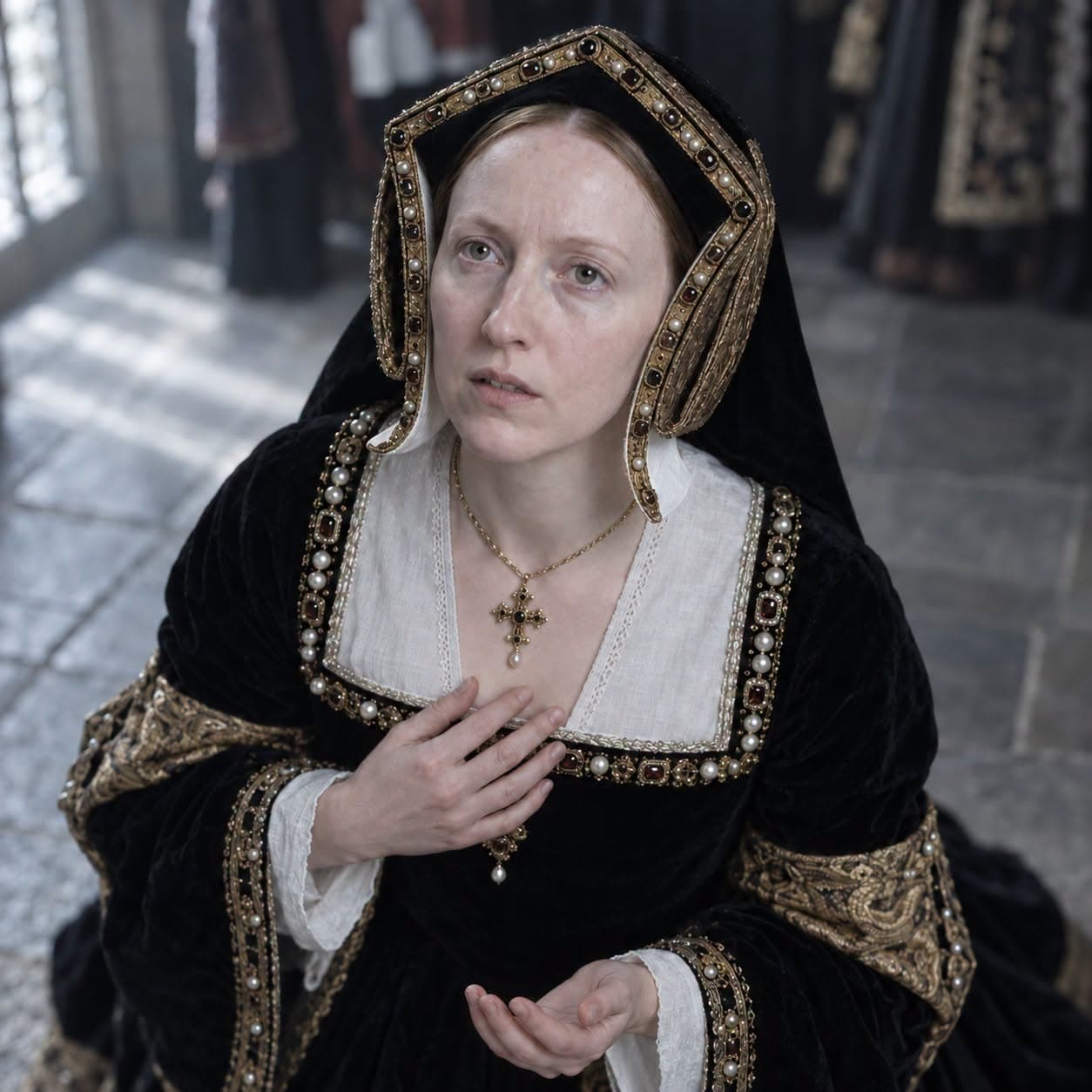
She knelt. She said, in Latin, this is the Lord's doing and it is marvellous in our eyes.
What happened in the breath before she said it is not recorded. The breath before the performance began, the last private moment she would have, the last instant in which Elizabeth Tudor existed without the weight of England pressing on every word and gesture and expression. That moment belongs to her alone and the records do not reach it. Then she said the words and rose and the performance began. It did not stop for forty-five years.
She had been preparing for it since she was not yet three years old, when her mother was taken from her in a way she was too young to understand and old enough to register. It was the specific wordless knowledge of a very small child whose world reorganises itself overnight and does not explain why. Anne Boleyn's name was removed from the court records. Anne Boleyn's household was dissolved. Anne Boleyn's daughter was declared a bastard and redesignated the Lady Elizabeth. She was moved from household to household with the careful efficiency of a court that needed her to exist without mattering. She had no memory of her mother's face. She had the knowledge of what her mother's visibility had cost.
She watched from the edges of courts and households across the years that followed. She watched with the specific attention of a child for whom observation was survival. She watched Jane Seymour arrive and produce a son and die. She watched Anne of Cleves annulled and pensioned. She watched Catherine Howard, whom she had known, taken to the Tower at nineteen on the same charge that had taken her mother, and executed. She was eight years old when Catherine Howard died. She registered it with the thoroughness of a girl who understood, without being told, the precise connection between wanting the wrong things and ending up in the Tower.
She learned Latin and Greek and French and Italian with the focused intensity of a child who needed the life of the mind because the life around her was not safe. She learned to present a surface so polished it showed people what they wanted to see rather than what was there. She learned that the question men most wanted answered about her was what she felt, and that the most powerful thing she could do with that question was never answer it.
When Henry died and Edward reigned, Elizabeth was thirteen and she went to live in the household of Catherine Parr. This was the stepmother who had survived Henry and who now married Thomas Seymour within months of the king's death. Thomas Seymour came into Elizabeth's room in the mornings before she was dressed and Catherine Parr held her still while her husband tickled her and cut her gown to pieces in the garden. Elizabeth was thirteen. She was fourteen. She was old enough to understand what the visits meant and too young to have any power over them. When Catherine Parr died in childbirth in 1548 and Seymour moved toward Elizabeth with more directness, Elizabeth had already learned the lesson that the situation was designed to teach her. She learned that her body was a political object that men felt entitled to handle, and that the only protection available was the cold performance of a woman who had nothing to offer because she wanted nothing.
Seymour was executed in 1549. Elizabeth was questioned by Northumberland's men about what had passed between them. She gave nothing. She was fifteen years old and she sat in front of men who needed her to be frightened. She was a surface and they could not find a way in. She was released, and she went back to her books.
She was at Hatfield when Northumberland proclaimed Jane Grey queen in July 1553 and she was at Hatfield when Mary's army made the proclamation irrelevant nine days later. She had kept still through both. Then Mary rode into London and Elizabeth rode with her. The Protestant sister was beside the Catholic queen. The performance of unity was precise and convincing. The court watched her with the specific attention of people who understood that she was the alternative and were waiting to see what she would do with that.
She did nothing. She attended mass. She was reported to be suffering from ill health and unable to attend mass, and then she attended it again. She gave Mary no declaration, no resistance, and no visible position of any kind. The men around Mary who needed her to make a move they could use as evidence found themselves repeatedly arriving at the same surface Elizabeth had been constructing since she was three years old.
When Wyatt raised his rebellion in 1554 against Mary's Spanish marriage, Elizabeth was questioned. She was brought to the Tower and held for two months. The room she was held in was, by some accounts, the same room her mother had occupied eighteen years earlier. She wrote to Mary from the Tower. It was a long letter, careful and steady, asking her sister to see her before she was condemned. She insisted on her innocence with the composed authority of a woman who knew that composure was the only thing standing between her and the block. Mary did not answer. Elizabeth was released. She went back to Hatfield.
She watched Mary burn her Protestants and she watched Philip of Spain leave and not return. She watched Mary's phantom pregnancies and she watched Mary's face in the last months of the reign become the face of a woman who understood she had failed. Elizabeth watched all of this from Hatfield with the stillness of a woman who had learned that the most dangerous moment was the moment you let yourself believe it was almost over.
She believed nothing. She waited.
On the morning of the seventeenth of November 1558 the park at Hatfield was quiet and then it was not. Elizabeth Tudor became the last thing her father had never intended her to be.
She was twenty-five years old and she had been in training since her mother's household was dissolved. The curriculum had been loss and danger and the sustained discipline of wanting nothing visibly. Now she took that curriculum and she had to make it into something it had never been required to be. It had to be not a shield but a governing instrument. It had to be not survival but power. It had to be not the stillness of a woman with nothing to defend but the authority of a queen with everything to protect. She had spent her entire life learning to hold herself in. She now had to learn to direct outward what she had spent so long containing. She had to do it immediately, completely, and without showing anyone that she was learning as she went.
She made it into Robert Dudley kept close and displayed and danced with and never, never married. Dudley was the man she may have come nearest to loving and loving him was the one thing she absolutely could not afford. She knew it and she kept him at the precise distance that was close enough to be useful and far enough to be safe. Dudley grew old in that distance and died in it and Elizabeth kept his last letter in a box beside her bed for the rest of her life. It was marked in her own hand: his last letter. She did not explain this to anyone because she had spent forty years not explaining herself to anyone and she was not going to begin.
She was not going to marry. The men around her spent twenty years presenting candidates and constructing arguments and petitioning and pleading. She listened with the composed attention of a woman hearing a case she had already decided. She had decided it in the households of her childhood where she had watched what happened when Tudor women made themselves legible to the men around them. A husband was a man with authority over her body, her decisions, and her name. She had watched what men with authority over Tudor women did with it and she was not going to give anyone that authority. Not for a kingdom. Not for an heir. Not for the resolution of the succession question that had been consuming England since January 1511.
She would be the question. She would make them live inside it. That was safer.
When Mary Queen of Scots came to England in 1568, a refugee from a Scotland that had turned against her, Elizabeth recognised her with a precision that she never spoke aloud. Mary had been everything Elizabeth had refused to be. Mary had married for feeling, twice, a man she loved and a man she wanted, and both had destroyed her. Mary had shown her hand at every stage and her enemies had read it and played it back against her. Mary had been visible and need-bearing and legible and they had taken everything from her. Elizabeth kept her in comfortable captivity for nineteen years. The men around Elizabeth spent all nineteen of those years explaining why Mary had to die. Elizabeth resisted and delayed and deflected and refused. She kept refusing, and let it sit.
In 1587 she signed the warrant. She said afterward that she had not intended for it to be acted upon immediately and that her secretary Davison had acted without authority. She wept and had Davison imprisoned. The men around her watched her performance of grief and anguish and not one of them believed it and not one of them said so. She had signed the warrant. The thing was done.
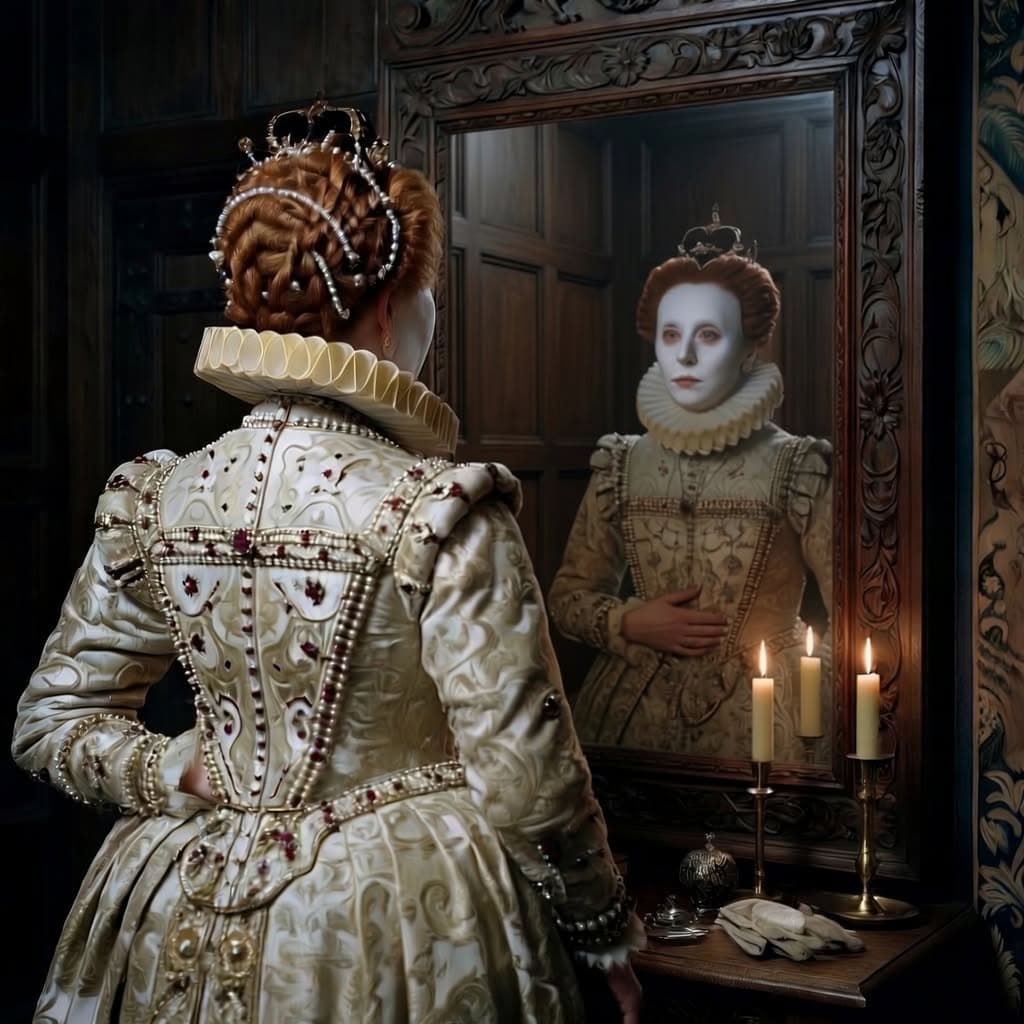
The performance continued. It became more elaborate as she aged. It became more demanding and required more maintenance. The white lead on the face thickening. The wigs were more elaborate. The dresses were more encrusted. The portraits were commissioned with specific instructions to eliminate shadow and line and the evidence of time. She was constructing an icon because the icon was the protection. The further the image was from the woman the harder it was to find the woman underneath it. She had understood this at twenty-five and she was still understanding it at sixty-five and at sixty-nine and at the last.
She fell ill in the winter of 1602. She would not be examined. She stood for hours rather than sitting because sitting was closer to lying down and lying down was the one position she had never been willing to occupy. She stood and held herself upright and the court watched her hold herself upright with the specific helplessness of people who have spent decades not knowing what she was thinking and have no way to reach her now.
She stood before a mirror in those final weeks and looked at her reflection for a long time. The records note it without explaining it. She stood and she looked and then she walked away. The court, which had been watching, had nothing to report because her face had shown them nothing. The woman who had not shown her face to anyone in forty-five years was not going to show it now. Not at the mirror. Not at the end. Not with the court watching.
What she saw is not recorded. What she felt is not recorded. The mirror held it and she walked away and took it with her.
She died on the twenty-fourth of March 1603 at Richmond Palace, on cushions on the floor, having refused to go to bed for days. They asked her who should succeed her. She could no longer speak. She raised her hand and made a gesture, a touch of her fingers to her head, which the men around her interpreted as indicating a king. They interpreted it as James of Scotland, which was correct. She died before the sun rose.
In January 1511, at Richmond Palace, Henry VIII had held a living son and the Tower guns had fired and the bonfires had been lit across London and the dynasty had believed itself secure. In March 1603, at Richmond Palace, the last of that dynasty's children died on the floor in the dark and indicated her successor with a hand she no longer had the breath to explain.
The question that had consumed everything. The marriages and the church and the executions and the burnings and the nine days and the boy who signed his name in a failing hand and the girl who could not find the block. That question had not been answered. It had simply run out of Tudors.
She had been the last one. She had survived them all. She had stood at the mirror and looked at what forty-five years of survival had made her and she had walked away without showing anyone what she saw. Then she had lain down on the floor and died. The doorway she had been standing in since Hatfield, the one Edward had left open, finally closed behind her.