At twelve she married a boy of ten who was not even in the room. On the same day, his sister married her brother. Each family would gain a daughter-in-law. Each would send a daughter away.
On 18 October 1615, Elisabeth of France was married by proxy at Bordeaux to Prince Philip, the ten-year-old heir to the Spanish throne. A nobleman stood in for the absent bridegroom. At Burgos, in Spain, fourteen-year-old Anne of Austria was married in the same way to Elisabeth's brother, Louis XIII, who was also fourteen. The two ceremonies completed the same arrangement from opposite ends. Each girl married the other's brother, and each would leave her own country to join him. The husbands could be represented by somebody else. The daughters would have to make the journey themselves.
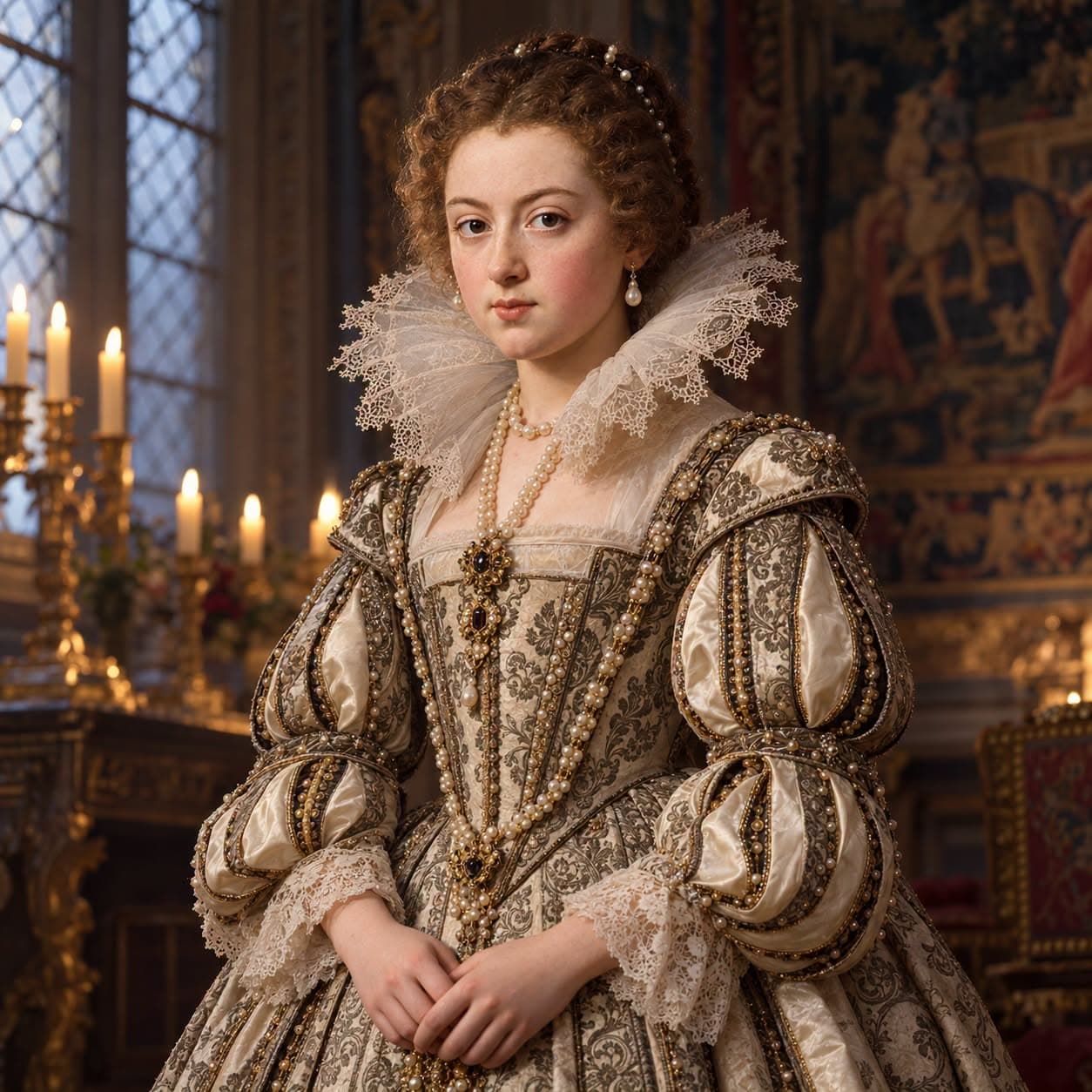
Elisabeth was the daughter of Henry IV and Marie de' Medici, born at Fontainebleau in November 1602. She had been seven when her father was assassinated in May 1610. His death made her brother King of France and her mother regent, responsible for governing in his name. The family into which she had been born had already been rearranged by a murder. Five years later, her mother was arranging a different future for it, with a Spanish wife for her son and a Spanish husband for her eldest daughter.
That spring, Elisabeth had danced before the French court in a ballet organised by Marie. She appeared as Minerva, the goddess of wisdom, in a production celebrating the order and peace her mother's government claimed to have secured. The twelve-year-old had a part in the performance as well as a place in the marriage negotiations. Before she became the wife of the Spanish heir, France had seen her as a goddess. Courts could give a girl a great deal of importance without giving her much time to grow up.
Across the border, Anne had also lost a parent. Her mother, Margaret of Austria, had died in 1611, and Anne had helped care for her younger brothers and sisters afterwards. She was Philip III's daughter, born at Valladolid and brought up in the royal household, where she received a strongly religious education. The brother Elisabeth was marrying belonged to that household too. He was ten. The two brides were connected by more than the negotiations between the two crowns: each was about to become the wife of a boy the other had grown up with. A brother at one end of the arrangement was a husband at the other.
Anne had turned fourteen only the previous month. Marriage to Louis made her Queen of France; Elisabeth was marrying an heir and would have to wait for the Spanish crown. Even their new ranks were not quite symmetrical. But both marriages served the same purpose. The Bourbon and Habsburg families were binding themselves together after generations of rivalry between France and Spain. Marie had helped engineer the matches, which had been agreed in 1612. By the time the October ceremonies took place, the weddings had already occupied three years of diplomacy and celebration.
There had been opposition too. The Prince of Condé was among the most vocal enemies of the marriages, and pamphlets argued fiercely over what an alliance with Spain would mean for France. Supporters presented the unions as a promise of concord; opponents saw danger in the same prospect. Elisabeth's mother had persisted. In October, the agreement at last had two married daughters to show for it.
One was going north. One was going south.
The exchange came twenty-two days later, on 9 November, on the Bidasoa, the river dividing France from Spain. There the arrangement required something more than representatives speaking for absent husbands. The brides themselves had to cross.
A pavilion fitted out as a room had been moored in the middle of the river, near the Isle of Pheasants. Thick ropes ran out to it from both banks, and courtiers watched from stands built along the shore. Each princess set out from her own side in a decorated boat, hauled along the ropes by sailors, timed so that neither would reach the meeting place before the other. Nothing in the arrangement had been left to favour one kingdom over the other, including the speed of the boats.
The two girls embraced. Then each was handed over to the escort of the other kingdom, and the boats that had brought them went back without them. Anne went towards the French bank, Elisabeth towards the Spanish one. The girl who had married at twelve was still twelve when she crossed into her husband's country, and her husband was still ten. Her thirteenth birthday was thirteen days away.