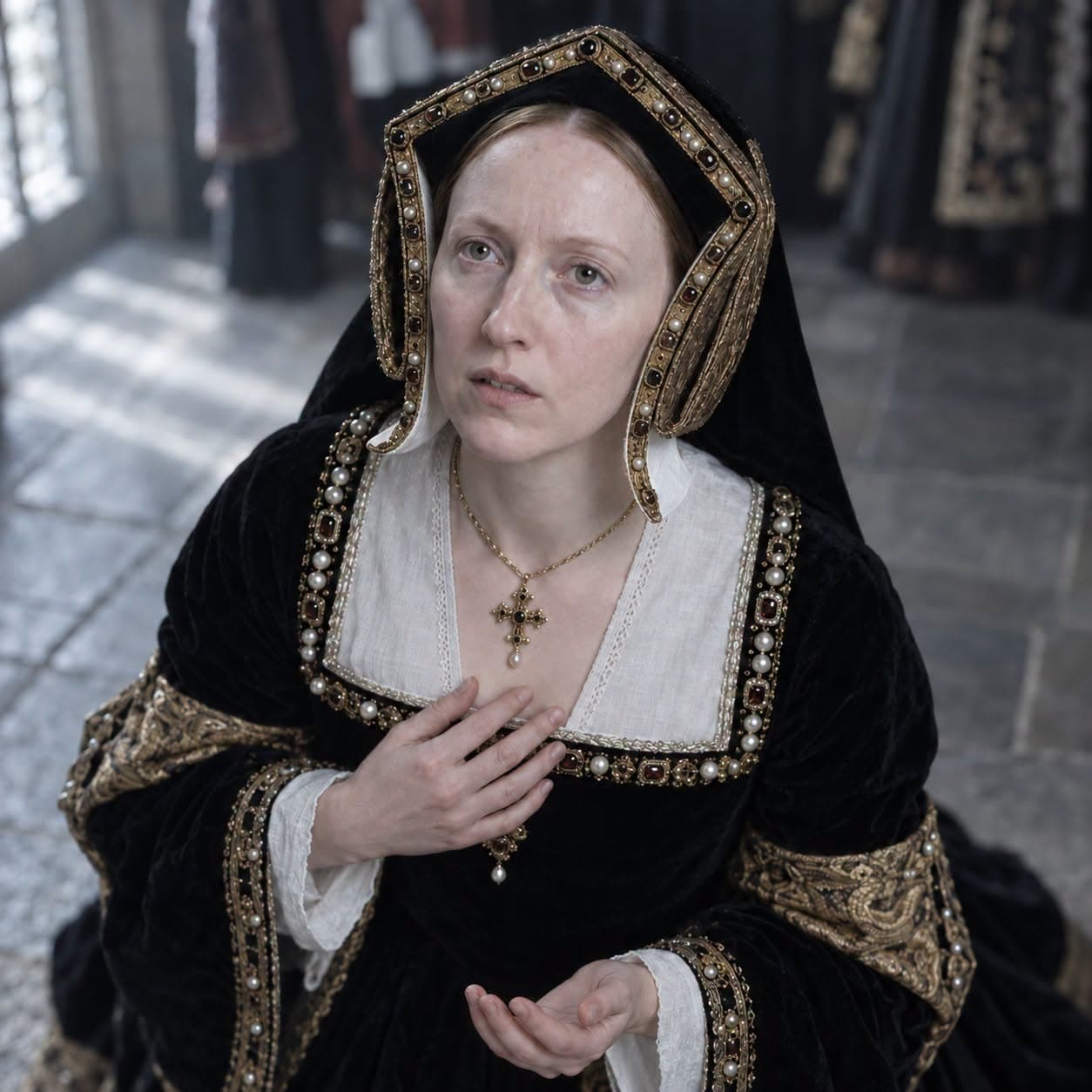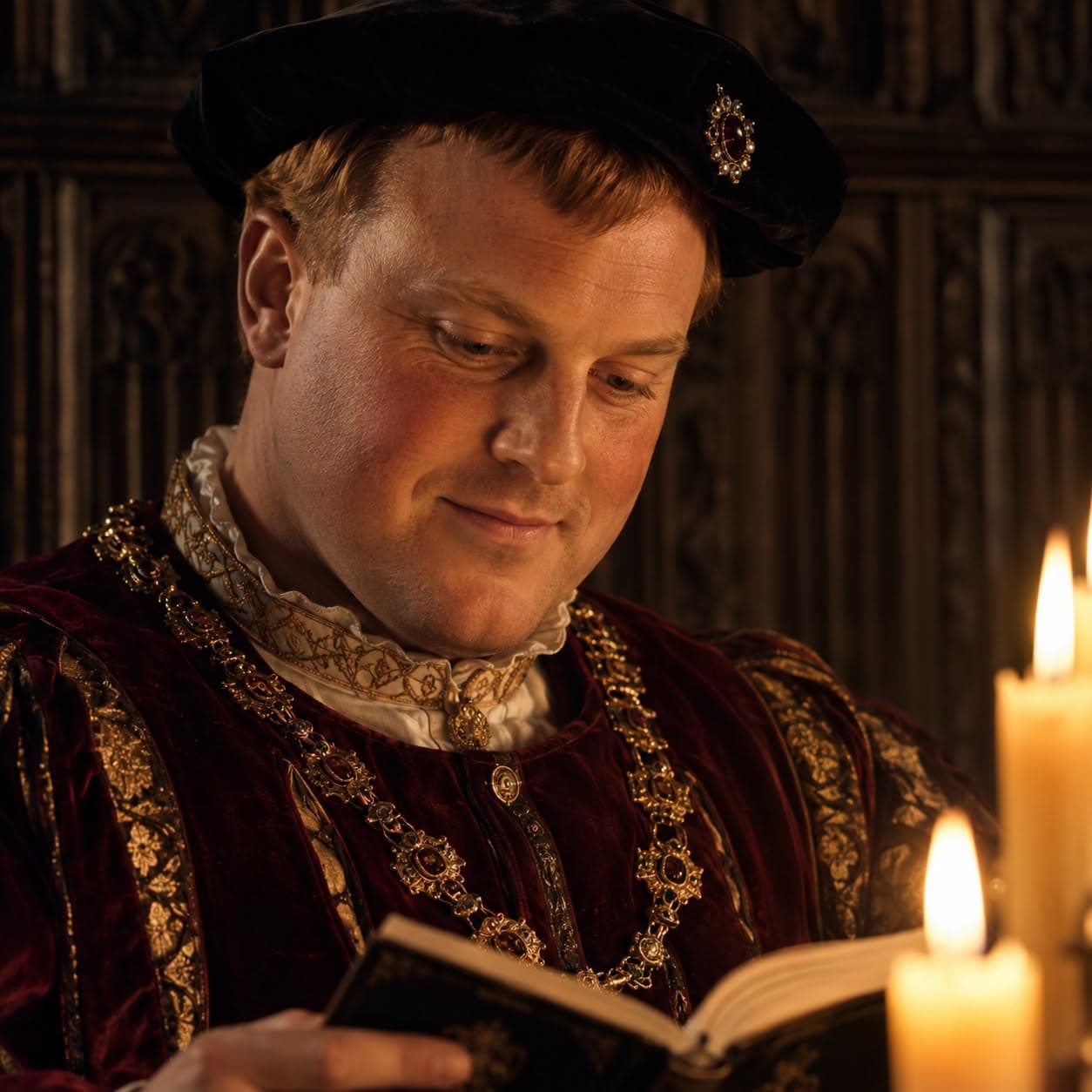
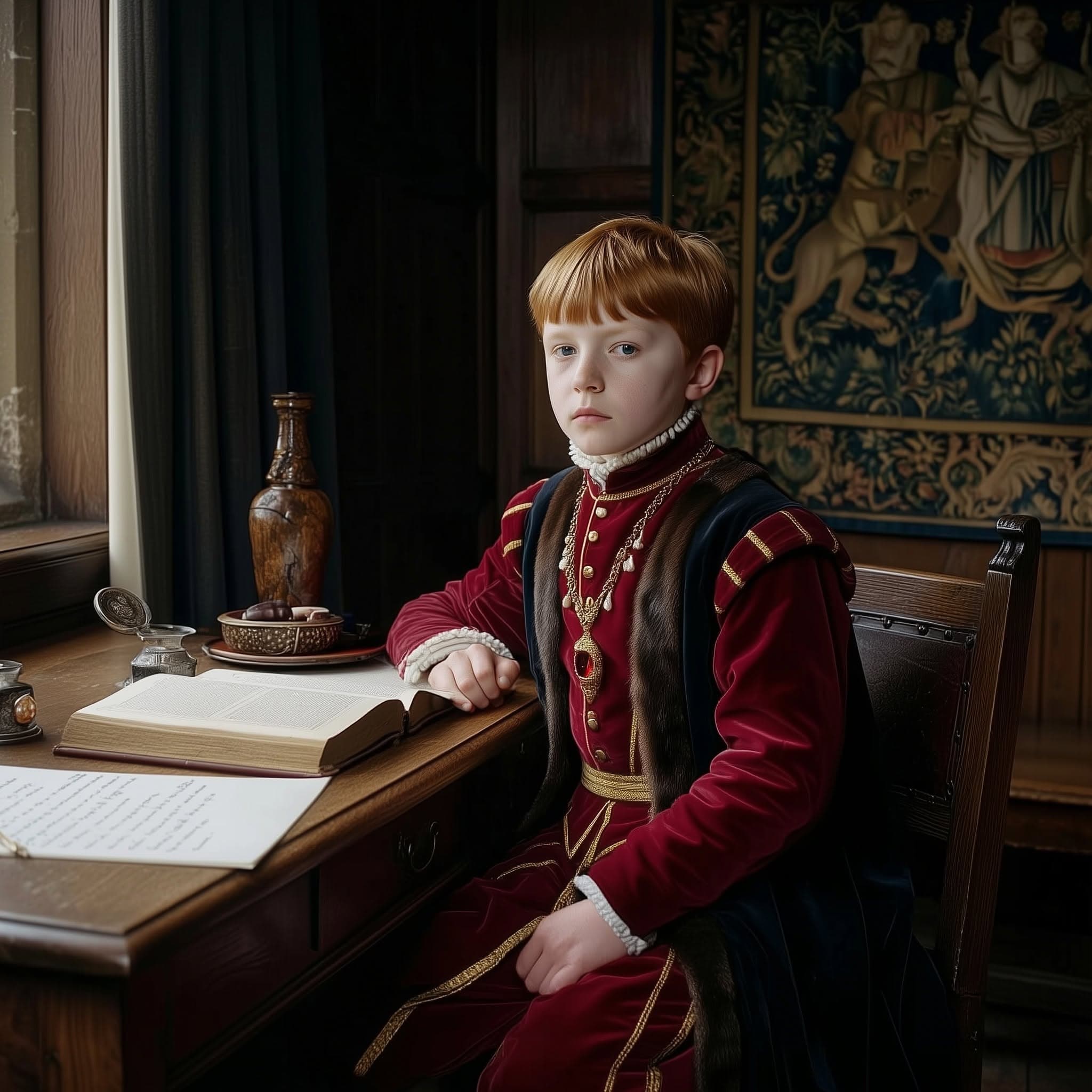
He was the answer to a question that had cost Henry VIII a church, two marriages, and several lives. He was fifteen years old when tuberculosis made the question relevant again.
Edward VI was born on the twelfth of October 1537 at Hampton Court Palace, the third surviving child of Henry VIII and the only surviving child of Jane Seymour, and the guns of the Tower fired for three days and the bonfires were lit across London and the Te Deum was sung in every church in England and Henry VIII, forty-six years old and already thickening into the man the portraits remember, wept.
He had been waiting for this for twenty-six years.
The last time the guns had fired for a son was January 1511, when Catherine of Aragon had delivered a boy at Richmond Palace and the court had celebrated with the specific hysteria of people who had been waiting for something so long that its arrival felt like a miracle. That boy had lived for fifty-two days.
Between that boy and this one had come a long interval of daughters and stillbirths and miscarriages and the systematic dismantling of two marriages and one church and several lives, and somewhere in that interval Henry Fitzroy, Henry's acknowledged illegitimate son, the boy he had elevated to Duke of Richmond and Somerset at the age of six and loaded with offices and titles and a Howard bride, had died in July 1536 at the age of seventeen, taking with him the nearest thing to a male heir Henry had been able to produce.
There had been others, whispers of other children, other names, other women who had been quietly compensated and quietly removed, but Henry had acknowledged none of them. Fitzroy alone had been given the weight of his father's need, and Fitzroy was gone.
And now there was Edward.
Jane Seymour died on the twenty-fourth of October 1537, twelve days after the birth, of puerperal fever. She was approximately twenty-eight years old. She had given Henry what six years of pursuit and a destroyed church and two dead queens had been for, and she died before her son was a fortnight old, and Edward grew up in a household from which she was entirely absent except as the story of how he arrived.
He was told she had died giving him life. He was told she was the queen his father had loved best, because Henry did love her best, in the way that men love the women who give them what they wanted before they have time to be disappointed. Edward had no memory of her. He had the portrait Holbein painted, the pale contained face, the jewelled hood, the small particular mouth, and he had the knowledge that her dying had been the cost of his living, and that is a complicated thing to carry from infancy.
The apartments at Hampton Court were washed daily with soap and vinegar. His food was tasted at every stage of its preparation. The women who attended him in his first years were replaced by male tutors at the age of six, and those tutors were selected with the deliberateness of men who understood that they were not merely educating a child but constructing a king.
Richard Cox and John Cheke between them gave Edward Latin, Greek, French, Spanish, logic, rhetoric, theology, and the specific intellectual rigour of the new Protestant humanism that was remaking English thought from the ground up. Edward absorbed it all with a speed that his tutors described in letters to each other in terms that contain genuine astonishment. He was not merely competent. He was exceptional.
He was also alone. The protocols that protected him isolated him. He ate behind a wall of ceremony. He was displayed to the court at careful intervals, carried to a window at Hampton Court at the age of one for the people outside to see, the moment recorded in dispatches sent to foreign courts as though it were a state occasion, which in a sense it was. He was the most important person in England and he was an infant and the two facts together produced a childhood conducted largely in the absence of ordinary human contact.
His sisters were permitted to visit, Mary who was twenty-one when he was born and who wrote him careful letters full of maternal warmth, and Elizabeth, four years old, who grew up alongside him with a closeness that the court noticed and Henry encouraged, because two Protestant children educated together were two Protestant children whose educations he could monitor simultaneously. But they were not constant presences. He was the heir. The heir could not be risked.
Henry kept him close in the way that men keep things they are afraid to lose. He was shown off to ambassadors and foreign dignitaries who were invited to marvel at him and who did so in letters home full of the specific diplomatic language of men describing a child they find unnervingly self-possessed for his age. He had been trained to receive their attention. Henry visited him, held him, paraded him, but Henry was also, for most of Edward's conscious childhood, a man in his late forties and then his fifties, increasingly immobile, increasingly ill, increasingly volatile, surrounded by a court that managed his moods with the careful attention of people who understood that the wrong word at the wrong moment could end a career or a life.
Edward watched this from the position of the child who was the justification for all of it and could therefore see it clearly, and what he wrote in his journal when he was old enough to write suggests a child who had learned very early the difference between what people said and what they meant.
Henry VIII died on the twenty-eighth of January 1547. He had been ill for years, the jousting accident of 1536 never properly healed, the leg wound that suppurated for the rest of his life, the weight that accumulated until he had to be moved through his palaces on mechanised chairs and winched onto horses, the paranoia and the rages and the executions that had come to define the last decade of his reign. He died in the early hours of the morning at Whitehall, and the death was kept secret for three days while the men around him organised the transition of power, and then it was announced, and Edward was King of England.
He was nine years old.
He began keeping his chronicle at approximately ten years old. It is a remarkable document, dry, precise, meticulously dated, recording the events of his reign with the detachment of a civil servant filing reports rather than a boy describing his own life. In January 1552 he wrote that his uncle Edward Seymour, Duke of Somerset, had been executed. He recorded the date and the charge and moved on to the next entry. Somerset had been his Lord Protector, the man who had governed England in his name during the first years of his reign, the man who had been the closest thing to a paternal presence in his life after Henry died. He wrote it down with the same tone he used to record the weather.
His tutors had made him formidably intelligent and almost entirely opaque, and it is not entirely clear that the two things are separable.
The men who governed in his name, Somerset first, then John Dudley, Duke of Northumberland, who displaced Somerset with the efficiency of a man who understood that the Protectorate was not an institution but an opportunity, were not governing for Edward. They were governing for themselves, and Edward's education had made him perceptive enough to understand this before he was twelve and entirely unable to do anything about it. He watched Somerset fall and had Northumberland brought to him to explain it and wrote the explanation down in his journal. He was ten. He wrote about the explanation with the same tone he would later use to record Somerset's execution. He was learning, with the specific speed of a boy raised among people who used language as a weapon, that the words adults used to explain their actions to children bore a complicated relationship to the reasons behind them.
He was Protestant with the fervour of a child whose entire education had been organised around the new faith, and the England he was being given to rule was being remade in that faith's image with a speed that Catherine of Aragon and Mary Tudor would have found unbearable if they had seen it clearly. The chantries dissolved. The images stripped from the churches. Cranmer's Prayer Book imposed on a country that had been Catholic for a thousand years and was being told, by proclamation, that it was Catholic no longer.
In Cornwall and Devon in 1549, men marched on Exeter to say they had not agreed to it. They called the new prayer book a Christmas game, a thing in English they could not understand, and they marched barefoot through the summer lanes carrying their saints' banners, and when they were defeated the reprisals were specific and local and thorough: priests hanged from their own church towers in the vestments they had refused to stop wearing.
Edward recorded that the rebels had been dispersed. He did not write what dispersed had cost.
In 1552 he fell ill. It appeared at first to be measles or smallpox, both swept the court that winter, and he recovered partially and then did not recover further, and by the spring of 1553 it was apparent to the doctors around him that the king was dying. He was fifteen years old. His body, which had been protected with such obsessive care for his entire life, was being consumed from within by something that all the tasted food and washed apartments and removed women had not been able to prevent.
The symptoms recorded by his physicians, the greenish-yellow sputum, the swollen legs, the difficulty breathing, the skin gone a specific greyish colour, point almost certainly to tuberculosis complicated by secondary infections. He had the specific dying of a boy whose immune system had been protected from everything and was now meeting everything at once.
He was still writing in his journal in the spring of 1553. He was still receiving councillors and signing documents and performing the functions of kingship from his sickbed with the composed efficiency of a boy who had been performing the functions of kingship since he was old enough to hold a pen. And in those final weeks, the men around him brought him a document and set it on the table before him and explained what it was for.
The Device for the Succession would pass the crown to Lady Jane Grey, Protestant great-niece of Henry VIII, recently married to Northumberland's son. It would disinherit both his sisters. Edward took the pen. He had been trained his entire life to receive information in this room and respond to it with the correct expression and the correct action. Northumberland watched. The other councillors watched. The boy who had recorded his uncle's execution in the same tone he used to record the weather set the quill to the paper and signed his name in a hand that the physicians noted was increasingly difficult to form, and the room was entirely quiet except for the sound of it.
He died on the sixth of July 1553 at Greenwich Palace. He was fifteen years old. The last entries in his journal are dated some weeks before his death, the hand increasingly difficult to read, the characteristic precision beginning to blur at the edges.
He had been king for six years. He had been the answer to the question that the Duke of Cornwall's fifty-two days had left unanswered, the justification Henry VIII had needed for everything he had done and everything he had destroyed. And in the end he had signed a document from a sickbed and died at fifteen and the succession lasted nine days before Mary Tudor's army arrived at the gates of London and the men who had placed Jane Grey on the throne discovered, with considerable speed, that they had miscalculated.
His sister was waiting. She had been waiting since she was born, and what came through that door before her was not resolution. It was Jane Grey's nine days, and then five years of fires, and then the ash of a country that had been Catholic and then Protestant and then Catholic again and had run out of certainty about what it was.
England did not arrive at its answer cleanly. It never does.
He had been the most precious jewel in England and England had not been able to keep him, and in the end what he left behind was not a Protestant settlement or a reformed church or a secured succession but a door, left open, and a question still unanswered, and a girl at Hatfield who had survived everything by giving no one a reason to come for her, waiting for that door to be hers.