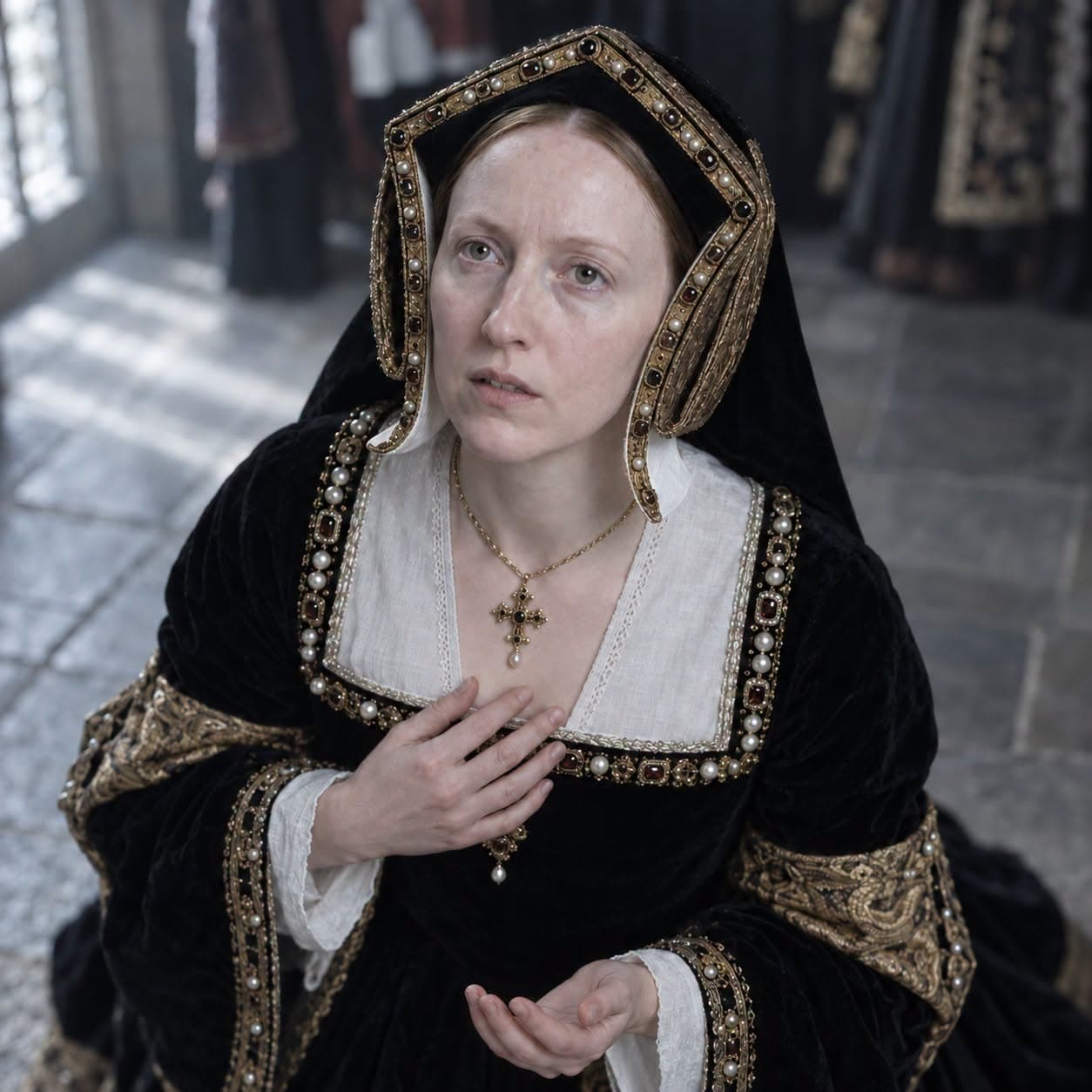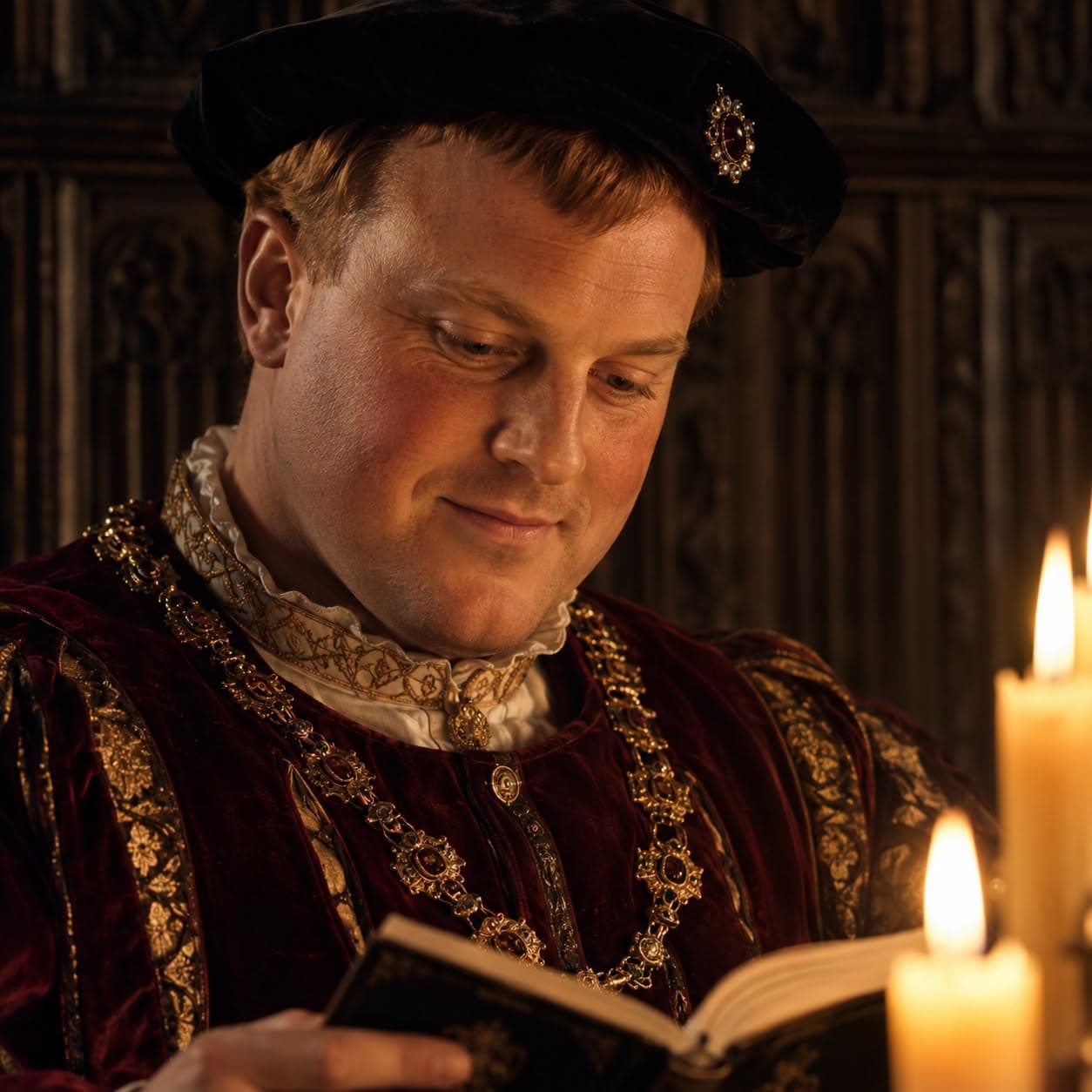
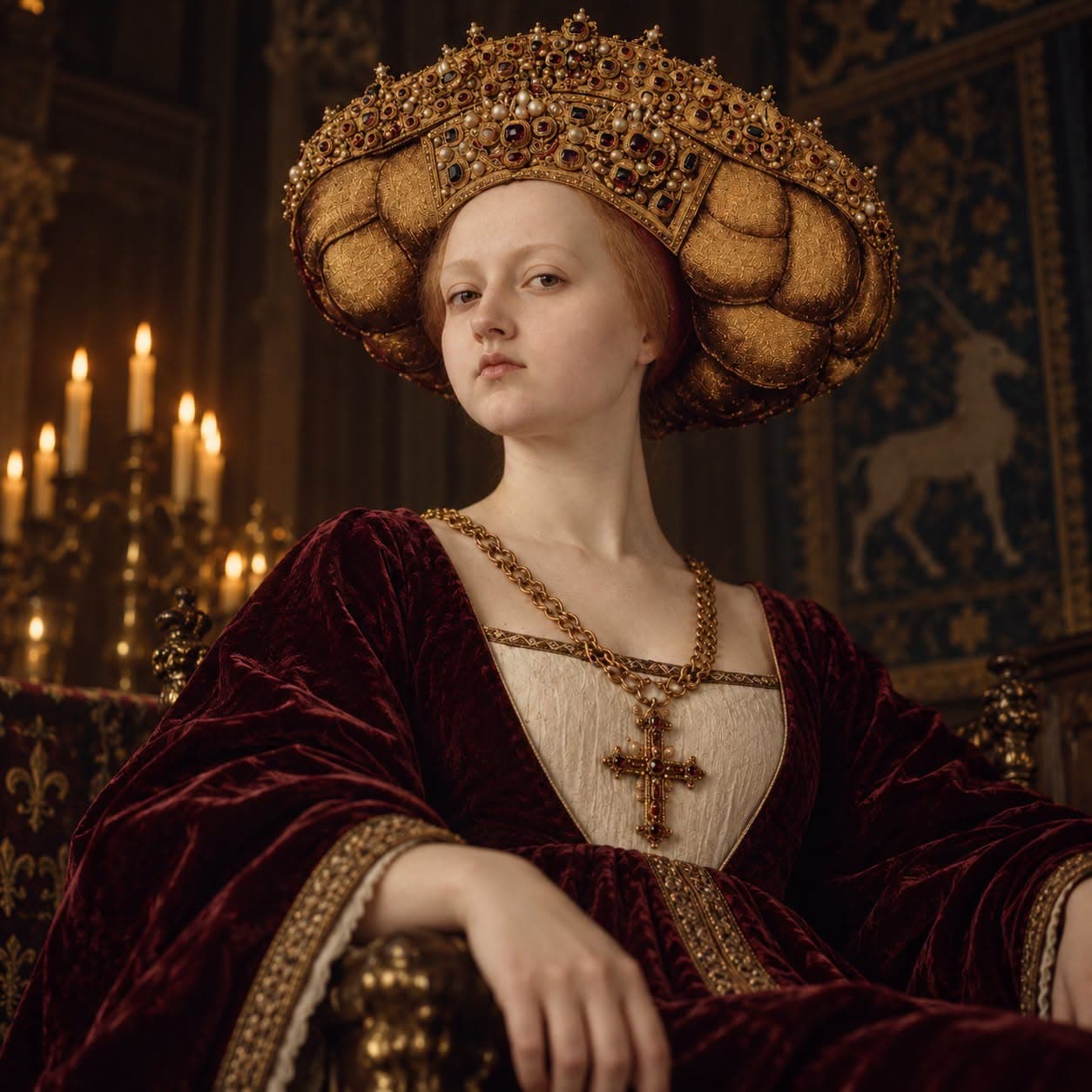
For three hundred years, Habsburg royals were painted with the same unmistakable jaw. Legend blames one woman for it. Her own statue doesn't have it.
On 28 September 1429, a widow died at Türnitz, a small town in the Austrian hills, while travelling on pilgrimage to the shrine at Mariazell. She was buried at the Cistercian abbey of Lilienfeld, and for centuries afterward, most of Europe forgot her name. Her name was Cymburgis of Masovia, and almost every Habsburg emperor and Spanish Habsburg king who came after her descended from her body.
She had been born around 1394 or 1397, a princess of the Masovian Piasts, daughter of Duke Siemowit IV and Alexandra of Lithuania, into a dynasty that had ruled fragments of Poland for centuries though the greater Polish crown had already passed to another family. That other family carried a grudge against her own.
A generation earlier, Cymburgis's uncle, the Lithuanian grand duke Jogaila, had converted to Christianity, taken the name Władysław Jagiełło, and married Jadwiga of Poland, the very bride once intended for Ernest's elder brother, William of Habsburg. The engagement had been broken, the insult remembered, and the Habsburgs had not forgotten it.
Into that resentment, in January 1412, Cymburgis arrived in Kraków to marry Ernest "the Iron," Duke of Inner Austria. She was his second wife; his first marriage, to Margaret of Pomerania, had ended in her death without children. The wider Habsburg family did not approve of the match. According to legend, Ernest had won her love only after saving her from an attacking bear during a royal hunt, a courtship dramatic enough, perhaps, to explain why a Habsburg duke might overcome his family's objections for a Piast princess.
Whatever the family thought, the marriage worked. Chroniclers described it as a happy one, and over the following years Cymburgis bore Ernest nine children. Only a handful survived infancy. Among them was a son named Frederick, born in 1415, who would grow up to inherit far more than his father's duchy. Other stories from this period describe a woman of remarkable physical strength: capable, it was said, of pulling iron nails out of walls with her bare hands and cracking nuts between her fingers, tales that, true or not, filled the space left by an otherwise undocumented life.
Ernest died in 1424, leaving Cymburgis a widow with young children who passed into the guardianship of Ernest's younger brother. She lived only five more years, dying at Türnitz in 1429, likely still in her early thirties, on what should have been an ordinary act of devotion rather than the end of her life. Nothing about the death itself suggests significance. It is what came after that made her extraordinary.
Her son Frederick became Duke of Austria and, in 1452, Holy Roman Emperor Frederick III. His was the only branch of the sprawling Habsburg family to continue in the male line, which meant that when historians later traced the ancestry of every subsequent Habsburg back through the centuries, the line converged on two women. One was Gertrude of Hohenberg, who had lived two hundred years earlier. The other was Cymburgis. Frederick III's son was Maximilian I. Maximilian's descendants included Charles V, who ruled an empire spanning Europe and the Americas, and Charles's son Philip II of Spain.
Every Habsburg monarch who followed, Austrian emperors and Spanish kings alike for generations, descended from the marriage negotiated in the shadow of a Polish family's grievance against a Habsburg brother.
A duchess from a minor Polish branch dynasty had become, through the accident of which children survived and which did not, the single common ancestress of an empire that would eventually stretch from Vienna to Madrid to Mexico City. But empires remember faces as well as bloodlines, and the face attributed to Cymburgis outlasted almost everything else about her.
For three centuries, Habsburg portraits display a recognisable feature: a heavy, protruding lower lip and jaw, visible in Maximilian I, in Charles V, and eventually in the tragically inbred Charles II of Spain. The legend has circulated since at least the seventeenth century that Cymburgis introduced this trait into the family, giving a name and a face to something that would otherwise have seemed to emerge from nowhere.
Her depiction in bronze tells a different story. Cymburgis’s statue stands as one of the ancestral guards flanking her grandson Emperor Maximilian I's cenotaph in the Hofkirche in Innsbruck. Created long after her lifetime to glorify the family's legacy, the monument's face shows no trace of the heavy jaw later generations claimed she had given them.
She left no writings, no confirmed portrait from her own lifetime, and no detailed contemporary account of her character. What she left was a son who became emperor, a bloodline that produced kings across two continents, and a face that her own descendants would spend three hundred years attributing to her without ever quite proving it was hers at all.