Concepción began her first article by acknowledging her own incapacity. The men who belittled women received rather less consideration. She was eighteen.
On 7 November 1869, a Zaragoza newspaper called El Trovador del Ebro published her article, A los impugnadores del bello sexo, addressed to the detractors of the fair sex. It occupied three pages. Its author was Concepción Gimeno, later known by her married name, Gimeno de Flaquer, and she began by explaining that this was her first attempt to put her ideas before the public. Perhaps, she added, it would be her last.
There was a good deal of argument left in her for someone apparently preparing to retire.
She had been born in Alcañiz, in Aragón, the daughter of an army officer who died when she was small. Her mother took her to Zaragoza and in 1855 married a court clerk, who died in 1863. By the time Concepción turned thirteen, her mother had been widowed twice. Concepción received a careful education, learned languages and studied at the city's school for women teachers. She was approaching her nineteenth birthday when the article appeared.
Spain itself was in the middle of a much louder argument about who should be heard. The revolution of 1868 had driven Queen Isabel II from her throne. A new constitution followed in 1869, with an extensive declaration of rights. Men were debating the future of the country. A man of twenty-five could vote. A woman of any age could not, though women were already writing, publishing and arguing in its newspapers. Concepción was entering a conversation in which other women had made careers before her.
Her opening was suitably modest. The injustice she described was not. She declared that attacking it would be the constant purpose of her life, and that the severity of those who judged her would not intimidate her. She had reason on her side. The young woman who had just mentioned her incapacity was already examining the qualifications of her critics.
Some censured women out of habit, she wrote. Others repeated absurd theories because they had no opinions of their own. Then there were the young men who had scarcely begun to live and already claimed to be exhausted by life. Their hearts were shattered. Their souls were crushed. They had suffered terribly from romantic disappointment.
These were, she observed, precisely the men whom no woman had taken the trouble to deceive.
The comedy had a purpose. Men who called women weak were congratulating themselves on attacking them. Concepción turned their own language against them, asking what became of their celebrated chivalry in the process. The supposed weakness of women made a peculiar foundation for male heroism.
Then she brought the argument home.
Every one of these men owed his existence to a woman. Concepción described a mother feeding her infant, giving the child something of her own life, and entering the long succession of nights in which sleep would be interrupted. The work continued as the baby grew. There was a character to form, a faith to teach, an unruly nature to soften. The woman gave the child his earliest language. The boy she had taught to speak could grow up to use that gift to insult her sex.
That was the debt beneath the argument. A man's opinion of women could become very grand and very dismissive once he had ceased to need someone to feed him.
Concepción offered another figure for her readers to consider: a daughter brought up in comfort who had lost it, living in a poor attic, doing humble work while caring for a sick mother. She put this woman before the men who called women frivolous and asked them to account for her. The daughter was an example in her argument, one of the lives that the easy accusation failed to explain.
She widened the picture to women tending the sick, nursing through epidemics and caring for the dying. Her defence drew its strength from Christian charity and the duties of home. Tenderness, sacrifice and motherhood carried much of its weight. Yet the eighteen-year-old assembling those familiar virtues was doing something rather public with them. She was putting them in a newspaper, where the men in question could read them.
At the end, she named the offence she believed her opponents had committed: ingratitude. The opening disclaimer had given way to an accusation.
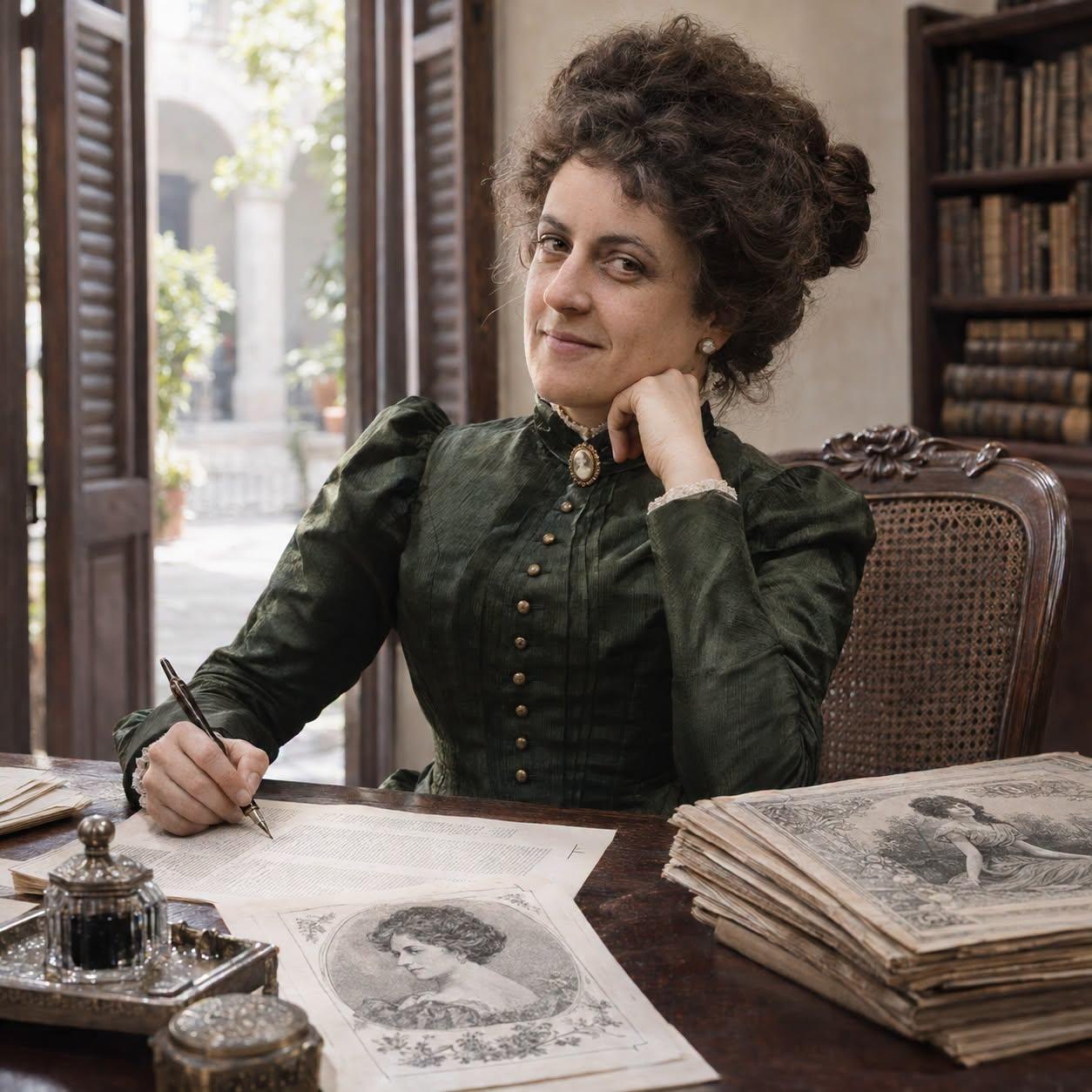
Concepción kept writing. In 1870 she qualified as a teacher and moved with her mother to Madrid. There she joined literary circles, and by 1871 was writing for La Mujer, a magazine edited by Faustina Sáez de Melgar. Education became a sustained concern of her work. In 1877 she published a book about Spanish women, their education and their intellectual abilities.
She married Francisco de Paula Flaquer in 1879, and in 1883 the couple settled in Mexico. That September they founded El Álbum de la Mujer, an illustrated periodical carrying serial novels, biographies of notable women and arguments for women's education. In the early issues she also wrote under a string of pseudonyms, including Vestina and Luz de la Fuente y García, which made the list of contributors look rather longer than it was. In Zaragoza she had warned that her first three pages might also be her last. El Álbum de la Mujer ran until 1890. Concepción was the editor, and for a while several of its authors as well.