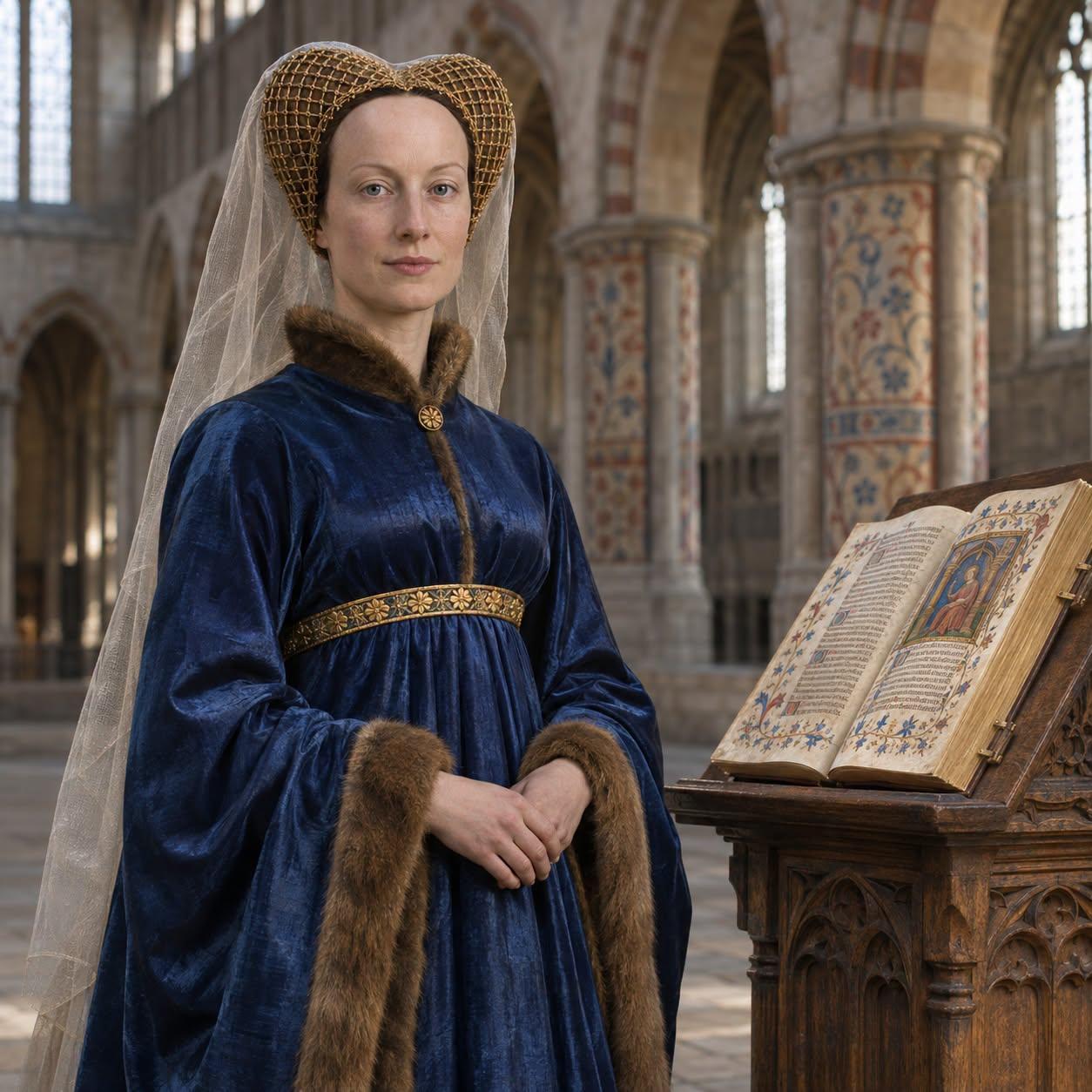
Christina held Stockholm, then surrendered with a promise of pardon. Two months later, he was crowned. Three days after that, the castle doors were shut on his guests.
On 4 November 1520, Christian II of Denmark was crowned King of Sweden in Stockholm's great church, Storkyrkan. The archbishop who crowned him was Gustav Trolle, an enemy of Christina's late husband. Celebrations followed at Stockholm Castle. The fighting was over, the surrender terms had been agreed, and the new king had promised an amnesty. Christina had negotiated protection for the people who had resisted him. Within days, she would have to defend them again.
She was about twenty-six. Born Christina Gyllenstierna into the Swedish nobility, she had married Sten Sture the Younger in 1511, when she was about seventeen. He became Sweden's regent the following year, governing a country divided over its relationship with Denmark. The two kingdoms belonged to the Kalmar Union, but Sten's party resisted rule by the Danish king. Christina bore six children in under ten years of marriage and still took part in governing alongside him. When he died, she already knew how the work was done.
It came apart in the first weeks of 1520. Sten was wounded fighting Christian's invading forces in January and died in February, on the journey back towards Stockholm. Their youngest son, a baby, died that same year and was buried beside his father. Christina was left with a city to defend and children whose future depended on the outcome.
She continued the resistance. From Stockholm Castle she wrote to Sture loyalists across the country urging them to fight on, and she sought help abroad. Her eldest son, Nils, a boy of about seven, was sent to Danzig for safety. Christian's forces arrived in May, and the city endured a siege into September. Its burghers called her "our dear princess". Christina's part was government and command: keeping the defence going and, eventually, negotiating the terms on which it would end. Her husband's death had not delivered Stockholm to his enemies.
It took a settlement to open the gates.
On 5 September, an agreement was reached. The letter of surrender promised that the past would be wholly forgotten. The amnesty covered resistance to the king and the union, but also offences against the Church. That last protection mattered. Sten's supporters had been involved in the removal of Archbishop Trolle and the destruction of his fortified stronghold at Stäket. Christina had obtained terms addressing the very quarrel that would shortly be brought back against her family.
Stockholm's gates opened on 7 September. By November, Christian could take his crown in the city that had held out against him for months, with Trolle restored to his position. The feasting at the castle lasted three days. Under the settlement, his former opponents were supposed to live under his rule without punishment for the struggle that had gone before.
Then, on 7 November, the celebrations gave way to an assembly at the castle. The doors were closed and guards were posted. Trolle brought his accusations against those responsible for his removal and the destruction of Stäket, and the dispute was now treated as heresy, an offence against the faith. Christian's answer was that he could not override the law of the Church. A promise that had covered offences against the Church turned out not to cover this one.
Christina answered the charge.
The action against Trolle had not been her husband's private undertaking. In 1517, a collective decision had been made to remove him and destroy his stronghold. Christina produced the document recording that decision. Her defence placed Sten's actions within an agreement supported by others, rather than leaving him to bear the accusation alone. She had defended Stockholm with its walls, then with its surrender terms. Now she defended a dead man with a document.
The document did not save them. Evidence of a collective decision could also identify a body of people to accuse, and the agreement she presented in defence was used against those who had made it. Churchmen found the accused guilty. Christina could produce a defence. She could not make her opponents accept it.
The executions began on 8 November and continued on 9 November. Bishops, nobles and townspeople were killed in what became known as the Stockholm Bloodbath. Christina's brothers, Erik and Eskil, were among the dead. Her husband's remains and those of their infant son were afterwards dug up and burned. She had been promised that the past would be forgotten. Its graves were now being opened.
Christina was condemned to death as well, but the sentence was not carried out. She was held prisoner at Stockholm Castle, then sent to Denmark in 1521. Her daughters, her mother and other women of the family were held too. Captivity brought further losses: her half-sister Cecilia and Cecilia's daughter Emerantia died, and so did Christina's daughter Magdalena, who was five. The mother who had carried on the defence after losing her husband and baby lost another child long after the fighting had ended.
Christina returned to Sweden in January 1524, more than three years after the coronation that was supposed to settle it all. She had opened Stockholm's gates on a promise that the past would be forgotten. Her brothers had died for that past, and the grave of her husband and baby had been opened because of it. Magdalena never came home.