
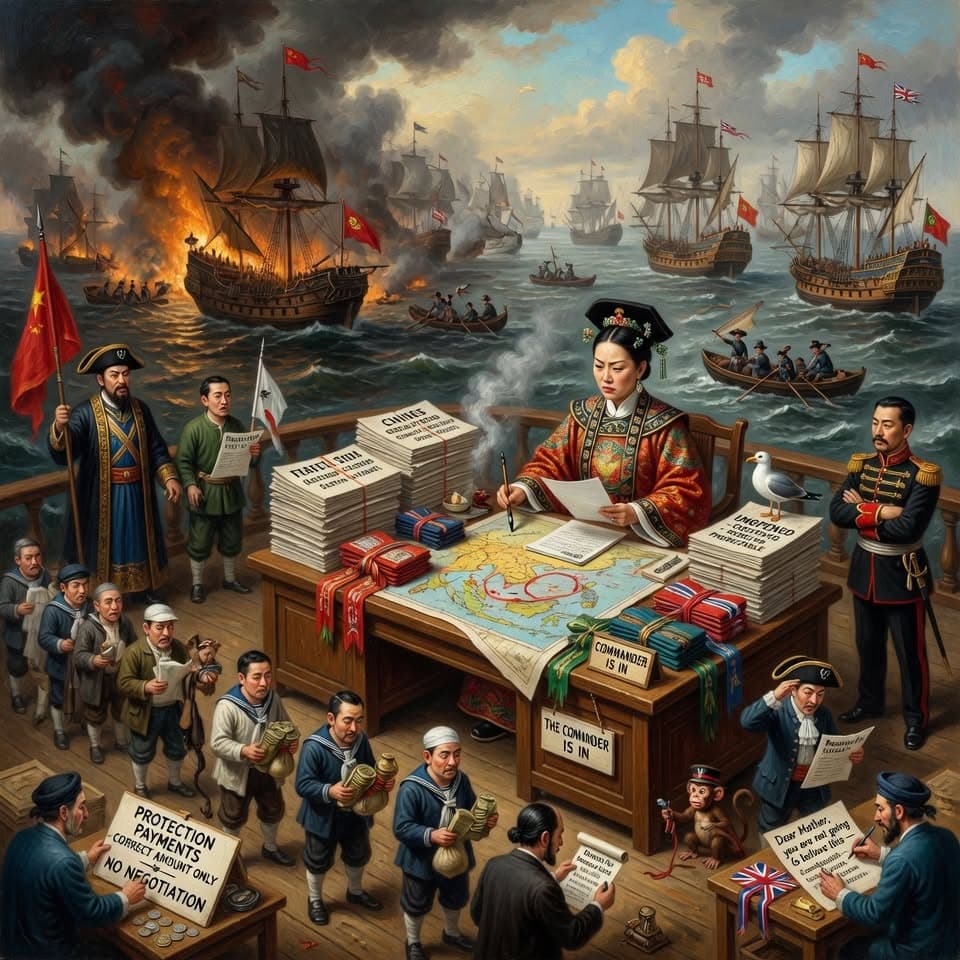
Ching Shih: The Woman Who Built The Largest Pirate Empire In History And Then Retired Because She Felt Like It
In 1801 Ching Shih married Zheng Yi, a Chinese pirate of some reputation, and within six years the two of them had built a confederation of pirate fleets along the South China coast that operated at a scale that made the word pirate feel inadequate.
When Zheng Yi died in 1807 Ching Shih did not retire, grieve quietly, or defer to any of the male commanders who presumably felt they had opinions about succession. She took over. She negotiated with her late husband's family, secured the loyalty of his commanders including the formidable Cheung Po Tsai who she subsequently also married, and proceeded to expand the operation with the focused ambition of a woman who had identified an underperforming asset and intended to realise its full potential.
Within three years she commanded 1,800 ships and somewhere between 50,000 and 80,000 sailors, controlled the tribute and trade routes of the entire South China Sea, taxed coastal villages with the efficiency of a functioning government, and had constructed a code of conduct for her fleet so comprehensive and so rigorously enforced that it covered everything from the distribution of plunder to the treatment of female captives to the correct procedure for requesting shore leave. The Royal Navy had a code of conduct. Ching Shih's was better maintained.
The Chinese Imperial government sent a fleet to deal with her. She destroyed it. They sent another fleet. She captured it and recruited most of the crew. The Portuguese sent warships. She defeated them. The British attempted intervention. She was unimpressed. At one point in 1809 the Imperial government assembled a combined force of their own navy supplemented by Portuguese warships in a coordinated assault that represented the maximum conventional military force available to the most powerful empire in Asia, and Ching Shih defeated it so thoroughly that the government spent the next year reconsidering its options.
The options, on examination, were limited. She could not be beaten by force. She could not be blockaded because she controlled the sea. She could not be starved out because the coastal villages paid her tribute and she had supply lines the Imperial government could not interrupt. In 1810 the Chinese Emperor's representatives came to negotiate. Ching Shih arrived at the negotiations with the calm unhurried composure of someone who had agreed to the meeting as a courtesy and had not altered her fundamental position.
The terms she secured were, by any measure, extraordinary. She was permitted to keep the majority of her ships. Her sailors were offered Imperial pardons and the option of joining the Chinese military with their ranks recognised. She kept her money, which was considerable. She and Cheung Po Tsai retired from piracy with full financial security and she subsequently opened a gambling house in Canton which she ran with the same organisational efficiency she had applied to everything else, dying at approximately 69 years old surrounded by her family, having outlasted every navy that had tried to stop her, every government that had tried to destroy her and every man who had underestimated her, which was essentially all of them, repeatedly, without apparent learning.
The South China Sea went back to being governed by the Imperial navy, which managed it considerably less efficiently. Ching Shih had set a high bar. Nobody has matched it since.