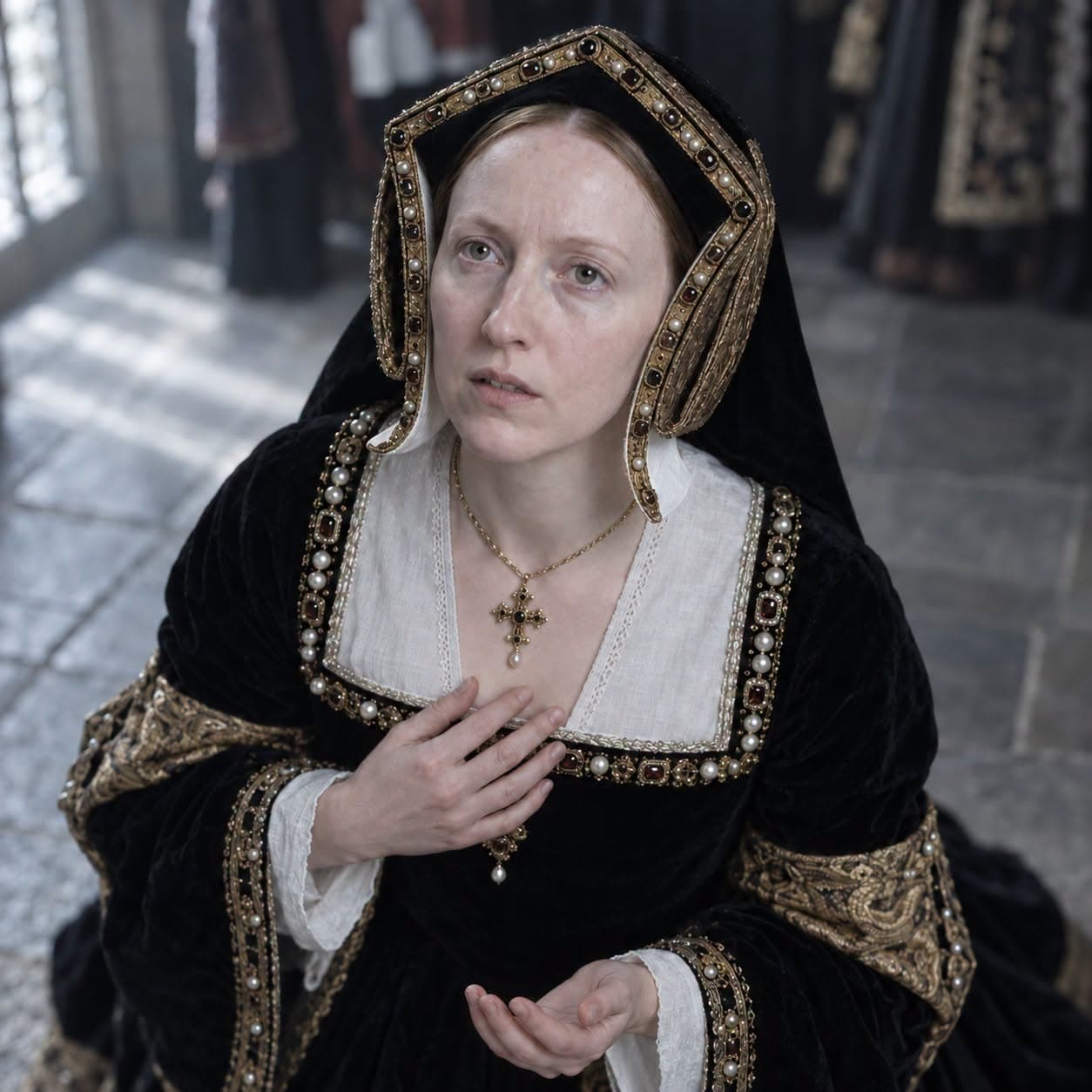
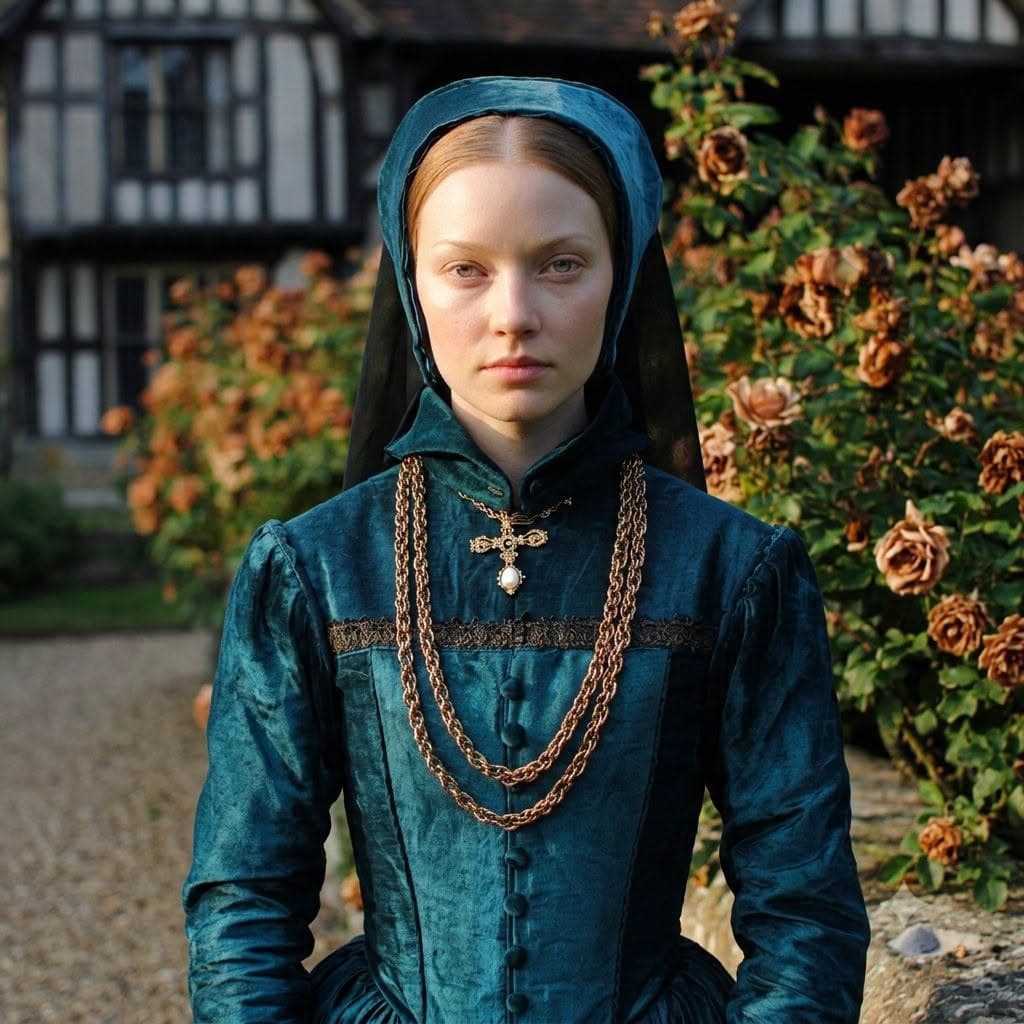
She was seven when her father died and the king sold her wardship to a man who would eventually decide to marry her himself. She was fourteen when that happened. She had no say in it.
She spent the next eighteen years becoming one of the most formidable women in England, and then in the space of thirty minutes on a July afternoon in 1551 she lost everything that marriage had given her. What she did next is the whole story.
Catherine Willoughby was born on the twenty-second of March 1519 in Suffolk, the only child of William Willoughby, 11th Baron Willoughby de Eresby, and Maria de Salinas, a Spanish lady who had come to England with Catherine of Aragon in 1501 and stayed, becoming the queen's closest friend and most loyal companion.
Catherine was named after the queen. She grew up in a household defined by that friendship, by the specific atmosphere of women who had given their loyalty to a Spanish princess who had become a English queen and who did not intend to withdraw it for anyone. Her father died on the fourteenth of October 1526 when Catherine was seven years old, and with his death she became one of the most valuable commodities in England: a female heir to a substantial barony with no male relatives in the direct line, which meant that her wardship and her marriage were the king's to bestow on whoever he judged most useful.
He judged Charles Brandon most useful. Brandon was the Duke of Suffolk, Henry's oldest and closest friend, the man who had been at his side since boyhood, who had jousted with him and caroused with him and secretly married his widowed sister Mary Tudor in 1515 without permission and been forgiven because Henry could not quite stay angry at Brandon for long.
Brandon bought Catherine's wardship in February 1529, when she was nine, intending her for his son Henry, the Earl of Lincoln, who was five. Then Mary Tudor died in June 1533. Brandon buried her and barely ten weeks later married his fourteen-year-old ward himself. His son, for whom Catherine had originally been intended, died the following year, which resolved any awkwardness about the rearrangement.
Brandon was forty-nine. Catherine was fourteen. The age difference was thirty-five years. The historical record does not preserve what Catherine thought about it because nobody asked her, and because what a fourteen-year-old girl thought about the disposal of her person was not information anyone in 1533 considered worth writing down.
What the record does preserve is what she became. She ran the Suffolk household with the efficiency and intelligence of a woman who had understood since childhood that competence was the only power available to her. She became a committed Protestant reformer at a court where that required careful navigation, and she navigated it with a sharpness that made enemies and kept friends in equal measure.
She corresponded with Thomas Cranmer and Hugh Latimer. She was close to Katherine Parr, Henry's sixth wife, around whom a circle of Protestant intellectual women gathered in the dangerous last years of Henry's reign. She said things in public that other people said only in private, and she said them with the specific confidence of a woman who had been managing powerful men since she was a teenager and had developed an accurate sense of what she could get away with. She named her dog Gardiner, after Stephen Gardiner, Bishop of Winchester, the most conservative churchman at court, and she brought it to court and called it by name in his presence.
Gardiner noticed. Gardiner did not forget. The fact that she did it anyway is the measure of her.
Brandon died in August 1545. Catherine was twenty-six, a widow with two sons: Henry, born in 1535, and Charles, born in 1537, both of them carrying the Brandon name and the Suffolk title and the specific promise of boys who had been raised by a formidable mother and educated at Cambridge. She had given Brandon twelve years and two heirs and the management of a ducal household, and she was free of it, and by 1552 she had married again, this time a man of her own choosing: Richard Bertie, her gentleman usher, the son of a master mason, a man of no title and no fortune and no political consequence, who loved her. The court noticed the marriage with the raised eyebrow it reserved for duchesses who married their servants. Catherine did not appear to notice the court noticing.
But before that marriage, before the choice and the freedom and the love, came the fourteenth of July 1551.
The sweating sickness came to Cambridge in the summer of 1551, the same disease that had swept England in waves since the beginning of the Tudor dynasty, killing fast and without warning, a man well at breakfast and dead by supper. Catherine's sons Henry and Charles were at Cambridge when the outbreak began. She rushed them out of the city, moving them to Buckden in Huntingdonshire to get them clear of the contagion.
It was not enough.
Henry, the elder, was struck first. He died. In the time it took Catherine to absorb that, Charles was struck. Charles died. The two boys died within the hour, one after the other, the elder and then the younger, in a house their mother had brought them to specifically to save them. Henry had been fifteen. Charles had been thirteen.
In the specific cruel machinery of English peerage, the title of Duke of Suffolk devolved automatically to Charles in the moments between his brother's death and his own, so that the title would pass through him to the next male heir rather than expiring with Henry, which meant that one of the last things Catherine Willoughby watched was her dying younger son become a duke for an hour.
There is no letter from Catherine describing what those hours were. There is no record of what she said or did not say. The sources go quiet in the way they go quiet around the things that were too large to write, and the silence is its own kind of testimony.
What came after the silence was a different woman, or the same woman with everything that had been restraining her removed. She gave away much of the Suffolk estate. She married Bertie the following year, quietly and without seeking anyone's approval. When Mary came to the throne in 1553 and the Protestant settlement began to be dismantled, Catherine was among the first people Gardiner moved against, as he had not forgotten the dog, and in early 1555 she and Bertie and their infant daughter fled England as Protestant exiles, crossing to the continent in the dead of winter with almost nothing.
They spent four years moving across Europe, living in near poverty, dependent on the charity of Protestant sympathisers and eventually on the generosity of the King of Poland, who gave them shelter and a small estate at Kroze. She had been one of the wealthiest women in England. She was now a refugee in Lithuania with a baby, a husband of no rank, and a faith she had decided was worth all of it.
She came home when Elizabeth came to the throne in 1559. She lived another twenty-one years, Protestant and unrepentant and exactly as sharp as she had always been, corresponding with reformers and managing estates and doing what she had always done, which was survive in the full active sense of the word rather than simply continue to breathe. She died on the nineteenth of September 1580, sixty-one years old, and was buried at Spilsby in Lincolnshire.
She had been sold at seven. Married at fourteen to a man thirty-five years her age. She had built a life inside that marriage that was genuinely her own and had lost it in thirty minutes on a July afternoon. She had married for love in the wreckage, chosen poverty and exile over compliance, and come home to an England that had finally, narrowly, become the one she had risked everything for.
She had wanted a life of her own choosing. It took her sixty-one years to get one. She got it.