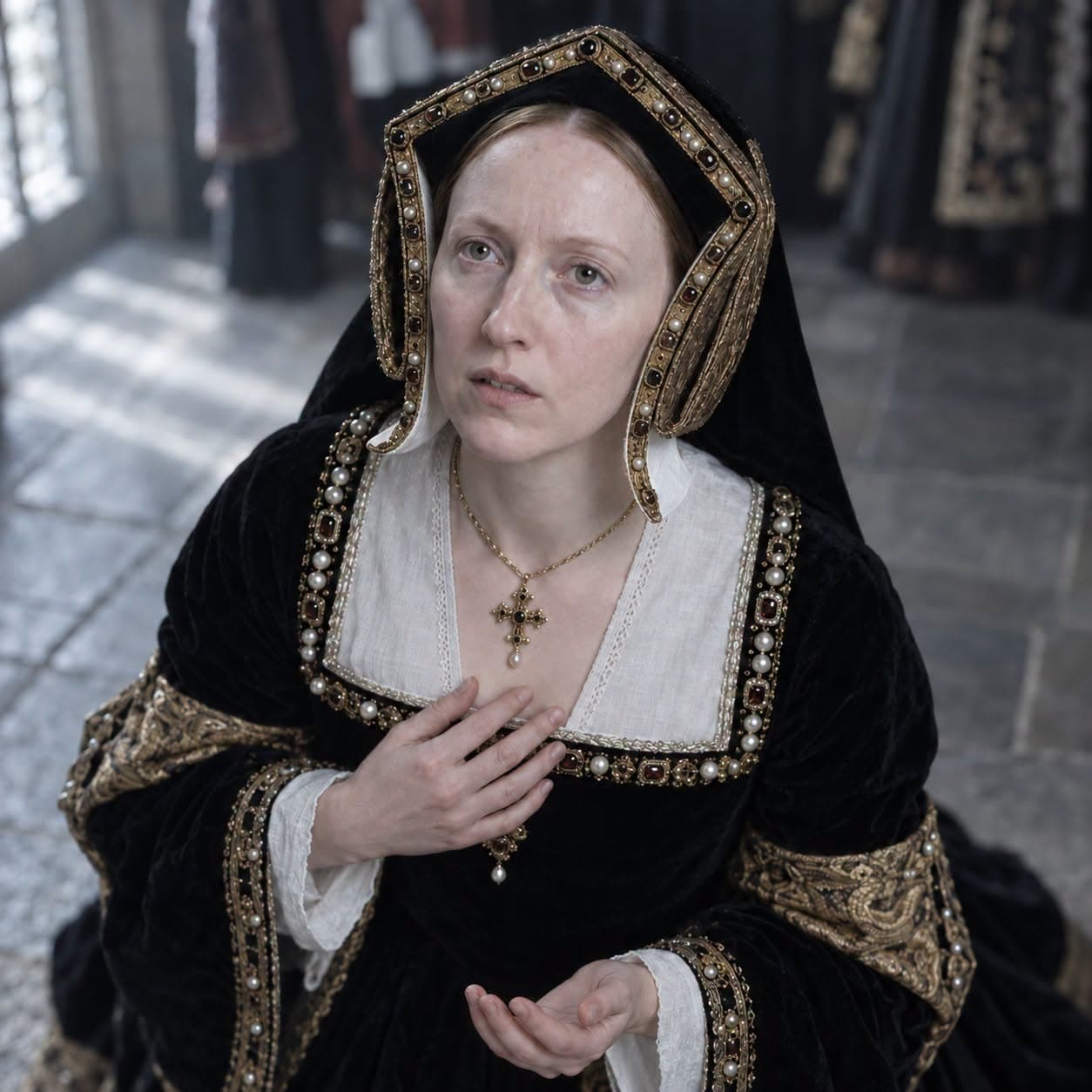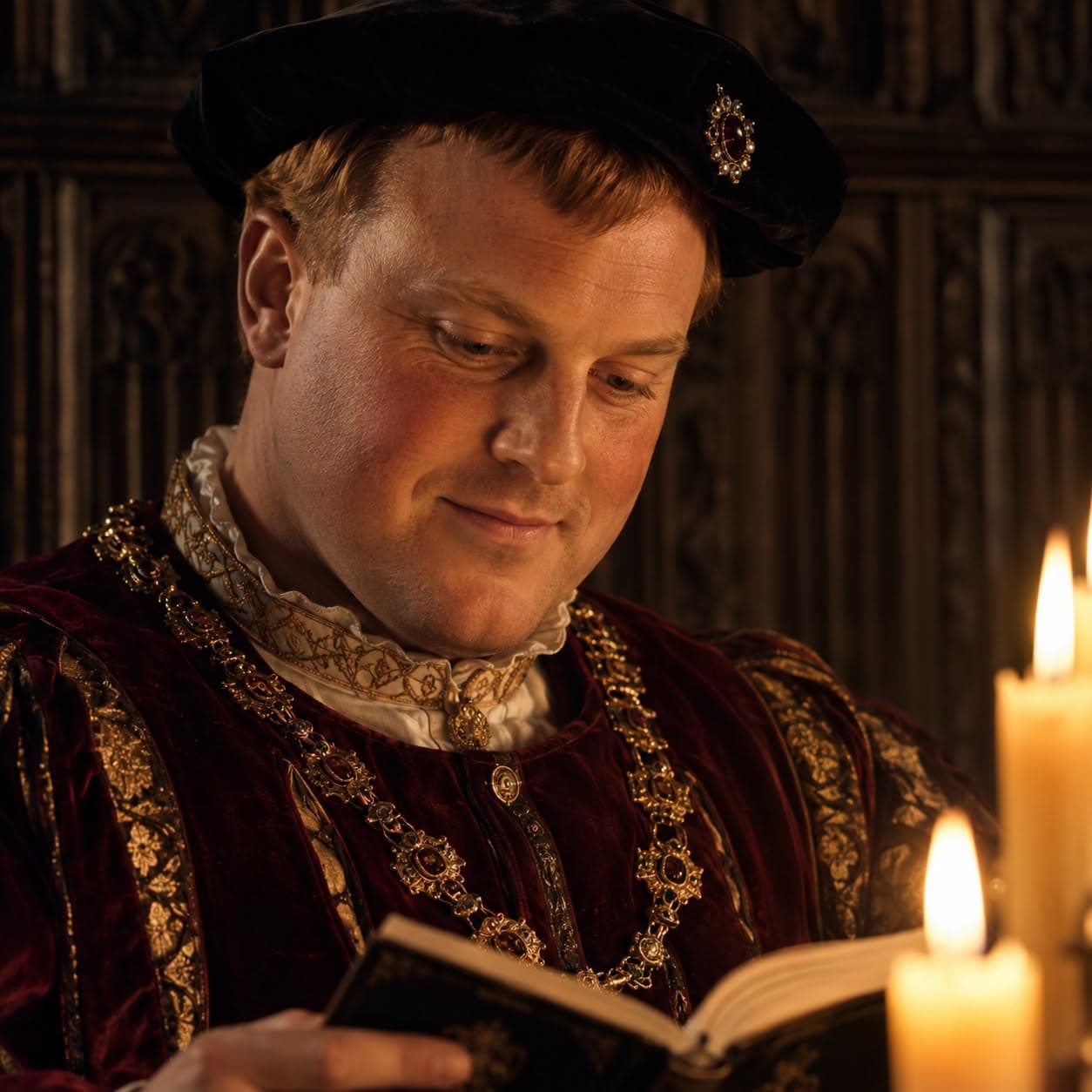
History remembers her as the sensible one. The survivor. The wife who outlived Henry VIII and had the good sense to stay out of trouble.
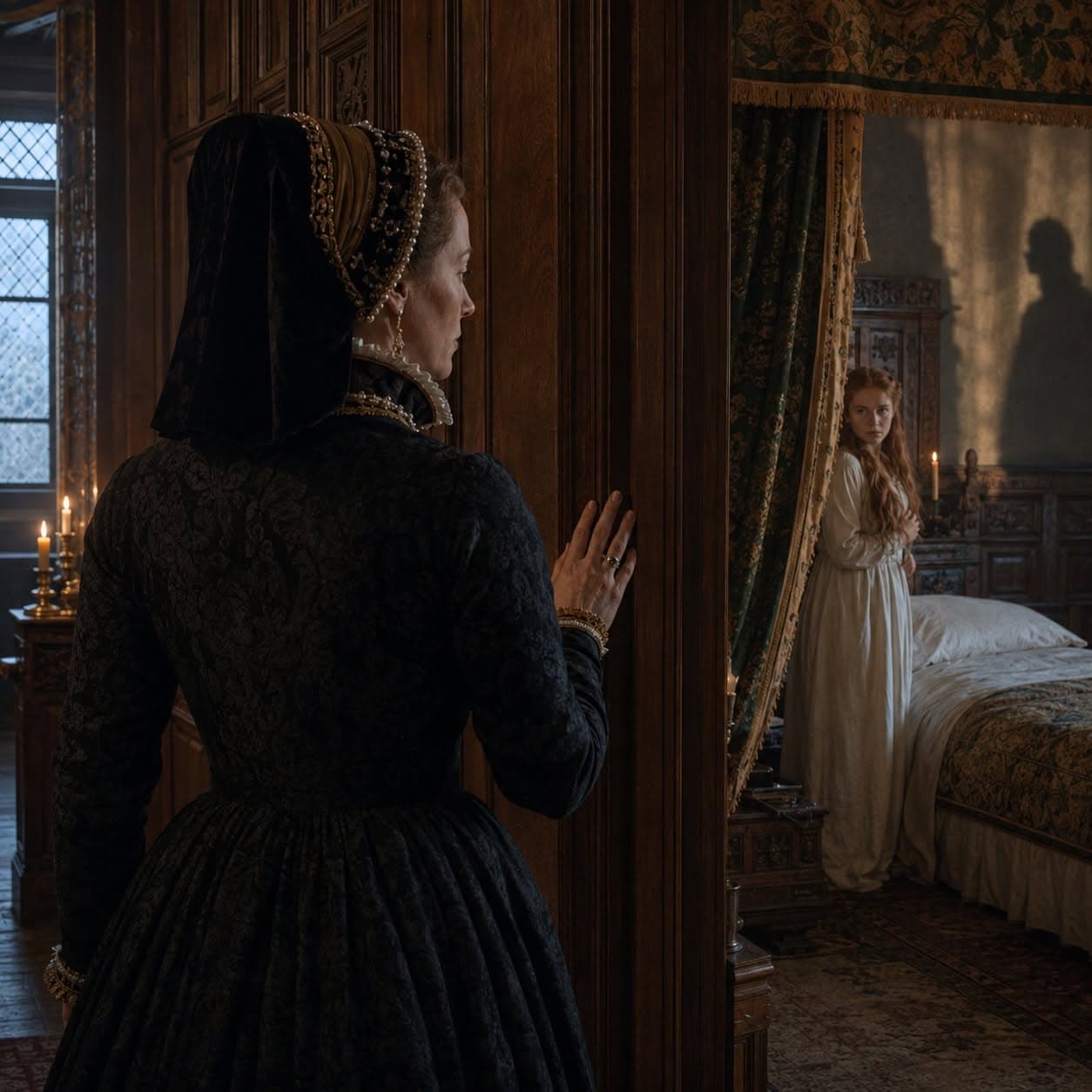
She was also the adult woman in the room when Thomas Seymour was entering a fourteen-year-old girl's bedchamber before dawn. And she was not trying to stop him.
Catherine Parr was born around 1512, the daughter of Sir Thomas Parr, a court official who died when she was five years old. Her mother, Maud Green, had served Catherine of Aragon and named her daughter after the queen she loved, which meant Catherine Parr spent her childhood bearing the name of the woman Henry VIII would spend two decades trying to erase from history. She was educated well beyond the standard expected of women of her time and by the time she reached adulthood she was one of the most intellectually formidable women at the English court.
She was married twice before Henry noticed her. Her first husband, Edward Borough, died in 1533. Her second, John Neville, Lord Latimer, died in March 1543. By the time she was widowed for the second time she was thirty-one years old and had already been managing households, estates, and difficult men for more than a decade. She had also, by the early 1540s, caught the attention of Thomas Seymour, brother of the late Jane Seymour, a man of considerable charm, considerable ambition, and almost no judgment at all. Catherine wanted to marry him. Henry VIII had other plans.
On the twelfth of July 1543, Catherine Parr became the sixth and final wife of Henry VIII. Whatever she had wanted was beside the point. Henry had noticed her at court and Henry's noticing was not a courtship in any normal sense of the word. It was an announcement. Two of his previous wives had been beheaded, one had died in childbirth, one had been divorced, one had been divorced with such speed and finality that the man who arranged the match had nearly lost his own head over it. Catherine accepted. She had studied the options available to her and she chose the one that kept her alive.
She was an exceptionally skilled queen. Henry was by 1543 obese, ulcerated, and in constant physical pain, a king whose moods had become unpredictable to everyone except the people who had spent years learning to read them. Catherine learned to read them. She managed him with the specific intelligence of a woman who understood that her position required being indispensable without being threatening, present without being challenging, influential without being visible. She served as regent while Henry campaigned in France. She published theological works under her own name, becoming the first woman to publish in English. She was also, by 1546, in serious danger.
Catherine's Protestant sympathies had made enemies among the conservative faction at court, led by Stephen Gardiner, Bishop of Winchester. They had already moved against Anne Askew, a Protestant reformer connected to Catherine's household, having her arrested, questioned, and racked in the Tower in an attempt to extract testimony against the queen. Askew refused to name names even under torture and was burned at Smithfield in July 1546. The conservative faction proceeded anyway. A warrant was drawn up charging Catherine with heresy, accusing her of hosting unauthorised theological debates, distributing reformist literature, and contradicting the king's doctrinal authority. The warrant was signed. The arrest party was assembled. Then the warrant was accidentally dropped, and someone loyal to Catherine found it.
What happened next was one of the most extraordinary pieces of political self-preservation in the Tudor period. Catherine went directly to Henry, presented herself as a devoted wife who had been engaging in theological discussion only to learn from his superior understanding, reframed her independent religious convictions as a pupil's attempt to benefit from her husband's wisdom, and talked her way out of a heresy charge within hours. When the arrest party arrived the following day Henry sent them away and called the man leading them a knave, a beast, and a fool. Catherine had survived, as she had survived everything, by correctly reading a dangerous man and giving him precisely what he needed to hear.
Henry died on the twenty-eighth of January 1547. Catherine was free, solvent, and in possession of a jointure that made her one of the wealthiest women in England. She could have remained at court. She chose to retire to Chelsea, and within months she had married Thomas Seymour, the man she had wanted before Henry had intervened. The scandal was immediate. A queen dowager remarrying within months of her husband's death, and to a man of Seymour's reputation, was not received quietly at court. Catherine does not appear to have cared. She had spent four years nursing a dying king and she was thirty-five years old and she married the man she wanted.
The Princess Elizabeth, fourteen years old and third in line to the throne of her ten-year-old brother Edward VI, came to live in their household at Chelsea.
What happened next is documented in the testimonies of Elizabeth's governess Kat Ashley and her steward Thomas Parry, both of whom were arrested on the twenty-first of January 1549 and taken to the Tower for questioning following Seymour's fall. Their accounts were given under duress and their reliability is not absolute. What they described was consistent and specific. Seymour would come to Elizabeth's bedchamber in the early mornings, sometimes before she was dressed, in his nightclothes, to tickle her and slap her on the back. Elizabeth's response was to begin rising earlier and earlier in order to be fully dressed before he arrived. Catherine, according to the testimony, did not object to the early visits. On more than one occasion, she came with him.
The visits continued for months. Catherine knew about them. Kat Ashley testified that she had raised her concerns with Catherine directly and had been told, in effect, not to raise them again. Catherine had survived four years in Henry's court by identifying danger before it reached her.
She had talked her way out of a heresy warrant in an afternoon. She had read the mood of a dying tyrant closely enough to know when to speak and when to go quiet and precisely what to say in each case. She did not raise the morning visits with her husband. She joined them.
The incident that ended it is recorded in the testimony. Catherine came upon Seymour with Elizabeth, alone, in an embrace. What is consistent across the accounts is that Catherine saw something that could no longer be managed as innocent morning play. She sent Elizabeth away from the household in May 1548.
The letter Catherine wrote to Elizabeth at the time of her departure has been read as warm and affectionate, the farewell of a woman who loved her stepdaughter and was protecting her. It has also been read as the letter of a woman who had finally removed a fifteen-year-old girl from her husband's reach and wanted to remain on good terms with a princess who was third in line to the throne of England.
Catherine Parr gave birth to a daughter, Mary, at Sudeley Castle on the thirtieth of August 1548. She died six days later of puerperal fever, aged approximately thirty-six. Mary was left in the care of Catherine's close friend Katherine Willoughby, Duchess of Suffolk, who resented the cost and petitioned William Cecil repeatedly for additional funds to support her. The Privy Council's grant to Mary was not renewed in September 1550. She never claimed any part of her father's estate. After her second birthday she disappears from the historical record entirely, most likely buried near Grimsthorpe in Lincolnshire, where she had lived, in the words of the historian Linda Porter, as an unwelcome burden for most of her short, sad life.
Thomas Seymour was executed on Tower Hill in March 1549. When Elizabeth was told of his death she said he was a man of much wit and very little judgment.
She said nothing about Catherine Parr. Whatever Elizabeth felt about the woman who had joined her husband in her bedchamber before dawn and then written her a warm farewell letter, she kept it entirely to herself.
She kept it to herself for the rest of her life.