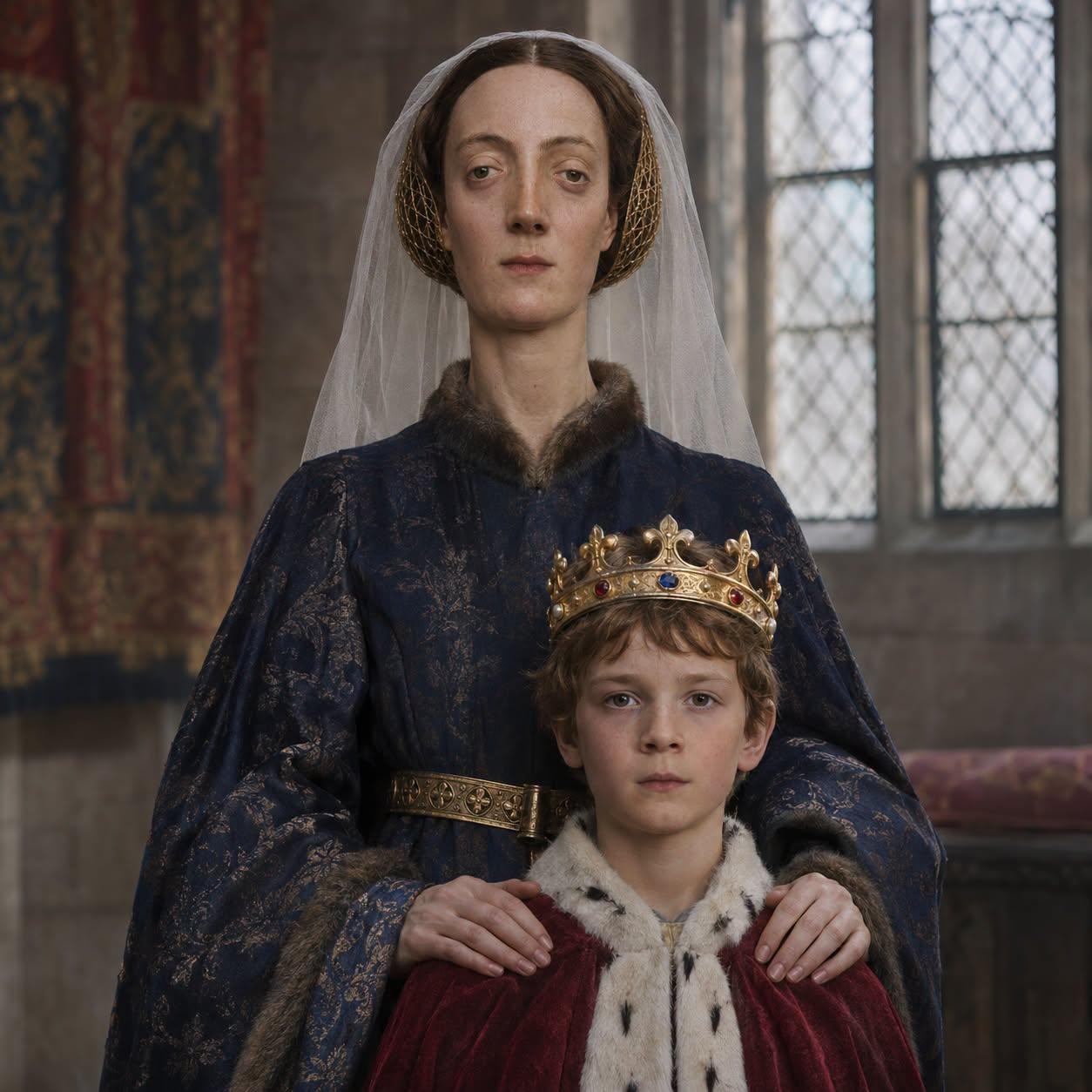
Her seven year old son and her brother claimed the same crown. Her brother had just been crowned in France. Her son was about to be crowned in England.
On 6 November 1429, Henry VI was crowned at Westminster Abbey, exactly a month before his eighth birthday. His mother, Catherine of Valois, was twenty-eight. She was the daughter of a French king, the widow of an English king, and the mother of a child whose government claimed that he should rule both countries. Across the Channel, her brother Charles VII claimed France for himself.
Henry had already been king for seven years. His father, Henry V, had died in France in August 1422, when the baby was not yet nine months old. Within weeks, Catherine's father, Charles VI, was dead as well. The English recognised her infant son as the successor to both men. Her brother's supporters recognised him instead.
It was a family divided into rival kingdoms before the youngest member could speak.
The arrangement had been made at Troyes in 1420. After years of English victories and bitter divisions within France, Charles VI had agreed that Henry V and his heirs would succeed him. His own son was set aside. Catherine's marriage to Henry accompanied the settlement, joining the two royal houses while excluding her brother from the inheritance.
She married Henry at Troyes that June. Their son was born at Windsor in December 1421. The marriage that was supposed to help secure two crowns had produced a baby, and then both the men who had made the agreement were gone. The treaty remained. So did the French prince it had attempted to disinherit.
Her brother had never accepted that their father could give France away. By the summer of 1429, Joan of Arc's campaign had helped bring him to Reims, where he was crowned on 17 July in the place French kings expected to receive their crown. Catherine's brother had now been anointed. Her son had not. Henry's government had a child in England and a claim that needed to be made visible.
At Westminster, the Earl of Warwick led Henry into the Abbey. The boy was seated on a throne on a raised platform, and one account of the day says he looked out at the people around him "saddely and wysely", which then meant gravely. Archbishop Henry Chichele called for his acceptance as king, and the answer came back: "Ye! Ye!" Before the high altar he lay prostrate at least five times. He was changed out of his robes and into new ones four times. Then he was anointed with holy oil.
The men arranging it could provide the robes, the procession and the crown. They could not provide the years between seven and adulthood.
Catherine was at the coronation banquet in Westminster Hall. The account of the feast gives her a single line: "Quene Kateryne, moder of the Kyng", with a great number of ladies and gentlewomen "rially arrayed". Where she sat, and what she made of it, went unrecorded. Her son sat at the high table, with a cardinal at his right hand on a lower chair. Warwick carried his train into the hall. The child was surrounded by the officers and ceremonies of kingship, while the government of his kingdoms remained in adult hands.
Even the banquet displays explained what those kingdoms were supposed to be. One showed the young Henry between Saint Edward and Saint Louis, an English royal saint and a French one. The accompanying verses hailed him as heir to the "floure de lice", the lily of France. The food and its decorations carried the same argument as the ceremony: this boy belonged to both royal lines.
For Catherine, that was also a description of her family. The French royal blood being celebrated in her son was the blood she shared with the man opposing his claim. The English case rested on the treaty rather than on any automatic right through his mother, but it was her parentage that made the picture work.
Catherine's importance as a mother was plain. Her freedom to marry again was another matter.
A measure from the Parliament of 1427-28 threatened any man who married a queen of England without the king's special permission with the loss of his lands and goods for life. The king could give that permission only once he had reached the age of discretion. Catherine's king was her son.
The obstacle was built into his age. A boy could be anointed and crowned, but he could not yet authorise the marriage of his own mother. She faced a long wait if she followed the rules. A new husband for the queen mother might acquire influence around the king, and that possibility was enough to make her private future a public concern.
Henry's coronation did not remove the obstacle. He was still a child when the feast was over, and Catherine was still a young widow whose next marriage mattered to the men governing in his name.
Her second husband was Owen Tudor, a Welsh squire. Their marriage was secret, and its exact date has not survived. One chronicle claimed she chose him because he had nothing to forfeit. The marriage produced another family, including Edmund and Jasper, half-brothers to the boy crowned at Westminster.
Edmund became the father of Henry VII, the first Tudor king. Catherine was twenty years dead when that grandson was born. On the day her seven-year-old was crowned, the rival French king was his uncle. The future Tudor king would be his nephew. Both connections ran back to the same woman, one of the ladies at his feast: "Quene Kateryne, moder of the Kyng".