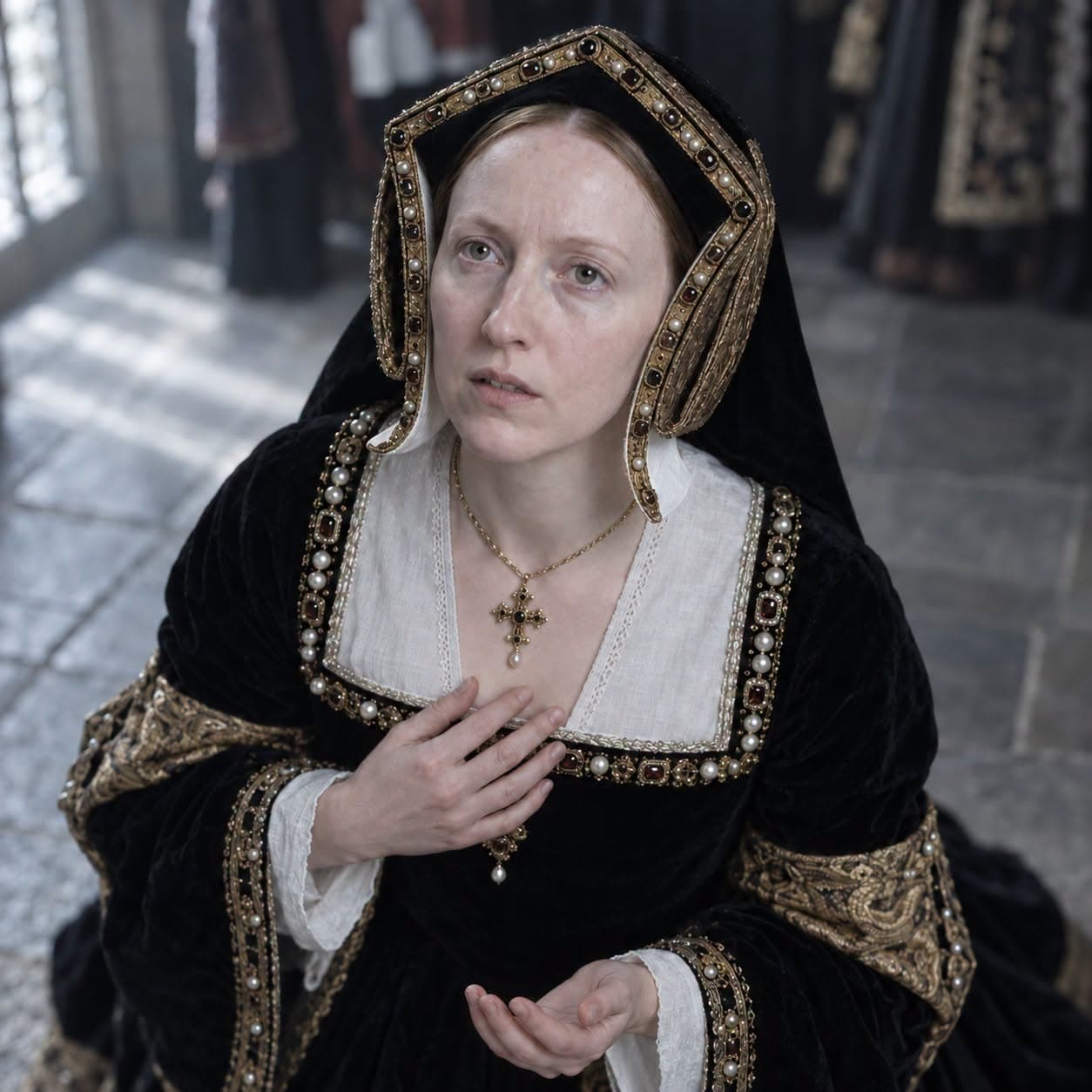
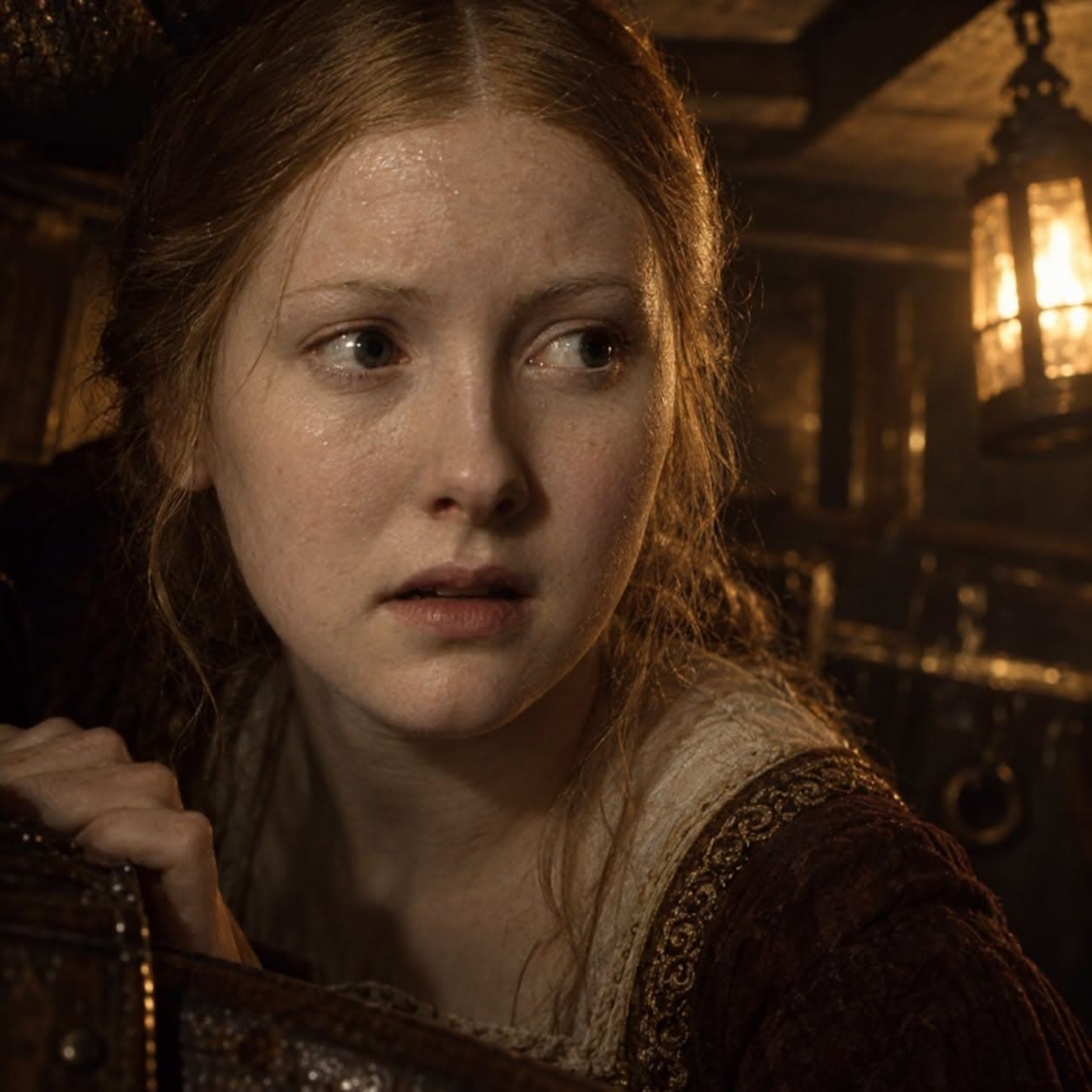
The first time Catherine of Aragon sailed for England, the sea returned her to Spain. On 27 September 1501, she tried again. This time it took her away forever. The journey would be no less perilous.
At five o’clock in the afternoon, the ship carrying Catherine of Aragon weighed anchor at Laredo. The weather was favourable, the sails filled, and the coast began to recede behind her. Catherine was fifteen years old. She was leaving Spain to join a husband she had never seen, in a country she knew through letters, ambassadors and the promises adults had been making on her behalf since she was a small child.
Her first attempt had failed. Catherine’s fleet had sailed from A Coruña on 17 August, but storms and hurricanes in the Bay of Biscay had forced the ships back towards the Spanish coast. For a time, nobody in England even knew whether she had reached a harbour safely. Henry VII sent one of his captains to find her and escort her across the sea. In a letter written on 25 September, he expressed relief that she had survived the “furious sea” and urged her attendants not to delay. The season was advancing, and the weather would only grow worse.
Catherine had every reason to understand what that meant. The Atlantic had already shown her what it could do. The crossing had frightened and exhausted those aboard, and after reaching Laredo they had been forced to wait until conditions changed. Then, two days after Henry wrote his anxious letter, Catherine boarded another ship.
There would be no second return.
Her departure from Laredo was not the moment at which she said goodbye to her parents. That had happened months earlier. On 21 May, after recovering from an attack of ague, Catherine had left Granada and begun the long journey north. Ferdinand and Isabella had intended to accompany their youngest daughter, but in the end they remained behind. Their official explanation was practical: Catherine would travel more quickly without them.
She did not travel quickly. The summer heat became so intense that her household could manage only short distances. By early July, she had reached Guadalupe, still hundreds of miles from the northern coast. Everywhere ahead of her lay another road, another lodging, another stage in a journey planned by diplomats years before she was old enough to understand it.
Behind her were Granada, her parents and the world in which she had been raised. Isabella would never see her youngest daughter again.
Catherine was not travelling to England simply as a princess about to be married. In diplomatic and legal terms, she was already Arthur Tudor’s wife. The arrangements had begun with the Treaty of Medina del Campo in 1489, when Arthur was two and Catherine three. Their proposed marriage formed part of a wider alliance between the newly established Tudor dynasty and the increasingly powerful rulers of Spain.
Years of negotiation followed. Dowry payments, territories, mutual defence and the timing of Catherine’s journey were all argued over. Ceremonies were performed without the couple ever entering the same room.
On 19 May 1499, twelve-year-old Arthur attended a proxy marriage at Tickenhill Manor near Bewdley. Catherine remained in Spain while the Spanish ambassador, Rodrigo de Puebla, stood in her place. After Arthur reached fourteen, the ceremony was performed again in the chapel at Ludlow Castle on 22 November 1500. Isabella formally ratified what De Puebla had done in her daughter’s name so that the marriage could be regarded as lawful and indissoluble.
Catherine had therefore been betrothed by proxy, married by proxy, and married by proxy again before she ever saw her husband’s face.
Arthur and Catherine had exchanged letters in Latin, the formal language in which two carefully educated royal children could address one another as husband and wife. But they had never heard each other speak. They did not know each other’s gestures, expressions or silences. Catherine was crossing the sea to live beside a boy she knew only through words written across the distance between their courts.
England had been preparing for her arrival for months. Henry VII ordered towns and ports to make ready. Noblemen planned jousts and displays of magnificence. Foreign knights were invited, provisions laid in and accommodations arranged.
Isabella welcomed the honour being shown to her daughter but asked Henry to moderate the expense. The most important part of the celebration, she wrote, should be his love and that of Elizabeth of York. They were to treat Catherine as their own daughter.
Those words were written while Catherine still belonged to her Spanish household and Isabella could still direct what should happen to her. Once the ship left Laredo, the distance between instruction and reality would become much greater.
For the first hours of the voyage, the sea was calm. Sometime after midnight, the weather changed.
The fleet continued towards Ushant, the island marking the north-western edge of Brittany. The winds shifted, but the water remained manageable until the ships passed it. Then they were overtaken by a furious gale. Enormous waves rose around them. Thunderstorms returned every four or five hours for the remainder of the crossing.
The account was written by Licentiate Alcaraz, one of the men travelling with Catherine, in a letter to Queen Isabella. He did not claim to know what the princess herself felt as the ship pitched through the darkness. He offered something more honest about everyone aboard.
“It was impossible not to be frightened.”
Catherine had spent years preparing to become Princess of Wales. She had been taught languages, religion, music and the duties expected of a royal wife. Her household had assembled clothes, jewels, plate and the objects needed to reproduce part of a Spanish court in England. Her parents and Henry VII had negotiated over the marriage with immense care.
None of it could quiet the sea.
For five days, the fleet moved north through violent weather. On Saturday, 2 October, the English coast finally came into view. At three o’clock in the afternoon, Catherine’s ship entered Plymouth harbour.
People were waiting and whatever Catherine had endured between Laredo and England, her first sight of her new country was one of celebration. Alcaraz told Isabella that her daughter could not have been greeted with greater rejoicing “if she had been the Saviour of the world.” As soon as Catherine left the boat, she was taken in procession to church.
There, prayers were offered for the future everyone believed awaited her. Alcaraz hoped that God would give Catherine possession of the English realms for long enough to enjoy her life and leave heirs to the throne.
She had arrived as the answer to years of negotiation: the Spanish princess who would marry England’s heir, strengthen the Tudor dynasty and become the mother of its future kings. She was received not as a frightened girl who had crossed a dangerous sea, but as the promise of everything two royal families wanted from her.
Catherine met Arthur for the first time more than a month later. They were solemnly married in St Paul’s Cathedral on 14 November before an immense congregation. Arthur died the following April. Catherine was sixteen, widowed in a foreign country and no longer certain where she belonged.
The alliance that had carried her to England did not carry her home. Instead, Catherine remained while Henry VII and Ferdinand argued over her dowry and her future. She eventually married Arthur’s younger brother and became Queen of England. She would spend much of her adult life defending that marriage, and her final years separated from the daughter for whom she had endured so many pregnancies.
None of that was visible from the ship on 27 September 1501. There was only the harbour at Laredo, the favourable wind and the Spanish coastline growing smaller behind her. The first voyage had returned Catherine to her homeland. The second delivered her to England, where she would be a princess, a widow, a queen and finally a woman forbidden to call herself one.
She never saw Spain again.