She was born on the 16th of December 1485 at the Archbishop's Palace of Alcalá de Henares, the fourth surviving child of Isabella I of Castile and Ferdinand II of Aragon, and the world she was born into was the most formidable political construction of the late fifteenth century.
Her parents had united the crowns of Castile and Aragon through their marriage, completed the Reconquista with the fall of Granada, sponsored the voyage of Columbus, and expelled the Jewish population of Spain in a single catastrophic year — all before Catherine was seven years old.
She was a child of the most consequential decade in Spanish history, raised in a court that moved constantly between Segovia, Toledo, Granada, Seville, in the specific itinerant pattern of a monarchy that governed by presence and could not afford to stay still.
She learned to walk in royal palaces. She learned to read in three languages before she was ten. She was educated by her mother's direct instruction on the curriculum her mother had designed — Latin, French, heraldry, music, dancing, household management, theology, the specific combination of accomplishments required of a girl whose destiny was to be a queen of somewhere.
The somewhere was determined when she was three years old. Henry VII of England, cautious, calculating, perpetually alert to the diplomatic mathematics of European power, had a son called Arthur, Prince of Wales, heir to the English throne. Isabella and Ferdinand had a daughter called Catherine, fourth child, spare to several spares, available for export.
The Treaty of Medina del Campo in 1489 settled the matter in the way that the fifteenth century settled everything: in writing, in Latin, by men who had never met the children in question and would not be required to live with the consequences. Catherine of Aragon, aged three, was betrothed to Arthur Prince of Wales, aged two.
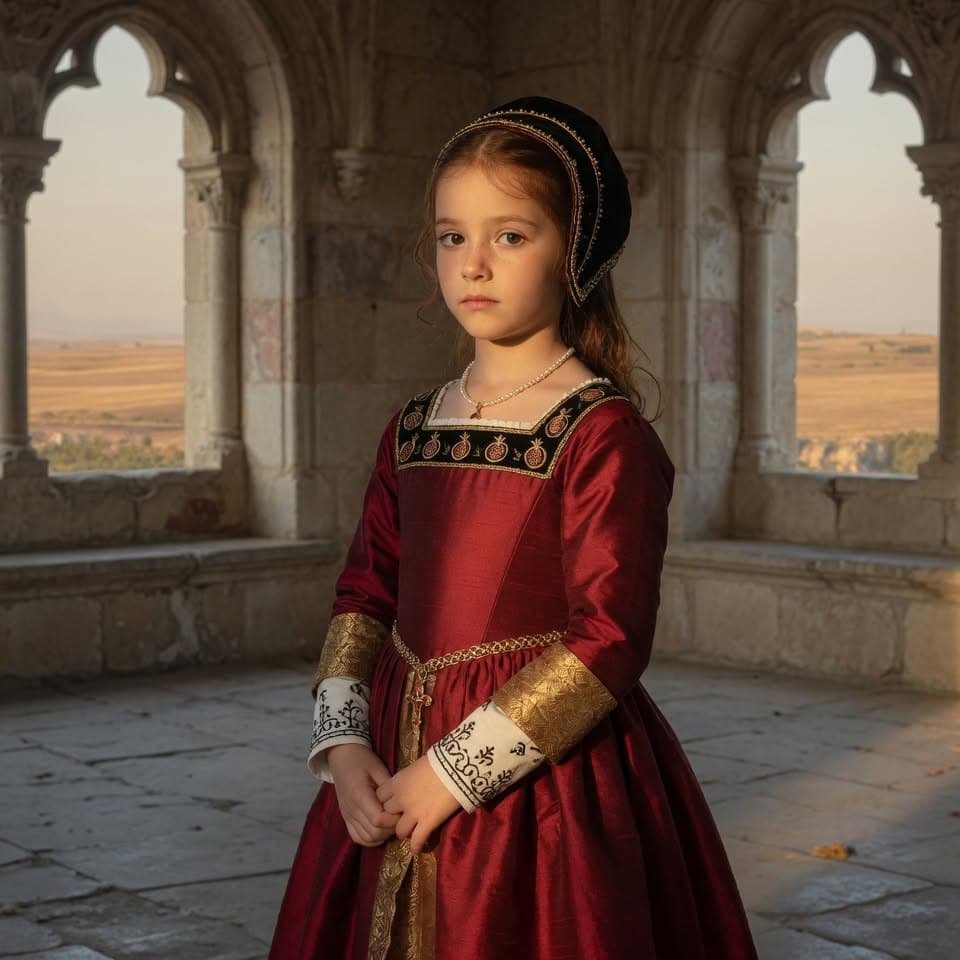
They would meet for the first time fourteen years later. They would be married sixteen days after that. Arthur would be dead five months after the wedding. But in 1492, none of this had happened yet, and the girl in the crimson silk dress at the Alcázar of Segovia was simply a child of the most powerful family in Europe, standing in autumn light, learning to be a queen for a country she had never seen, for a prince who was at this moment a nine year old boy doing his Latin homework in Ludlow Castle three thousand miles away, equally unaware that his life had already been decided.
Her mother Isabella was the dominant influence of her childhood in a way that shaped everything that followed. Isabella was not a woman who believed that daughters were lesser instruments of dynasty than sons — she had ruled Castile herself, personally, in armour when necessary, and she intended her daughters to be capable of the same.
Catherine was educated to the standard of a Renaissance prince, not a Renaissance noblewoman. She studied Latin with the humanist scholar Alessandro Geraldini. She learned to manage a household of hundreds. She was present at court from infancy, observing how power was exercised, how supplicants were received, how dignity was maintained under pressure.
When Isabella rode with her army, Catherine watched from the camp. She absorbed, from the earliest age she could absorb anything, the specific lesson her mother embodied without ever stating it directly: that a queen was not an ornament. A queen was a function. A queen governed. The girl in the crimson dress already knew this. She would spend the next fifty years proving it.
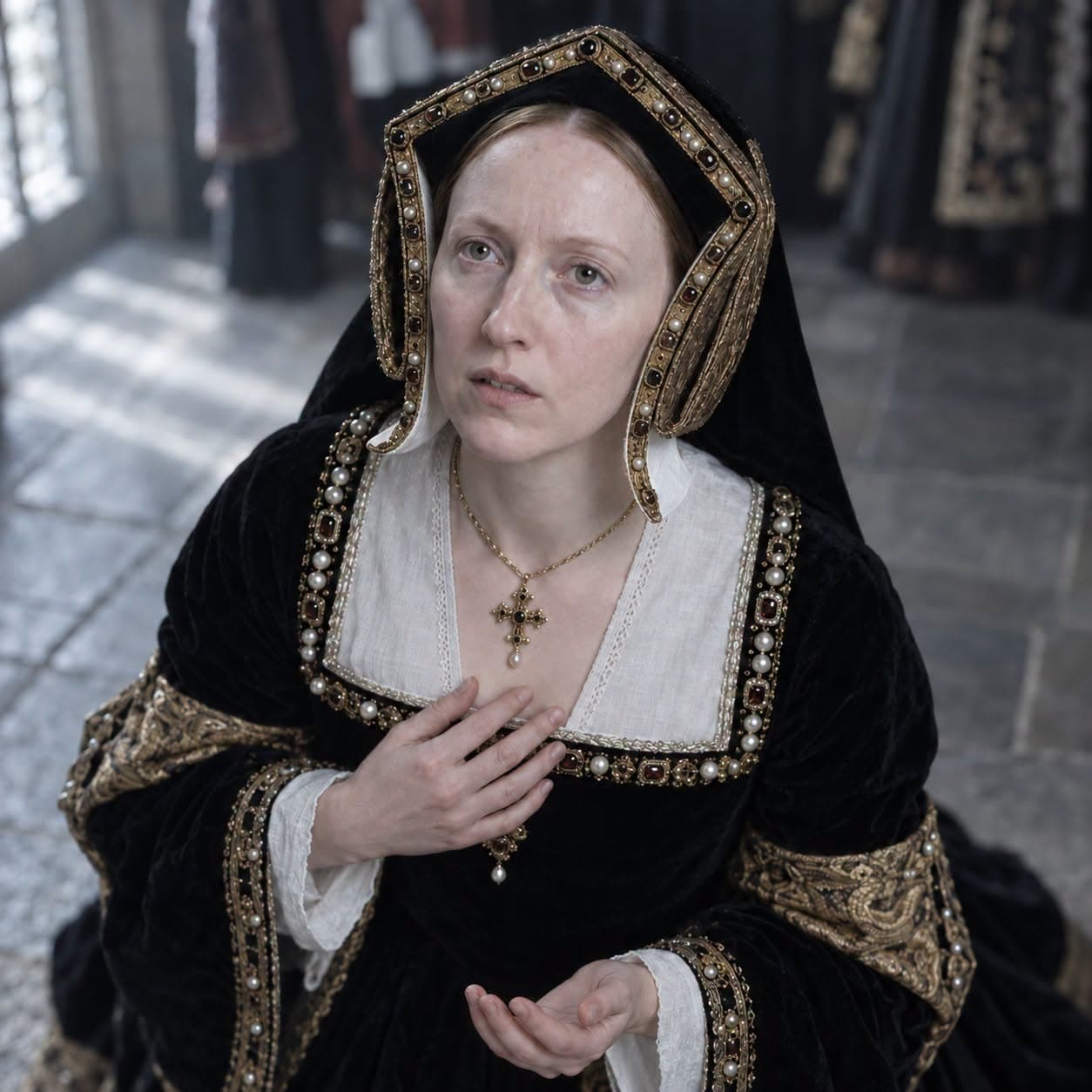
In 1501 she left Spain. She was sixteen, and she crossed the Bay of Biscay in weather violent enough that her ships were forced back to port twice, landed in England to crowds who had never seen a Spanish princess and treated her like a visitation, married Arthur at St Paul's Cathedral in November, moved to Ludlow Castle in the Welsh Marches in December, and was a widow by April.
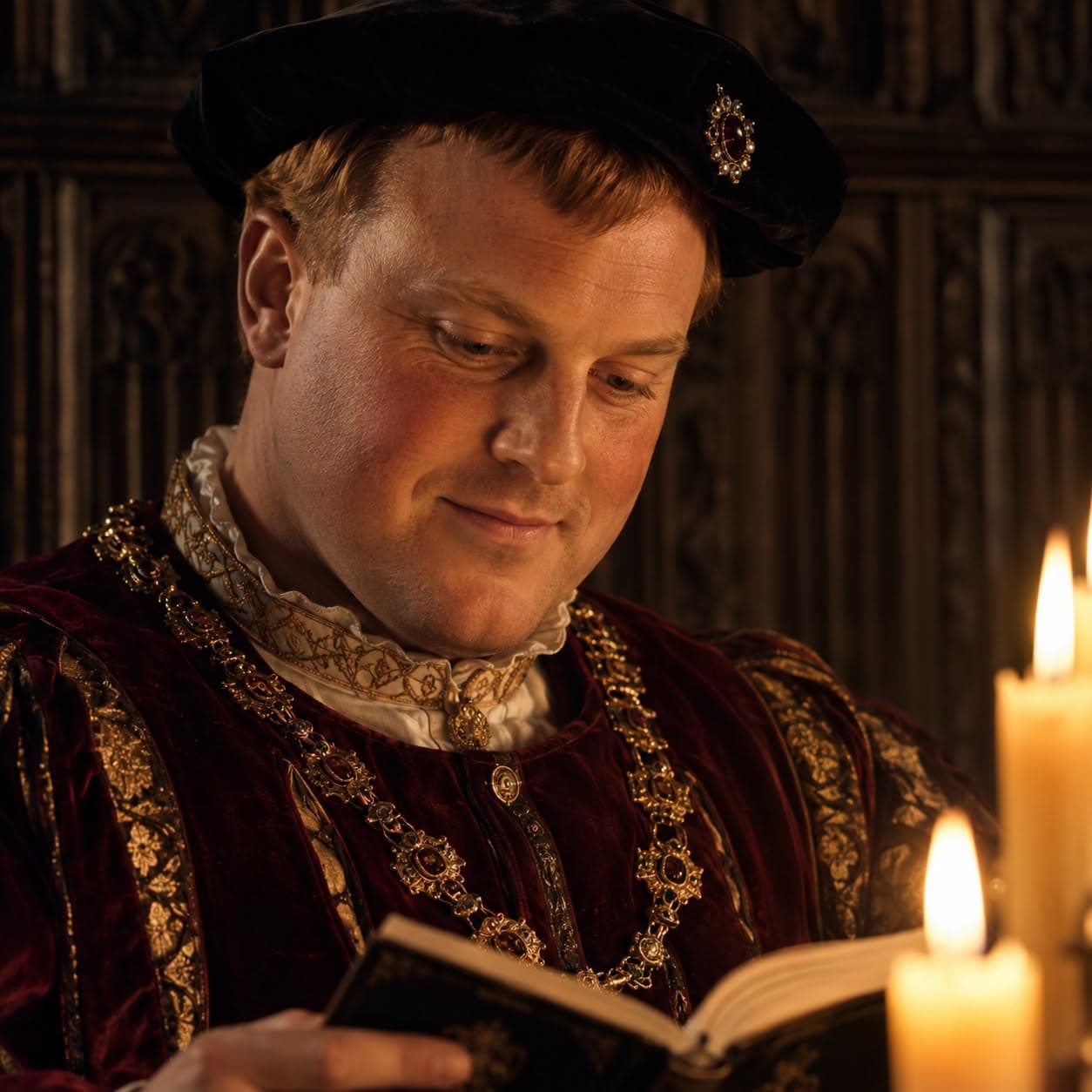
Arthur died of sweating sickness — possibly — at fifteen, taking with him the simple version of her life. What remained was thirty-five years of negotiation, displacement, remarriage to Arthur's younger brother Henry, six pregnancies and one surviving daughter, and eventually the full weight of Henry VIII's desire for a son falling on a woman who had been told since the age of three that she was destined to be Queen of England and had decided, with the quiet immovable certainty of someone raised by Isabella of Castile, that she was not going to stop being one because a man wanted her to.
The girl in the autumn light at the Alcázar of Segovia had no idea any of this was coming. She was standing still as she had been asked to, in her crimson silk dress with its pomegranate border, in the most powerful court in Europe, in the last years before everything changed. The pomegranates on her neckline would become her personal emblem. She would embroider them on her household linens. She would wear them in England through six pregnancies and thirty-five years of queenship.
She would still be Catherine of Aragon when Henry VIII had decided she wasn't, which is the most important sentence in her entire story.