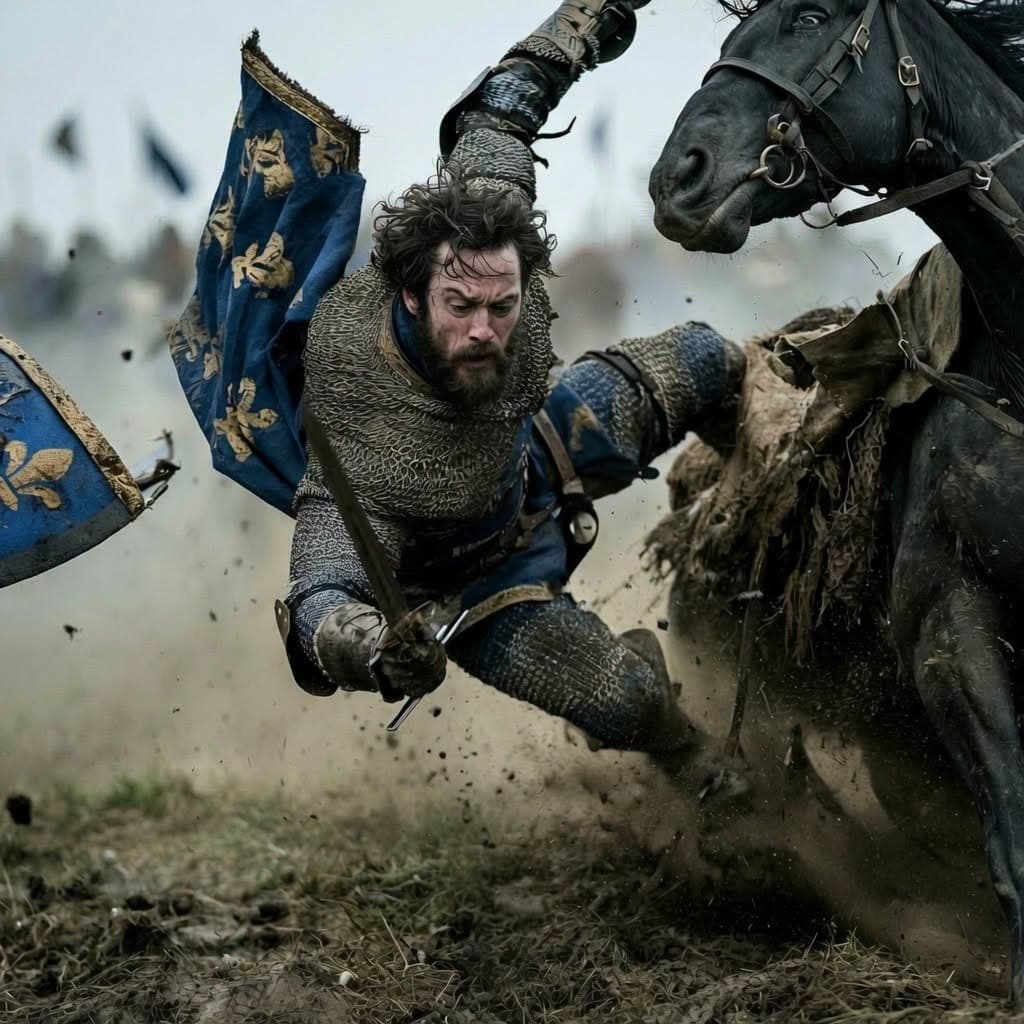
Philip Augustus went down in the middle of his own battlefield, hooked from his saddle by the men of Renaud of Boulogne, a lord who had once been his friend and was now doing everything in his power to end him personally, in the mud, before the day could be decided any other way.
For a few seconds, the King of France was on the ground, unarmoured knights and infantry pressing in around him, and the outcome of the entire campaign hung on whether anyone could reach him before Renaud's men finished what they had started. A household knight named Peter Tristan got there first, throwing himself over the fallen king and giving up his own horse so Philip could be pulled back into the saddle and back into the fight.
It is, by some distance, the closest any of the three monarchs tangled up in the Bouvines campaign came to dying that summer, and the king it happened to was the man who would walk away from the field as the greatest victor of his generation.
King John of England had spent years trying to claw back the vast Plantagenet territories his father and brother had once held across France, lands that had been steadily lost to Philip over the preceding decade. In 1214 he finally moved on a coordinated strategy: he would strike from the west, through Poitou and the Loire valley, while an allied coalition in the north, led by his nephew, the Holy Roman Emperor Otto IV, alongside the Count of Flanders and Renaud of Boulogne, pressed down on Philip's kingdom from the opposite direction. Caught between two fronts, the French crown would be forced to fight a war it could not win on both fronts at once.
It was, on paper, a reasonable plan. It required both halves of the pincer to actually function.
John's half failed first, and it failed badly. Weeks before Bouvines, his forces were routed at the Siege of La Roche-aux-Moines, and John was compelled to retreat, his campaign in the west essentially finished before the northern coalition ever engaged Philip directly. The news of what happened at Bouvines reached him only after the fact, a second catastrophe layered onto a first he had already suffered on his own.
The battle itself, when it came on 27 July 1214, was not the tidy set-piece engagement that later legend sometimes makes it sound like. Philip had been withdrawing his forces southward, apparently hoping to avoid a pitched battle altogether, when Otto's coalition caught up with his rearguard near the bridge at Bouvines. What followed was several hours of chaotic fighting, cavalry and infantry tangled together across open ground, with neither side entirely in control of how the engagement was unfolding once it started.
Thousands of the infantry on the French side were not knights at all but town militia, called up from named municipalities across northern France, ordinary men fighting alongside the mounted nobility in a battle that has sometimes been remembered as a purely chivalric affair but was, on the ground, a much messier and more communal effort than that. Individual moments of the fighting stood out even amid the chaos. Mathieu de Montmorency personally captured twelve enemy imperial banners in the course of the battle, a feat impressive enough that his family commemorated it afterward in their own coat of arms. On the English side of the coalition, William Longespée, the commander present on the field, was unhorsed and taken prisoner not by a knight but by Philip of Dreux, the Bishop of Beauvais, a churchman who apparently saw no contradiction between his office and personally dragging an enemy commander out of the fight.
It was in the middle of this that Renaud of Boulogne's men pulled Philip from his horse, and it was in the aftermath of Philip's rescue that the battle's momentum swung decisively away from the coalition.
Otto IV fared little better than his ally. Over the course of the fighting, three horses were killed under him in succession, the last one deliberately stabbed through the eye by a knight named Gerard La Truie, in an attack that sources describe as explicitly sanctioned by Philip himself, a targeted, borderline-illegitimate strike at an enemy commander rather than an accident of general melee. Unhorsed for the final time and with his own line collapsing around him, Otto fled the field, effectively ending both his personal participation in the battle and, within months, his hold on the imperial throne itself.
The Pope had already moved to depose him years earlier in favour of Frederick II, but Bouvines shattered whatever political and military leverage Otto had left. Otto largely vanishes from the history of imperial power from that point on, a man who arrived at Bouvines as Holy Roman Emperor and left it as a footnote to Philip's triumph.
Renaud did not flee. While Otto's line broke and the wider battle turned decisively toward France, Renaud organised what remained of his infantry, several hundred Brabançon pikemen, into a defensive ring and held it, refusing to surrender even as everyone around him gave up the field. He kept that ring intact until nightfall, the last organised resistance left on a battlefield that had already been lost hours earlier by everyone else. It was, by any honest measure, a remarkable piece of soldiering. The same instinct for direct, personal aggression that had nearly killed the King of France earlier that same day was now turned into one final, doomed act of discipline.
It did not save him. Renaud was eventually captured. What followed was not a quick execution or a ransomed release back into the ordinary rhythms of feudal politics, but something crueler and much longer. He spent more than a decade in chains, imprisoned continuously with no real prospect of release, the man who had come closer than anyone else that day to changing the entire outcome of the battle left to simply exist in captivity year after year while the world he had once operated in moved on without him.
In 1227, still imprisoned, he took his own life.
The political consequences of that day rippled outward in ways none of the men fighting in the mud that afternoon could have fully anticipated. John returned to England from a campaign that had cost him dearly twice over. He arrived home with his treasury drained, his continental ambitions in ruins, and his authority over his own barons weaker than it had been in years. Those barons, who had funded him and then watched their king fail on two fronts in a single summer without ever setting foot on the field that mattered most, had little patience left for him and considerably more leverage than they had held before.
Less than a year later, that leverage produced Magna Carta, a charter extracted from a king who no longer had the credibility, or the money, to refuse it. Bouvines did not cause Magna Carta by itself, but it emptied the account John would have needed to draw on to resist the demand, and it did so in the space of a single chaotic afternoon near a bridge in Flanders, decided as much by a household knight's borrowed horse and one nobleman's refusal to run as by anything either king had planned in advance.