Elizabeth "Bessie" Blount was born around 1498 or 1500 at Kinlet in Shropshire, the daughter of Sir John Blount of Kinlet and Katherine Peshall, the eldest daughter of a well-connected gentry family in the Welsh Marches, and she arrived at the court of Henry VIII in 1512 or 1513 at approximately twelve years old as a maid of honour to Catherine of Aragon.
She had been selected for the position on the basis of her appearance, her manners, and her considerable skill in music and dancing, which contemporaries noted as exceptional even in a court that ran on the performance of accomplishment. She passed the assessment for court service, as one source puts it, by excelling everybody.
She was twelve years old and from Shropshire and she walked into the most competitive room in England and came first. This is the kind of detail that gets lost in the history of the women adjacent to Henry VIII, because the history of the women adjacent to Henry VIII tends to be organised around what Henry did with them rather than what they actually were.
The court she entered in 1512 was Henry VIII's court at its most deliberately magnificent. Henry was twenty-one, athletic, educated, fluent in multiple languages, an accomplished musician himself, and entirely committed to the performance of Renaissance kingship on the most lavish scale England could be made to support. He danced. He jousted. He commissioned masques and pageants and elaborate court entertainments in which the young ladies of the household were expected to participate with the same professional quality he brought to everything he did publicly.
Bessie Blount participated better than anyone. She danced with a precision and energy that Henry noticed, then sought out, then began to depend on as a dancing partner, then began to seek in other capacities. She was his mistress by approximately 1514 or 1515. She was sixteen or seventeen years old.
He was in his early twenties and had been married to Catherine of Aragon for five years and Catherine had produced a series of pregnancies and a series of dead children and one surviving daughter and Henry was beginning to understand that the simple version of his dynastic future was not going to be available to him.
In June 1519, Bessie Blount gave birth to a son at Jericho Priory in Essex, attended by the king's own physician, in a confinement arranged and paid for by Henry VIII himself. The boy was named Henry Fitzroy. He was acknowledged immediately and publicly, which was the single most significant thing Henry VIII did in relation to any of the women in this series, because acknowledging him meant admitting that the failure of Catherine of Aragon's pregnancies was not Henry's failure. It was, in Henry's reading of his own situation, Catherine's.
The acknowledged bastard son was Henry's proof of concept. Everything that followed — the pursuit of Anne Boleyn, the break with Rome, the six wives, the two executions — has its origin in the moment Henry looked at Henry Fitzroy and understood that the problem was not him. Bessie Blount produced that understanding, and was married off to Gilbert Tailboys within the year, and was never Henry's mistress again, and lived out her life in the Lincolnshire countryside with her husband and her subsequent children, dying in 1540 at approximately forty years old.
She was not Catherine of Aragon, who refused to yield. She was not Anne Boleyn, who negotiated her own terms. She was not Mary Boleyn, who was used and discarded and eventually found her own way out. She was a girl from Shropshire who arrived at court at twelve with a gift for dancing and left it at approximately twenty with a son she would not raise and a husband she had not chosen and the specific knowledge that she had given Henry VIII the one thing Catherine of Aragon had not, which was proof, and that the proof had been taken and the prover had been thanked and removed. The court had no further use for her after that. It rarely did.
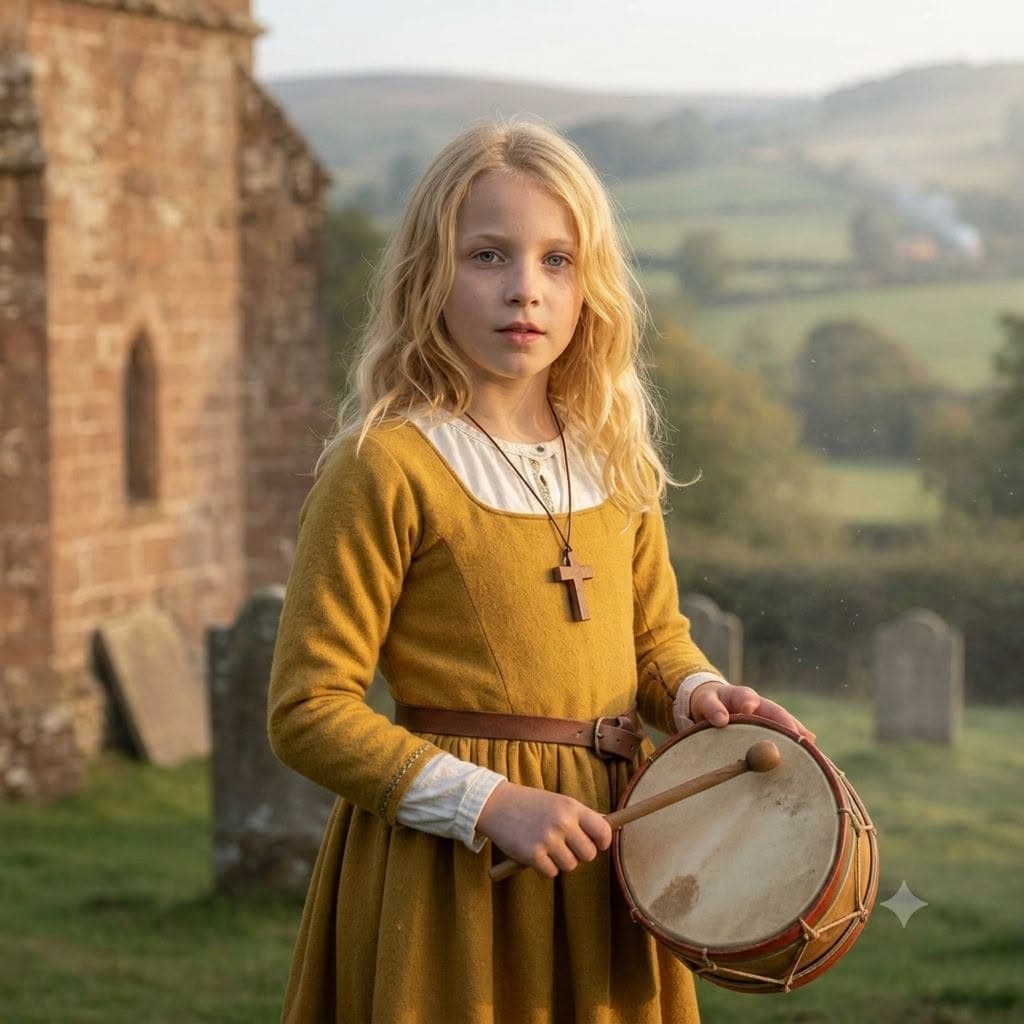
The girl in the Kinlet churchyard with the tabor drum was going to arrive at the most powerful court in England in two years and excel everyone in it and be noticed by a king and produce a son that changed the entire direction of Tudor history and then be married off and forgotten before she was twenty. None of that is visible in the churchyard. There is only the pale gold hair and the Shropshire light and the girl who was about to become, without ever intending it, the most consequential dancing partner in English history.