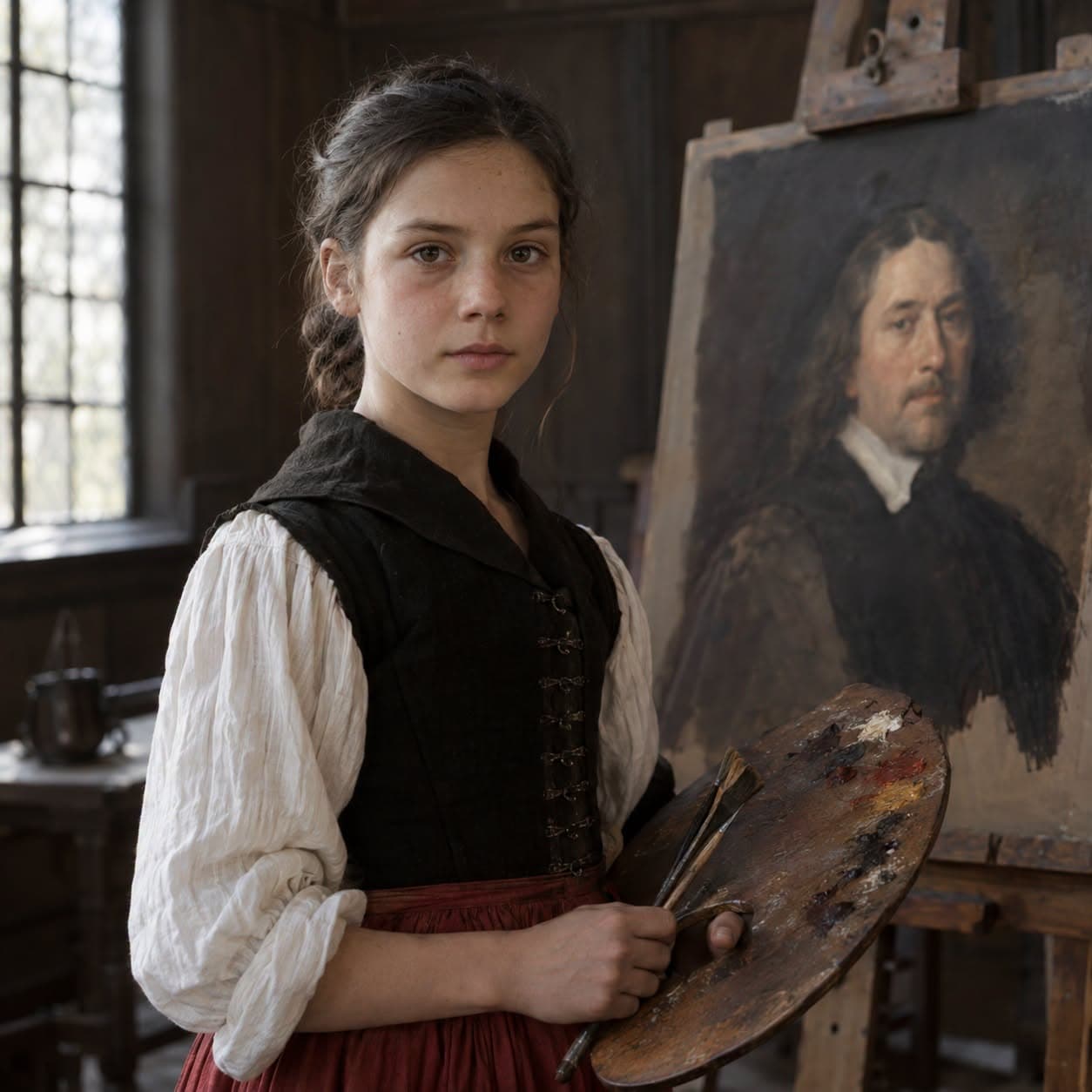
At twelve, Anna Waser painted her teacher. She put herself in the same picture, holding the brushes.
Anna was baptised in Zürich on 16 October 1678, the daughter of Johann Rudolf Waser and Esther Müller. Her father was an official of the Grossmünster foundation, and her education extended to languages and mathematics. When she showed an aptitude for drawing, he arranged for her to be taught. There was something practical behind the encouragement: calligraphy exercises to train her hand, lessons, and eventually the chance to study away from home. Her ability was given time and instruction to become something she could use.
Her first painting teacher was Johann Georg Sulzer of Winterthur, and she made the self-portrait in 1691 while she was still his pupil. His face looks out from a canvas on the easel beside her, his family coat of arms painted in to identify him. Anna stands in the foreground, her brush raised towards his likeness, her other hand holding a broad palette and a bundle of brushes. She has painted the little patches of colour on the palette as carefully as the fastenings of her bodice.
There is a great deal of careful dressing in the picture: full white sleeves, a dark collar, a red skirt and ornaments hanging at her waist. Her face is young, framed by dark hair, and she looks directly out at the viewer. The clothes place her within a respectable household. The tools give her an occupation. Her teacher has his place in the painting, but the larger figure, and the hand doing the work, belong to his pupil.
She was still learning.
In the early 1690s Anna went to Bern to study with Joseph Werner, a distinguished painter whose drawing school offered her further training. She applied with a copy she had made of his own picture of Flora, the goddess of flowers. She became the school's only known female pupil. The girl who had painted herself beside an easel was now being taught among young men for whom becoming an artist was a much more usual ambition. A place in that school mattered. Talent needed somewhere to practise, someone to correct it, and work demanding enough to improve it.
The lessons brought her into a circle of working painters, and she kept up a lively exchange with several of them after she left Bern. Back in Zürich, she established herself as a miniaturist, making the small, finely worked pictures on which her professional reputation grew.
The scale was small. The reputation travelled.
In 1697 she contributed a drawing to the family album of her cousin Johann Jakob Scheuchzer, a physician and naturalist. She drew herself as Flora, with flowers in her hair. Beneath it she wrote a cousin's greeting in French and signed it with her own name. She had once copied Werner's Flora to win a place at his school. This time the goddess had her own face.
In 1700 Count Wilhelm Moritz of Solms-Braunfels appointed her court painter at his castle on the Lahn in Hesse. Anna left Switzerland to take up the position. No other Swiss woman artist of the Baroque period is known to have held a court post. A German count had found a use for the skill developed through those years of lessons and practice, and had given it a title. Painting had become her work, with a place for her in a household far beyond the city where she had begun.
By about 1702 she was back in Zürich. The court appointment had been a short part of her life, and the work continued at home. Scheuchzer commissioned landscapes from her, and some were later used to illustrate his accounts of journeys through the Alps. The cousin whose album held her as Flora now needed her for mountains. Her hand could turn from the details of a face to the forms of a landscape, and Scheuchzer made sure her contribution was credited. It was noticed well beyond Zürich: one of his correspondents in England called her "the most Ingenious Madame Anne Waser".
Her work is well documented up to 1708, and one more silverpoint drawing survives from 1711. Anna died in Zürich on 20 September 1714, aged thirty-five. About twenty-five of her drawings survive, in ink, red chalk and silverpoint, the marks of a hand that had learnt several ways to make an image.
The early self-portrait is now at the Kunsthaus Zürich, the only oil painting by her known to survive. The red skirt, the palette with its little patches of colour and her teacher's face are still there, just as she painted them. So is the line she wrote beneath his coat of arms: "Painted by Ana Waser of Zürich in the twelfth year of her age, Anno 1691." The portrait on the easel is her teacher's. The painting that contains them both is hers, and she signed it.