
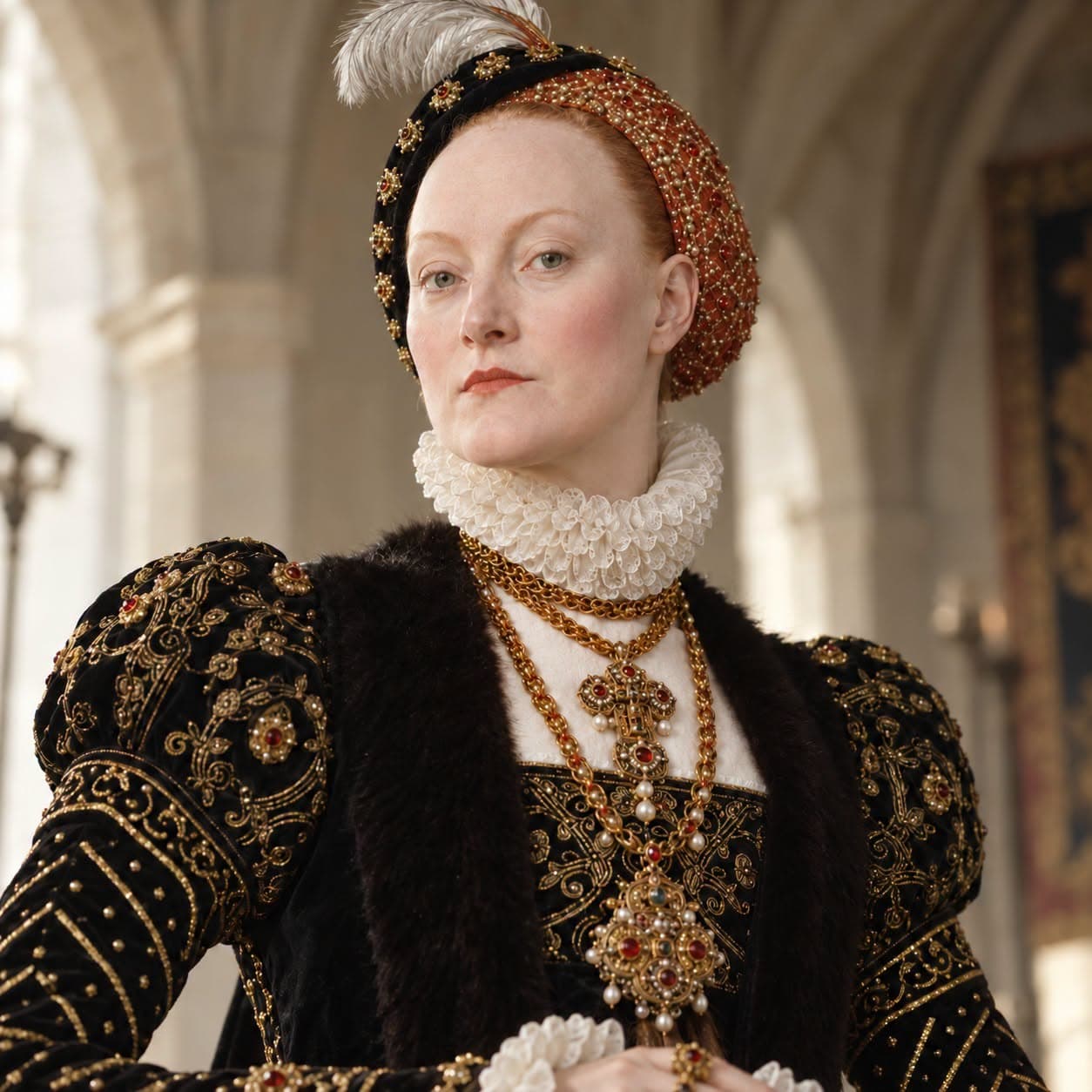
Anna of Saxony gave birth fifteen times. She also helped bring down her husband's favourite doctor.
In the 1570s the Elector of Saxony's physician and favourite, Caspar Peucer, ended up imprisoned, his letters used against him. She is better remembered as the kind lady of the herb garden.
Anna was born on 22 November 1532 at Hadersleben, the first child of the future Christian III of Denmark and his wife Dorothea of Saxe-Lauenburg. She was raised to be useful. At her mother's side she learned to gather healing herbs and to prepare remedies. Those lessons were not decoration.
In October 1548, at fifteen, she was married at Torgau to Augustus of Saxony. She left Denmark as a girl and arrived in Saxony as the wife of the elector's younger brother. The marriage would last thirty-seven years.
Then the children began to come. Over those years she bore fifteen of them. Five did not live to see their first birthday, and five more died before their fourth. Alexander, the hereditary prince, was eleven. Only four reached adulthood. She carried a child, gave birth, and often buried the baby before the next one arrived. She and Augustus travelled almost everywhere together, often while she was pregnant.
Yet she did not live only inside that grief. She worked, and the work was practical and unglamorous. Anna ran farms and gardens, and she became known as "Mutter Anna", Mother Anna. At Annaburg, the estate that carries her name, she had laboratories where she and her servants made medicines. In 1581 she founded the court pharmacy in Dresden. She is sometimes called the first woman pharmacist in Germany.
From 1581 she gave her subjects medical advice and remedies without charge. She collected recipes and wrote them down. Her most popular remedy was aqua vitae, a herbal spirit that she gave away as presents at New Year. She also built up a large library and kept up an extensive correspondence, with scribes to write her letters and books to record the ones she sent. The woman at the centre of all this was a gardener, a physician of sorts, an estate manager and a mother, all at the same time.
She obtained the first tulips and tobacco plants for the Dresden court garden. In 1578 Augustus handed her the management of all his estates. Anna did not only keep the household going. She tried to improve it, buying new breeds of livestock and searching out fruit trees.
Beside her stood Augustus. Their marriage was a harmonious one, and her letters show a close, trusting bond with him.
Anna was devout, and her faith was strict. In those years Saxony was torn by a quarrel between orthodox Lutherans and the so-called Crypto-Calvinists, who were suspected of leaning toward the Reformed faith and of being too close to the followers of Melanchthon. Peucer stood among the leaders of that suspected party.
In the spring of 1574 a letter from Peucer's circle said that once they had Mother Anna on their side, the elector would soon follow. Anna feared they meant to drive a wedge between her and her husband. In April, Peucer was arrested. He would be held for twelve years.
Anna played a significant part in the suppression of the Crypto-Calvinists from 1574, and the spread of strict Lutheranism in Saxony owed a good deal to her support. The same woman who handed out remedies free of charge had a part in the suppression that ended with her husband's own physician in prison.
She acted on her faith with real force.
From 1574 she was repeatedly seriously ill, and in 1584 she took the waters at Schwalbach in the hope of a cure. She died at Dresden on 1 October 1585, at the age of fifty-two, after months of illness, in the middle of the preparations for her daughter Dorothea's wedding.
She left behind a name that Saxony remembered as that of a mother of the country.
Peucer was still in prison when Anna died.On 3 January 1586, three months later, Augustus, now fifty-nine, married again. His new wife, Agnes Hedwig of Anhalt, was twelve. She and her father pleaded for the prisoner, and on 8 February Peucer was released. Augustus died a few days later.
Peucer went to Dessau, in Anhalt, where he served as physician and counsellor until he died in 1602. The notes he had kept in prison were printed after his death.
Anna had borne fifteen children and buried eleven of them. The doctor she helped to bring down outlived her by almost seventeen years.