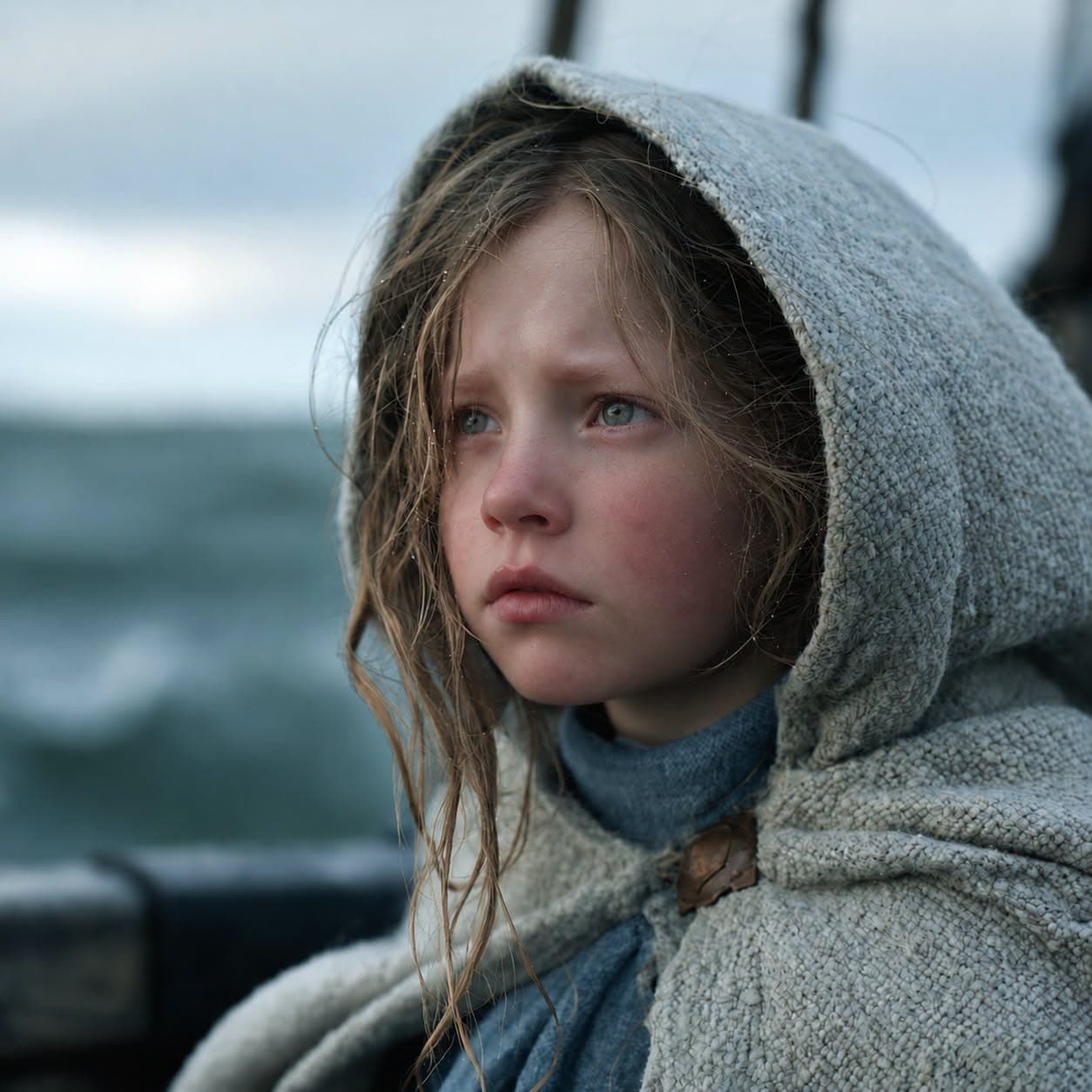
She was eight years old when they sent her across the Channel with no dowry. For the next twenty six years she would have no husband and no freedom either.
Alys of France was born on 4 October 1160, into a family that was already tangled. Her father, Louis VII, had once been married to Eleanor of Aquitaine. He lost her, and her great duchy of Aquitaine, when the marriage was annulled in 1152. The two daughters of that marriage, Marie and Alix, were Alys's half-sisters. Her mother, Constance of Castile, was Louis's second wife. She died giving birth to Alys, and five weeks later the king married for a third time. The new queen soon gave him a son, Philip, who would one day rule France.
So it was that Alys grew up as the youngest child of a king who had lost one queen, buried another and wed a third. In January 1169 her father signed a contract with Henry II of England. She was to marry Henry's son Richard. Richard was eleven, and he was the son of Eleanor of Aquitaine, the woman Louis had once married.
An eight-year-old girl was now being promised to the eleven-year-old son of her father's first wife.
She was sent to England as Henry's ward, to be raised in the household of the man whose son she would marry. Henry's court was seldom in one place, and the princess lived in his keeping, at one point being held under guard at Winchester.
Richard was fifteen years old when he launched his rebellion against his father. Shortly before his seventeenth birthday he found himself on his knees begging his father's forgiveness. Henry II had won the war, and he was not about to reward a rebellious son by finalizing a marriage that would give Richard a French alliance and potentially political leverage.
The years passed and the wedding still did not come. By 1177 she was seventeen and Richard was nearly twenty, old enough by any reckoning. That year a papal legate, Cardinal Peter of St Chrysogonus, told Henry to hold the marriage or see his French lands placed under interdict.
Henry gave his word. Still the wedding did not come.
Behind the delay lay a piece of land. The Norman Vexin was a strip of border country between Normandy and the French king's domain, and its stronghold was Gisors, a great keep that men called the key to the region. When her sister Margaret went home to France in 1183, the Vexin and Gisors were made part of Alys's dowry. As long as Alys remained unmarried and in Henry's keeping, so would the land.
Her half-brother Philip was king of France by then, and he pressed the matter again and again. In December 1183 the two kings met to talk about her. In 1188 Philip demanded that Henry either marry her to Richard or send her home with her dowry. Henry would do neither. That November, at Bonsmoulins, Richard knelt to Philip and did homage.
Eight months later his father Henry was dead.
By then another story had been going round for years. It was said that the king who kept the princess had himself taken her to his bed, and that she had borne him a child in secret.
Richard was king now, and he was still bound by oath to marry her. That winter the two kings were stuck at Messina in Sicily, waiting out the weather and each other, on their way to the crusade. Richard went to Philip and told him that he could not marry his sister.
He said that his father had already lain with her.
Philip, who had spent years arguing for this marriage, did not believe him at first. But the crusade could not go on with the two kings at odds, and in March 1191 they made a treaty. Richard paid Philip ten thousand marks as part of the settlement that ended the betrothal. Gisors was to be restored to Philip, while Richard retained the Norman Vexin under conditions laid down in the treaty.
On 12 May 1191 Richard married Berengaria of Navarre. Alys had been promised to him for twenty-two years. She was by now thirty, and the treaty that freed Richard from his oath had freed her from nothing. He kept Gisors and she stayed in his keeping, a French princess with a claim to lands.
The matchmakers were not yet done with her.
In 1192 her brother Philip offered her to Richard's younger brother John. Richard's mother, Eleanor of Aquitaine, put a stop to it. When Richard was taken prisoner on his way home from the crusade and held to ransom in Germany, John asked for her again. Once again, it was the fortress of Gisors and the land around it that the offer was really about.
In 1195, at thirty-four, she was finally sent home to France. She had crossed the Channel as a child of eight, with her hair still loose, and she came back a woman who had spent her whole youth in other people's halls. On 20 August Philip married her to William Talvas, Count of Ponthieu. William was sixteen, eighteen years younger than his bride. He had held his county since he was twelve, and he was loyal to the king.
Their daughter, Marie, was born in April 1199, the month Richard died of a crossbow wound at Châlus. The woman who had been traded at eight years old now watched the same thing happen to her own daughter. In the summer of 1208, before she was ten years old, Marie was married off to Simon of Dammartin. He was a count whom Philip wanted to keep close. He was twenty-eight years old.
Alys died around 1220, when she was about sixty. No one wrote down how, or where she was laid to rest. She had outlived every one of the people who had decided her life for her. Henry, who kept her, Richard, who refused her, Eleanor, who blocked her marriage to John, and John, who asked for her twice. Her husband and her brother the king would follow her within a few years.
Two kings had held the land that was meant to be her dowry, and for twenty-six years they held her with it.