Alexandra was seventeen, and the paperwork for her marriage was written on mourning stationery. The queen arranging it had lost her own husband. Her eldest son was about to gain a wife.
On 7 November 1862, at Osborne on the Isle of Wight, Queen Victoria signed a warrant authorising the formal arrangements for the marriage of the Prince of Wales to Princess Alexandra of Denmark. The document directed that the Great Seal be attached to letters patent empowering Lord Paget to conclude their marriage treaty. Alexandra's engagement was already settled. The promises made between two young people were now passing through the hands of the Lord Chancellor.
Her future husband was Albert Edward, known to his family as Bertie, Victoria and Albert's eldest son and the heir to the British throne. He was twenty, with his twenty-first birthday two days away. Alexandra would turn eighteen in December. Before either of them had reached those birthdays, their marriage required diplomats, a treaty and the sovereign's signature. Royal families could be remarkably thorough about a wedding.
The two had met at Speyer Cathedral in Germany in September 1861, when Alexandra was sixteen and Bertie nineteen. Less than three months later, Bertie's father was dead and his mother was a widow. In September 1862, when Victoria travelled to Brussels to meet her, Alexandra wore plain black, without jewels, out of respect for the queen's mourning. On 9 September the couple became engaged in the gardens of the royal palace at Laeken, near Brussels. A photograph taken to mark the engagement shows Alexandra seated, facing the camera, with Bertie standing beside her, his right arm around her shoulders. For that photograph, there are only the two of them.
By November, the arrangements had acquired the weight of the family Alexandra was joining. She would marry the queen's son, become Princess of Wales and eventually stand beside him as queen. The move from a Danish princess's life into the British royal household was being prepared while that household was still trying to live without the man whose name her bridegroom carried.
Prince Albert had died on 14 December 1861. Less than eleven months had passed when Victoria signed the warrant. He had been her husband for more than twenty years and the father of her nine children, as well as her companion in the work of the monarchy. Alexandra's wedding arrangements could continue. Victoria's mourning continued with them.
There was no separate stationery for the happier business.
Alexandra came to Osborne herself that month, on a brief visit to the queen. A photograph taken that November brings the two women together without a bridegroom between them. Victoria is seated and looks away to the left. Alexandra stands beside her, looking towards the camera. Both wear mourning dress. Their hands are joined.
Alexandra is still the prospective daughter-in-law, not yet the Princess of Wales. The photograph gives her a place beside the queen before the wedding has given her the title. The girl stands beside the widow, dressed for the loss that has shaped her future husband's family, and holds her hand.
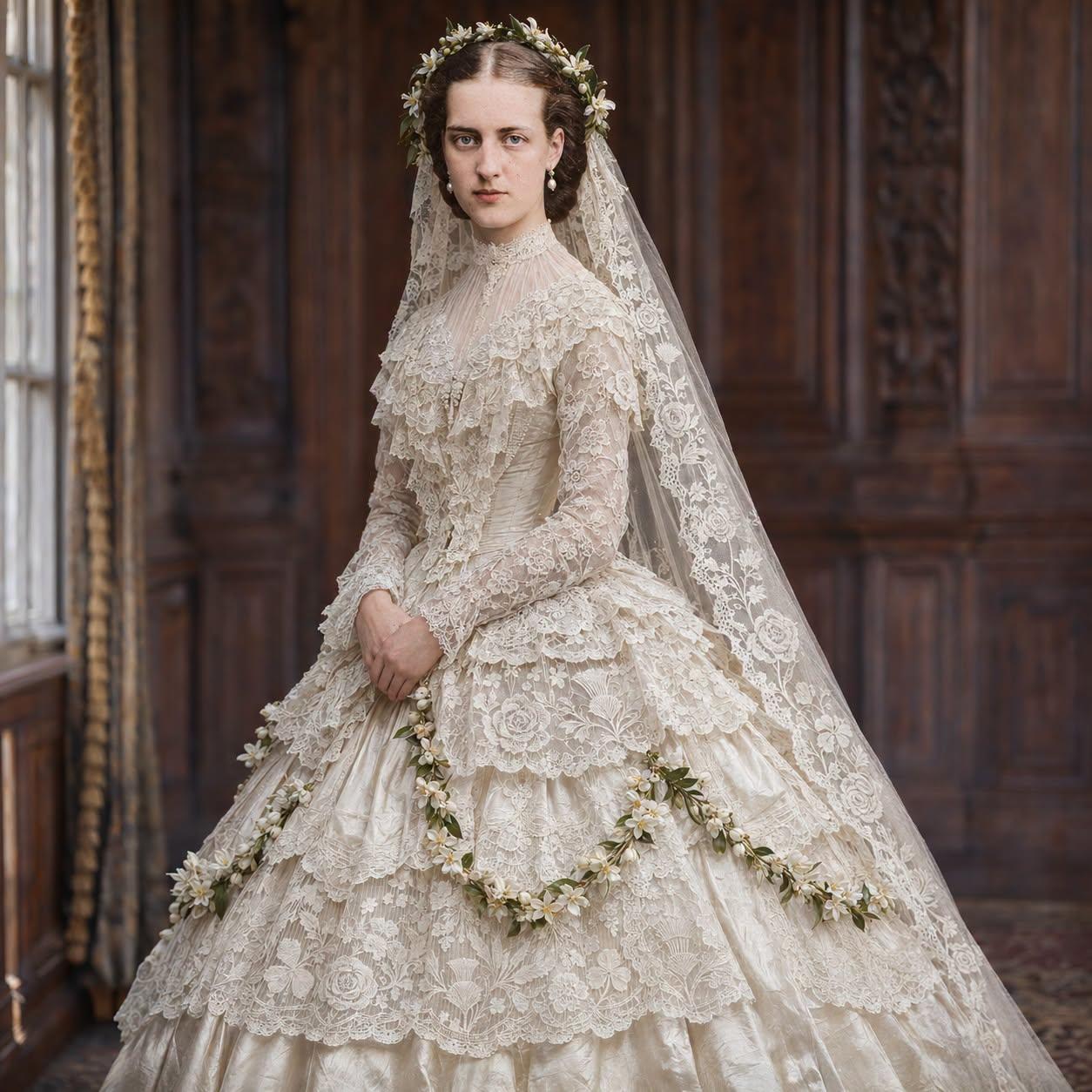
As the wedding approached, even Alexandra's dress became a matter in which the queen intervened. Alexandra had intended to wear Brussels lace given to her by King Leopold of the Belgians. Victoria objected. The bride's dress was to be entirely British in manufacture. Alexandra would be marrying the heir to the British throne, and the lace was expected to acknowledge the fact.
The new dress was trimmed with Honiton lace patterned with roses, shamrocks and thistles. Orange blossom garlanded the skirt. The details belonged to a wedding, but the decision about them belonged to a sovereign as well as a future mother-in-law.
Alexandra married Bertie in St George's Chapel at Windsor Castle on 10 March 1863. She was eighteen. The Archbishop of Canterbury blessed the couple at the high altar. Victoria watched from the Catherine of Aragon closet above it, wearing black with the blue sash of the Order of the Garter.
The court was still in mourning, and the female guests were restricted to grey, lilac or mauve. Alexandra could wear her wedding dress. The women watching her dressed within the limits of a bereavement now almost fifteen months old.
That day Victoria wrote in her journal: "Here I sit lonely & desolate, who so needs love and tenderness, while our 2 daughters have each their loving husbands & Bertie has taken his lovely pure sweet bride to Osborne." It was the house where she had signed the warrant four months earlier, on mourning paper, when the bride was seventeen. Alexandra went back to it as Princess of Wales. The queen who had authorised the marriage stayed behind, still in black.