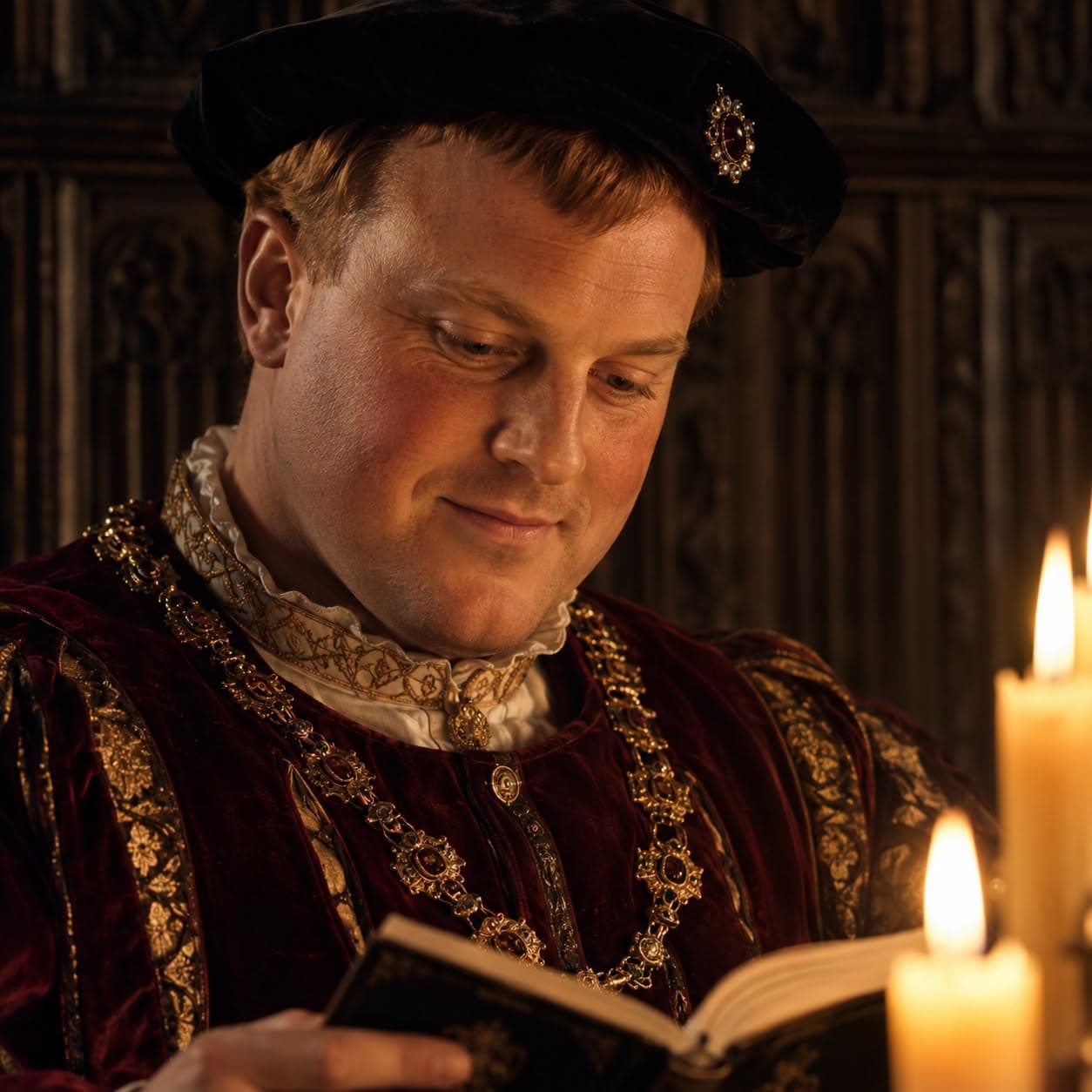
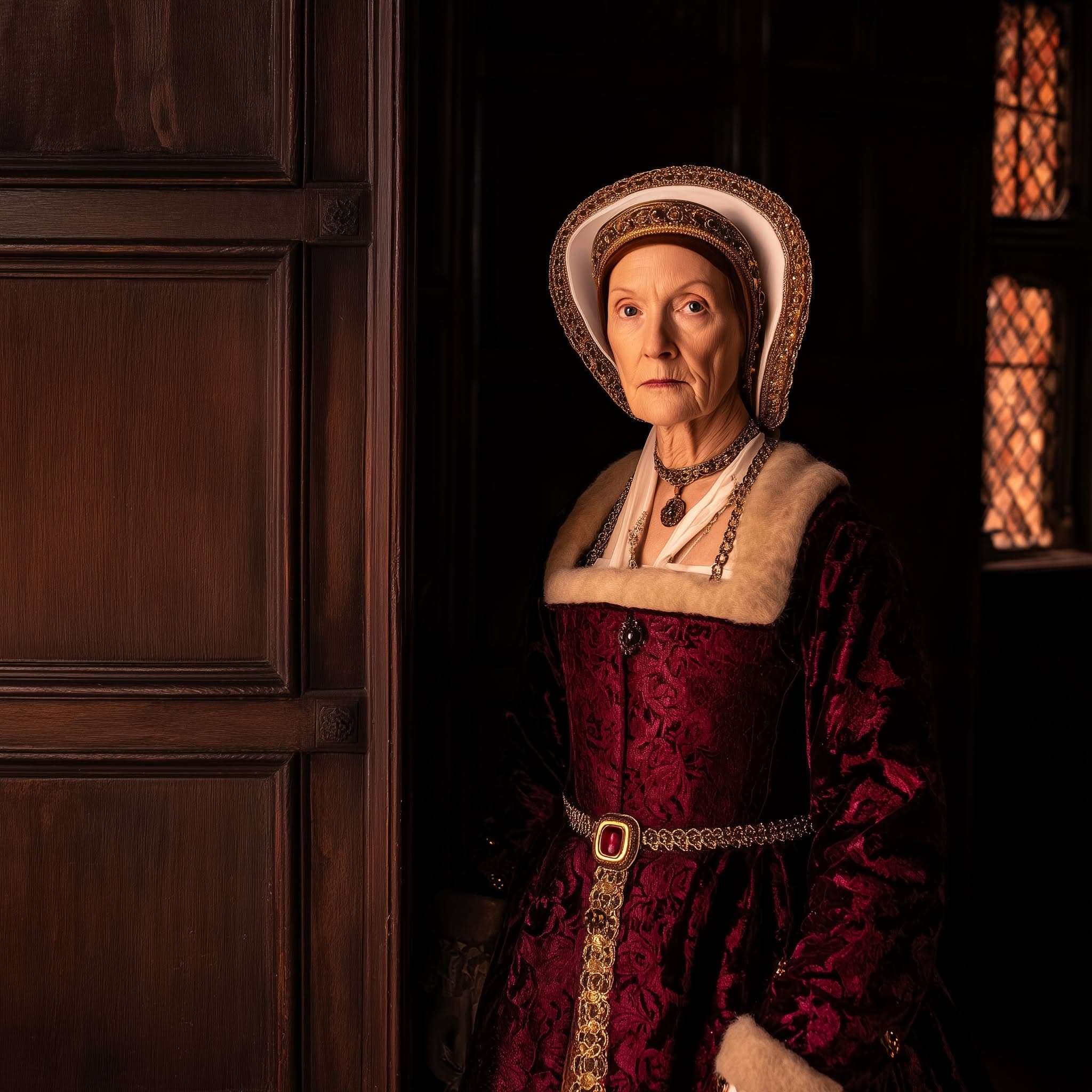
She ran a household where grown men crept into the girls' dormitory at night. She knew. She burned the evidence before anyone could take it from her.
The girl she failed went to the block at seventeen. Agnes Tilney lived three more years and died in her bed.
Agnes Tilney was born around 1477, the daughter of a Norfolk gentry family of no particular distinction, and she married well: twice: the second time spectacularly, becoming in 1497 the second wife of Thomas Howard, second Duke of Norfolk. He was the most powerful military commander in England, the victor of Flodden, a man whose family would spend the next fifty years placing women at the centre of Tudor power and collecting the wreckage afterward.
She bore him several children who survived to adulthood, including the future Lord Effingham, but she outlived her husband by decades, and when he died in 1524 she inherited his Lambeth residence, his Chesworth estate in Sussex, and the rank of Dowager Duchess of Norfolk, which was sufficient to make her one of the great ladies of England for the rest of her life.
She was also, by convention and expectation, responsible for the education and supervision of the young women of the Howard family and its connections who were placed in her household to learn the accomplishments required of girls of their station: music, dancing, French, deportment, the management of a great house.
This was entirely normal. Aristocratic households across England operated as informal finishing schools for the daughters of allied families, and the Dowager Duchess of Norfolk's establishment was among the most prestigious available. Families sent their daughters to Lambeth and Chesworth with confidence.
The confidence was not justified.
Agnes was frequently at court. The daily management of the household fell to subordinates, to a woman the records call Mother Emet, to servants whose authority over the girls in their charge was imprecise and inconsistently applied. The dormitory at Lambeth where the young women slept was accessible. Men of the household knew it was accessible.
A music teacher named Henry Mannox, engaged to instruct the young women, began abusing Catherine Howard, Agnes's step-grandniece, placed in the household at approximately twelve years old, before Catherine was old enough to understand what was being done to her. Mannox later admitted to intimate contact with the child and described it to investigators with a specificity that removes any ambiguity about what had occurred.
Agnes was told. She confronted Mannox. She told him the behaviour was inappropriate and that he should know his place. She did not remove him from the household. She did not remove Catherine from his access. She moved the matter from the category of crisis into the category of managed, which is a different thing, and she went back to court.
Francis Dereham came next. He was a young gentleman of the household, older than Catherine, with access to the dormitory at night, and what happened between them, whether seduction or coercion or some arrangement that a girl of fourteen is not equipped to negotiate freely with an adult man in a position of advantage over her, became the subject of intense interrogation in 1541 when Catherine was queen and the king's investigators began pulling the threads.
The girls who had shared the dormitory remembered the nights. They remembered the wine and the strawberries and Dereham pressing himself into Catherine's bed. They had lain still and pretended not to hear because they understood, with the instinctive self-preservation of children in an unsupervised house, that seeing and hearing were risks.
Agnes had known about Dereham too. She had found them together at some point, the records of her interrogation confirm she was aware of the relationship, and she had done what she had done with Mannox: she had spoken to him, issued a prohibition, and filed the matter away. Catherine's past was a problem to be managed, not a harm to be addressed. The distinction is the whole story.
In 1539 Thomas Howard, third Duke of Norfolk, Agnes's stepson, the man who had inherited the family's political machinery and its appetite for royal proximity, began positioning his step-niece Catherine for the king's attention.
Henry VIII was newly disgusted with Anne of Cleves, was looking for something entirely different, and Catherine Howard was young and vivid and entirely unprotected by either experience or family loyalty. Norfolk knew Catherine's history. The household was his family's household. He proceeded anyway.
Catherine became queen in July 1540. She was approximately seventeen years old.
She was arrested in November 1541, fourteen months later, on charges arising from exactly the history Norfolk and Agnes had buried. Dereham had followed her to court. Mannox had remained in contact. The girls from the dormitory had memories. An investigation was opened and the threads began to unravel with the speed of something that had never been properly secured in the first place.
Agnes burned the letters.
Dereham had written to Catherine from Ireland. The letters, evidence of the pre-marital relationship, the thing that had to be explained away or destroyed if any defence was to be constructed, were in Agnes's keeping. When the king's investigators arrived at Lambeth in November 1541, the letters were gone.
Agnes admitted under interrogation that she had burned them. She appears to have understood, with the clarity of a woman who had spent forty years adjacent to Tudor power, exactly what documentary evidence meant in a treason investigation, and she had acted accordingly and promptly, and it had not been enough because the girls from the dormitory were still alive and still remembered everything.
She was arrested. Her daughter Katherine Daubeney was arrested. Her stepson William Howard and his wife were arrested. The household that had produced a queen was dismantled in days, its members distributed across various forms of custody, their goods inventoried by the Crown.
Norfolk, who had built Catherine's path to the throne on the foundation of Agnes's negligence, led part of the investigation himself, writing to Henry on the fourteenth of December 1541 to denounce his stepmother's conduct in terms that made clear he intended to survive this by any means available to him. It was a Howard household through and through, to the end.
Catherine Howard was executed on the thirteenth of February 1542. She was approximately seventeen or eighteen years old.
Agnes Tilney was indicted for misprision of treason, the concealment of treasonous activity, and was sentenced to imprisonment and forfeiture of her goods. She was not executed. The king's council noted that she was old and infirm and that proceeding to attainder might prove difficult, and she was pardoned in May 1542, released from the Tower, and retired to her estates.
She spent her remaining years in relative piety, wearing a hair shirt under her finery as was recorded of her, attending to her soul with the seriousness she had not attended to the children in her care.
She died in May 1545.
She had supervised a household where girls were systematically accessible to men who should never have been admitted. She had been told, twice, and she had managed the information rather than the harm. She had burned the letters of a man who had abused her step-grandniece in order to protect a family that threw her before the investigators the moment it became convenient. She had watched Catherine Howard walk to a scaffold that was built, in part, from the timber of everything Agnes had known and chosen not to act on.
She put on her hair shirt and she said her prayers and history largely forgot her, which is perhaps the most Howard outcome of all: the damage outlasted the reckoning, and the woman most responsible for the conditions in which it grew died quietly, unexecuted, in a house she still owned.
Catherine Howard had been twelve years old when she arrived at Lambeth. Agnes Tilney had been in the next room.