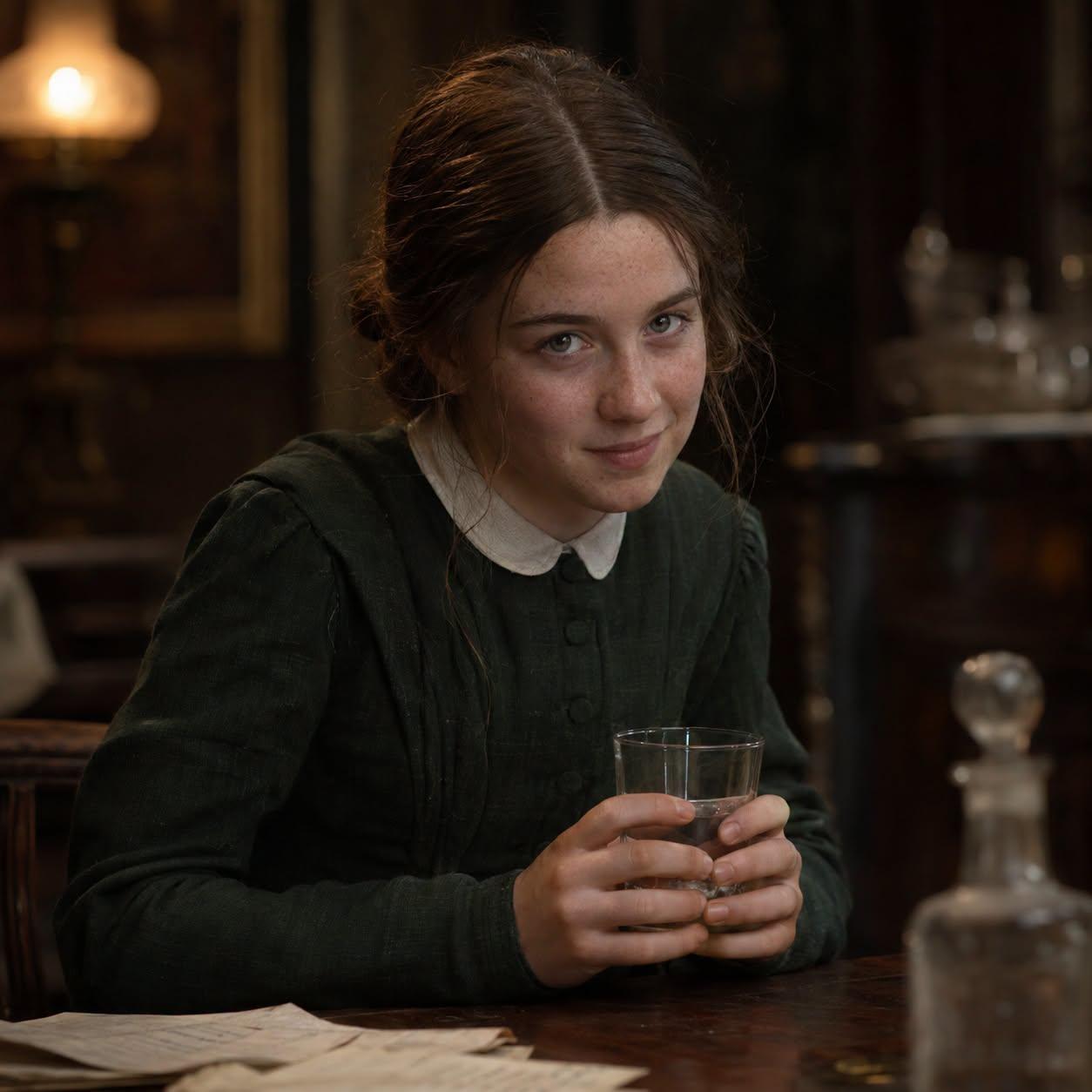
She was about sixteen when she volunteered to try the same liquid. The experiment was taking place in her aunt's dining room. The doctors were already unconscious.
On the evening of 4 November 1847, Agnes Petrie was at 52 Queen Street in Edinburgh, the home of James Young Simpson, Professor of Midwifery at the university. His wife was Agnes's aunt. Her father was there too, along with other members of the family, while Simpson and his assistants, George Skene Keith and James Matthews Duncan, tested a substance called chloroform.
It was an unusual use for a dining room, but by then the household had become accustomed to experiments. Simpson was searching for something he could give his patients to spare them pain. The chemicals were tried by inhaling their vapours, sometimes from ordinary tumblers. Medical discovery had come indoors, among the furniture and the family.
There was already an anaesthetic. Ether had been used in surgery, and Simpson had given it to a woman in labour in January that year. He had seen what relief could do. He had also found ether unsatisfactory enough to keep looking for an alternative, testing substances with Keith and Duncan in the evenings around his medical work.
For an obstetrician, the distinction mattered. A woman did not have to be undergoing an operation to be in agony. Giving relief during a difficult delivery was one thing. Giving it during a labour that was proceeding normally, because the woman was suffering, was a proposition some doctors found harder to accept.
Simpson intended to use anaesthesia for both.
The chloroform was in a bottle that had been put aside. That evening it was retrieved from beneath a heap of papers and brought into the experiment. The men inhaled it. There was a period of excitement, then unconsciousness. They recovered sufficiently to resume their trials, delighted with the effect of what they had found.
Watching this did not produce the same response in everyone present. Miss Grindlay, the sister of Simpson's wife, was frightened by what she had seen. Agnes, after the doctors had recovered, came forward to take her turn.
She was not in labour. There was no operation waiting for her, no pain that needed to be stopped. She was trying the effect of the substance itself, in the company of relatives and doctors who were still finding out what it could do.
A later account remembered her words as she fell asleep: "I am an angel, a beautiful angel! How are you all down there?"
That was the remark that survived. Agnes's part in the experiments did not end with it.
In the early demonstrations that followed, Simpson often pressed her into service, above all to assure women patients that chloroform was harmless. A prospective patient could watch someone take it, lose awareness and recover. Agnes had begun as one of the people looking on. Now she was the person other women were invited to watch.
Harmless was the family's word, remembered long afterwards. The demonstrations could show an apparently pleasant experience and a recovery, but they could not establish everything a patient needed to know. Chloroform could also kill. The confidence with which it was being welcomed ran ahead of an understanding of how safely to administer it.
Within days of the Queen Street experiment, Simpson was using it during childbirth. On 10 November he announced his results to the Medico-Chirurgical Society of Edinburgh, describing cases in which he had already used it successfully. The move from the household to the lying-in room was already under way, while the argument about how far pain relief should extend was still being fought.
Some objections concerned the drug's dangers. Others rested on the belief that pain belonged to normal childbirth and should not be interfered with. Simpson pressed the case that relieving suffering was part of a doctor's work, even when an operation did not make relief seem unavoidable.
More than five years later, on 7 April 1853, John Snow administered chloroform to Queen Victoria during the birth of her eighth child, Leopold. He gave enough to reduce her pain without rendering her completely unconscious. The circumstances were very different from the experiments in Edinburgh, but a substance Agnes had tried in a family dining room was now being used at a royal birth.
Agnes and her aunt had watched the same men go under in that dining room. Agnes volunteered, then took part again whenever Simpson wanted to show the drug to patients. Miss Grindlay absolutely refused to inhale it. Nearly fifty years later, after all the enthusiasm and all the demonstrations her niece had supplied, she still never had.